
Adding a bathroom to your basement is a game-changer for your home's usability and overall value.Adding a bathroom to your basement is a game-changer for your home's usability and overall value. But the first question on everyone's mind is always the same: what's it going to cost?
Generally, you can expect the cost to finish a basement bathroom to fall somewhere between $8,000 for a simple half-bath and upwards of $20,000 if you're planning a more spa-like full bathroom. Think of this as a solid ballpark figure to get your budget conversation started.
What Is the Real Cost of a Basement Bathroom
Before you start dreaming about tile patterns and vanity styles, let's ground ourselves in the financial reality of this project. Getting a handle on the average cost is the first, most crucial step in making sure your vision and your budget are on the same page.
A basement bathroom isn't just another bathroom remodel; it comes with its own unique set of hurdles that directly affect the price tag. The biggest one? Plumbing. Since your basement sits below your home's main sewer line, we often have to install new drain lines, which almost always means cutting into the concrete slab.
Basement Bathroom Cost at a Glance
To give you a clearer picture, here’s a quick breakdown of what you can expect based on the type of bathroom you’re planning.
| Bathroom Type | Average Cost Range | Key Features |
|---|---|---|
| Powder Room (Half-Bath) | $8,000 – $12,000 | Includes a toilet and a sink/vanity. Minimal plumbing work required. |
| Three-Quarter Bath | $12,000 – $18,000 | Adds a stand-up shower to the toilet and sink. More complex plumbing. |
| Full Bathroom | $15,000 – $20,000+ | Features a toilet, sink, and a full bathtub or a high-end custom shower. |
As you can see, the addition of a shower or tub is what really starts to move the needle on cost, largely due to the extra plumbing and waterproofing work involved.
Key Variables That Influence Price
So, what determines if your project lands at the lower or higher end of that $8,000 to $20,000 range? It really boils down to a few key factors.
- Plumbing Complexity: This is the big one. If we need to install an ejector pump or do extensive concrete trenching for new drain lines, that alone can add $3,000 to $5,000 to the budget. It’s the single biggest wild card in basement projects.
- Bathroom Type: A straightforward half-bath (powder room) is always going to be more budget-friendly than a full bathroom with all the bells and whistles of a shower or tub.
- Fixtures and Finishes: This is where you have the most control. Your choices in vanity, countertops, lighting, tile, and flooring can swing the final cost dramatically. Builder-grade materials will keep costs down, while custom or luxury selections will push them up.
- Labor and Permits: Skilled, professional labor is a significant part of any remodeling budget, and you’ll definitely need a building permit from your local municipality for a project of this scope.
For a deeper dive into the overall expenses and a broader perspective, explore this comprehensive guide on The Real Cost of a Basement Bathroom.
Ultimately, your final number is a unique mix of these elements. To get a more personalized estimate for your specific project, playing around with an estimation tool can be incredibly helpful. You can start building a preliminary budget right now with our instant pricing tool to see how different choices might affect your total investment.
What Really Drives the Cost of a Basement Bathroom?
To get a real handle on what your basement bathroom will cost, you need to look at the individual pieces of the puzzle. It's a lot like ordering a new truck; the base model has a sticker price, but the four-wheel drive, premium sound system, and leather seats all add up. Your bathroom works the same way.
The final price tag really boils down to four key things: the plumbing setup, the bathroom's overall size and layout, the quality of finishes you choose, and the skilled labor needed to put it all together. Each one of these can swing your budget up or down, and knowing how they interact is the secret to planning a project that fits your wallet.
The Below-Ground Plumbing Challenge
Let's be direct: plumbing is almost always the biggest and most unpredictable expense when adding a bathroom in the basement. An upstairs bathroom has it easy—gravity does all the work, pulling wastewater down into the main sewer line. But in a basement, you're below that line.
This means you have to fight gravity and actively push wastewater up and out of your home. We typically solve this in one of two ways:
- Ejector Pump System: This is the heavy-duty, long-term solution. We cut into your concrete slab to install a sealed basin with a powerful pump inside. Wastewater from the toilet, sink, and shower all drain into this basin. When it fills to a certain point, the pump automatically kicks on and ejects the waste up to the main sewer line. It's incredibly reliable but involves a lot of concrete and excavation work.
- Macerating (or Up-Flushing) Toilet: Think of this as the less-invasive option. The special toilet sits right on top of your finished floor and contains a grinder. It turns waste into a fine slurry and pumps it up to the sewer line through a much smaller pipe. The biggest plus here is that we don't have to break up your concrete floor, which can save a good chunk of money on labor.
Deciding between these two plumbing routes is the first major decision that will set the financial foundation for the entire project.
Size and Finishes: Where Your Choices Shape the Budget
Once the plumbing plan is locked in, we can focus on the things you can actually see and touch. The physical size of the bathroom is a straightforward cost factor—a bigger footprint requires more drywall, more flooring, and more paint. A compact 40-square-foot powder room is naturally going to be less expensive than a spacious 80-square-foot full bathroom with a tub and shower.
Then comes the fun part: picking your fixtures and finishes. This is where your personal style really comes into play and where you have the most control over the budget.
A standard 40-square-foot half-bath in a basement typically runs between $200 and $500 per square foot. This price point often includes a macerating toilet (about $1,000-$2,000) to handle the drainage challenges, plus robust waterproofing—a must-have to combat the natural humidity we see here in Michigan.
The cost difference between a basic vanity from a big-box store and a custom-built piece can be thousands of dollars. The same goes for tile; a classic ceramic is far easier on the budget than imported marble. Every single choice, from the faucet to the light fixtures, has a direct impact on the final number.
The Value of a Professional Crew
Finally, you have the cost of skilled labor, and this is one area where you don't want to cut corners. A basement bathroom done right is an asset. One done wrong is a nightmare of leaks, mold, and failing pumps. When you look at a proposal, a big part of the cost is for the expertise to prevent those future headaches. Understanding the local average plumber pricing can give you a clearer picture of where that money goes.
A professional contractor handles everything from pulling the right permits and making sure the work passes inspection to coordinating the entire team of plumbers, electricians, and tile setters. That expertise is your insurance policy, ensuring the job is done to code and built to last.
Want to see how these costs might stack up for your own project? Play around with our instant pricing tool to get a ballpark estimate based on different sizes and finishes.
A Detailed Budget Breakdown for Your Project
It's one thing to talk about general cost drivers, but seeing how a real budget breaks down line by line is where the numbers really start to click. I like to think of the total cost as a pie—each slice represents a different phase of the job, from the plumbing you'll never see again to the beautiful tile that catches your eye every day.
So, let's walk through a hypothetical project. We'll use a mid-range, full basement bathroom built right here in Southwest Michigan, with a total budget of $15,000. This gives us a practical look at where your money actually goes.
This chart shows how that budget typically gets split between the three biggest cost categories.
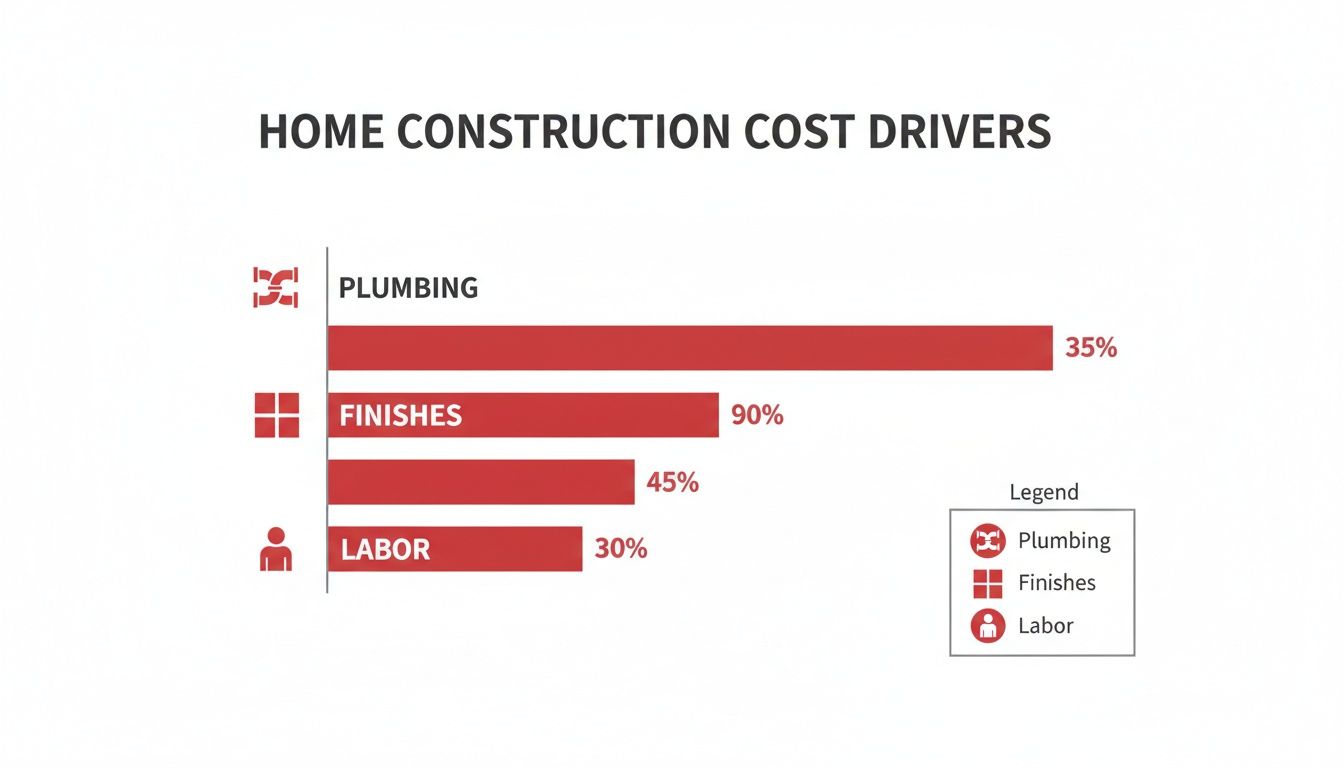
As you can see, the underground plumbing work and the visible finishes you choose eat up the biggest chunks of the budget. Skilled labor, of course, is the constant that ties the whole project together.
The Foundational Work: Rough-Ins and Framing
This first stage is all about building the bones of your new bathroom. It’s the critical work that happens behind the walls and under the floor, and you absolutely have to get it right from the start. For our $15,000 project, this phase accounts for a huge piece of the budget.
- Plumbing Rough-In (25-35%): This is the heavyweight champion of basement bathroom costs, hands down. It involves breaking up concrete, installing drain lines, setting up an ejector pump (if needed), and running hot and cold water supply lines.
- Cost: $3,750 – $5,250
- Framing (5-8%): Next, we build the walls that define the bathroom's layout and give it shape.
- Cost: $750 – $1,200
- Electrical and Ventilation (8-12%): This covers running wires for lights, code-required GFCI outlets, and a good exhaust fan to manage moisture—a non-negotiable in a basement.
- Cost: $1,200 – $1,800
The key takeaway here is that nearly half of your budget gets spent on work you’ll never see once the drywall is up. But that foundational investment is exactly what ensures your bathroom works properly and safely for decades.
The Finishing Touches: Fixtures and Surfaces
Once the "rough-in" work is inspected and gets the green light, the space finally starts to look like a real bathroom. This is the fun part where your design choices come to life, but it’s also where costs can swing dramatically based on your taste.
For our mid-range example, we're focused on quality, durable materials that look great without blowing the budget.
- Drywall, Paint, and Trim (10-15%): This includes hanging moisture-resistant drywall (a must for any bathroom), professional taping and sanding, a few coats of quality paint, and baseboards to finish it off.
- Cost: $1,500 – $2,250
- Tile and Flooring (10-15%): This covers the cost of durable floor tile and shower surround materials, plus the crucial labor for expert installation and waterproofing.
- Cost: $1,500 – $2,250
- Fixtures and Vanity (15-20%): This line item includes the toilet, sink, faucet, vanity cabinet, mirror, and shower fixtures.
- Cost: $2,250 – $3,000
While bathroom remodels average $12,126 nationally, basement projects often run 20-30% higher simply because of the unique challenges of building below ground. The good news? The return on investment here in the Midwest is strong, with homeowners often recouping 60-80% of the cost at resale by adding that versatile living space. [object Object] and see how these projects perform.
These numbers give you a solid framework, but every project is a little different. To get a clearer idea of what your specific project might cost, our instant pricing tool is a great next step for building a preliminary budget based on your own needs.
Three Real-World Basement Bathroom Budgets
Talking about cost percentages and averages can feel a bit abstract. The best way to get a real feel for what a project costs is to look at actual examples. Let’s walk through three different basement bathroom projects we see all the time here in Southwest Michigan.
These scenarios cover the most common goals, from a simple and affordable powder room to a full-blown spa retreat. You’ll probably see your own vision reflected in one of them.
Scenario 1: The Essential Powder Room
This is all about adding that crucial bit of convenience to a finished basement without a huge financial outlay. The goal here is simple: a clean, functional half-bath that gets the job done.
- Total Budget: Around $9,000
- Project Scope: A tight-and-tidy 30-square-foot half-bath with just a toilet and a small vanity. The main strategy is to keep the plumbing as simple as possible to manage the budget.
- Key Features & Cost Breakdown:
- Plumbing: The hero of this budget is the macerating (or up-flushing) toilet. This brilliant piece of tech avoids the need to break up your concrete slab, which saves a ton of money on labor and mess. ($4,000 – $5,000)
- Fixtures: We’d go with a standard-grade pedestal sink or a compact 24-inch vanity to keep the material costs down. ($1,000 – $1,500)
- Finishes: Waterproof and durable luxury vinyl tile (LVT) is the perfect choice for the floor here—it looks great and is super practical. ($2,000 – $2,500)
- Labor & Permits: Because the installation is more straightforward, labor hours stay in a very manageable range. ($2,500 – $3,000)
Scenario 2: The Functional Family Full Bath
This is our bread and butter—the project we build most often. It’s designed to be a hardworking bathroom that can handle anything a growing family, house guests, or teenagers can throw at it.
- Total Budget: Around $15,000
- Project Scope: A 60-square-foot full bathroom complete with a toilet, vanity, and a stand-up shower. We’re balancing quality, durable materials with smart, cost-effective choices.
- Key Features & Cost Breakdown:
- Plumbing: This budget accounts for some concrete work to install an ejector pump and run the necessary drain lines for the shower. ($5,000 – $6,500)
- Fixtures: This includes a quality mid-range toilet, a 36-inch vanity with a solid cultured marble top, and a pre-fabricated acrylic shower stall with a nice glass door. ($3,000 – $4,000)
- Finishes: Ceramic tile on the floor is a must for longevity, and a good exhaust fan is non-negotiable for managing moisture. ($2,500 – $3,500)
- Labor & Permits: The extra plumbing and finishing work means a bit more of the budget goes toward skilled labor. ($4,000 – $5,000)
By combining durable, mid-range materials with professional installation, this bathroom becomes a valuable asset that enhances daily life and adds significant resale value to the home.
Scenario 3: The Spa-Inspired Retreat
When the goal is to create a genuine escape, the budget opens up to allow for custom details and luxurious materials. Here, we're moving beyond pure function and into creating a relaxing, spa-like experience.
- Total Budget: $22,000+
- Project Scope: A generous 80-square-foot full bathroom built with premium features and a high degree of custom craftsmanship.
- Key Features & Cost Breakdown:
- Plumbing: This involves more extensive concrete work for the ejector pump and custom drain placement, especially for a curbless, walk-in shower. ($6,000 – $8,000)
- Fixtures: Think a high-efficiency comfort-height toilet, a double vanity topped with quartz, and premium faucets and shower hardware. ($4,500 – $6,000)
- Finishes: This is where you really see the investment. We're talking about a custom-tiled, curbless walk-in shower with a frameless glass enclosure, heated floors, and upgraded, layered lighting. ($6,000 – $8,000)
- Labor & Permits: The meticulous tile work and detailed installation require a significant investment in expert labor. ($5,500 – $7,000)
High-end projects like this, especially with features like curbless showers for homeowners planning to age in place, can easily push past the $20,000 mark. The custom glass enclosure alone can cost over $3,000, and radiant heated floors add another layer of cost and complexity. To get a broader perspective, you can find valuable insights from construction experts on overall basement renovation costs.
Feeling inspired? To get a better idea of where your project might land, play around with our instant pricing tool for a preliminary estimate based on your specific goals.
How to Save Money on Your Remodel
A brand-new basement bathroom is an incredible addition to any home, but you don't have to break the bank to get it done right. A bigger budget doesn't guarantee a better outcome; smart, strategic planning is what really makes the difference. With a bit of foresight, you can keep the costs in check without cutting corners on quality or durability.
Think of it like planning a road trip. You could take the long, scenic route with all the expensive tourist traps, or you can map out the most direct, efficient path to your destination. We're here to help you find that efficient path—one that ends with a beautiful, functional bathroom for the best possible price.
Plan Your Layout Wisely
The biggest-ticket item you can control right from the start is the plumbing. The farther you have to run new pipes, the more it's going to cost in both labor and materials. It's that simple.
- Proximity is Key: If you have the flexibility, position your new bathroom as close as you can to existing plumbing stacks or the main sewer line. The less distance water and waste have to travel, the less you'll spend.
- Create a "Wet Wall": Whenever possible, try to line up your sink, toilet, and shower along a single wall. This keeps all the plumbing consolidated in one area, which dramatically simplifies the installation and reduces the amount of pipe needed.
Be Strategic with Fixtures and Finishes
This is where you can really get creative and have the most direct impact on your budget. It's entirely possible to get a high-end look without paying high-end prices. The secret is to mix and match materials intelligently.
A great approach we often recommend is the "splurge and save" method. Pick one or two high-impact features to spend a little more on—maybe it's a statement vanity or some gorgeous tile for the shower wall. Then, find more budget-friendly (but still durable) options for everything else. For instance, a quality pre-fabricated shower stall can save you a bundle compared to a fully custom-tiled one.
Smart Savings Tip: Don't confuse "cheaper" with "better value." A material like luxury vinyl tile (LVT) for the floor might cost a bit more upfront than basic sheet vinyl, but its durability and water resistance will save you a fortune on repairs and replacement down the road.
Understand the Value of Professional Labor
This might sound backward, but one of the surest ways to save money, in the long run, is to hire a qualified professional. A DIY plumbing mistake isn't just a small leak; it can lead to catastrophic water damage, mold growth, and serious code violations that are incredibly expensive to fix.
There's a reason skilled labor is a significant part of the budget. It often accounts for 40-65% of the total project cost. In our area, an experienced plumber might charge between $100 and $150 per hour, and a job like this can easily take 20 to 40 hours. Paying for that expertise upfront is the best insurance policy you can buy against massive repair bills later. You can discover more insights about basement construction costs to get a sense of how these numbers fit into the overall project.
Ultimately, the best way to control your budget is to have a rock-solid, detailed plan before a single hammer is swung. Changing your mind halfway through a project is a surefire way to watch costs spiral. A great starting point is to get a realistic idea of what your project might cost. You can start building a custom estimate right now with our free instant pricing tool and see for yourself how different choices impact the bottom line.
The Long-Term Value of Your New Bathroom
Thinking about the initial cost of a new basement bathroom is important, but it’s really only half the story. A well-designed bathroom isn't just another line item on a budget; it's a smart investment that pays you back in daily convenience and, eventually, in your home's market value.
Let's look past the price tag for a moment. Imagine how this new bathroom will fundamentally change how you use your home. Your finished basement suddenly evolves into a truly independent living space. It can now serve as a comfortable guest suite for family, a self-contained hangout for teenagers, or a must-have amenity for your home gym or movie room. That's a huge upgrade to your quality of life.
Boosting Your Home's Resale Value
When you eventually decide to sell, a finished basement is a great feature. But a finished basement with a bathroom? That’s a total game-changer. Here in the Southwest Michigan market, that extra bathroom can make your home stand out, catching the eye of a much broader group of buyers.
A thoughtfully added bathroom doesn't just add convenience; it adds tangible market value. Homebuyers often see it as a premium feature that justifies a higher asking price, turning your initial investment into a powerful financial asset.
This kind of project consistently delivers one of the best returns on investment you can make in your home. While some renovations only get you a fraction of your money back, adding functional living space like a bathroom almost always performs well at resale, often letting you recoup a significant portion of what you spent.
It’s an investment in your lifestyle right now and your financial future down the road. To get a clearer picture of how different fixtures and finishes can impact your project's cost and potential return, try experimenting with our instant pricing tool. It’s the perfect way to match your vision with a smart, value-focused budget.
Frequently Asked Questions
It’s completely normal to have a list of questions when you’re thinking about a project as big as adding a new bathroom. To help you get some clarity, we've tackled a few of the most common ones we hear from homeowners.
How Long Does It Take to Add a Bathroom in a Basement?
For most basement bathroom projects, you can expect the work to take anywhere from 3 to 6 weeks. That timeline covers everything from the day we start demolition to the final walkthrough.
This includes framing the new walls, running all the new plumbing and electrical, hanging and finishing drywall, laying tile, and installing the vanity, toilet, and shower. The exact timeframe can shift a bit depending on how complex your design is, if you've chosen custom-order materials, or how busy the local building inspectors are. It's always smart to have a little wiggle room in your expectations.
Do I Need a Special Toilet for a Basement Bathroom?
Yes, in nearly every case, you will. Standard toilets rely on gravity to flush waste down into the main sewer line. But since a basement is below that line, gravity works against you. The waste has no way to get up to the drain.
This is a classic basement problem with two reliable solutions:
- Up-flushing (Macerating) Toilets: These clever units have a built-in pump and grinder. It liquefies waste and actively pumps it up to the main sewer line. This can often be done without having to break up your concrete floor.
- Ejector Pump Systems: This is the heavy-duty option. We install a sealed pit in the floor where waste from the toilet, sink, and shower collects. When the pit fills to a certain level, a pump kicks on and ejects the waste up and out. It’s a bigger job but is incredibly dependable.
Both of these are standard, proven methods for below-grade bathrooms, though they are an additional cost factor to keep in mind.
Are Building Permits Required for a Basement Bathroom?
Absolutely. A building permit is a must for this kind of project. You're adding new plumbing, new electrical circuits, and changing the structure of your home—all things that fall under local building codes.
Getting a permit isn't just about red tape; it's about safety. It ensures a third-party inspector verifies that all the work was done correctly and to current standards. Any professional contractor will manage this entire process for you, from submitting the plans to scheduling the inspections. This protects you, your family, and your home’s value down the road.
Getting a clear picture of your potential investment is the best first step. You can get a tailored cost projection by using our instant pricing tool, which helps you see how different choices affect the bottom line.
Ready to take the next step? The team at Trademaster Construction is here to bring your vision to life with expert craftsmanship and transparent planning. To get a personalized estimate for your project, use our instant pricing tool and build a preliminary budget in just a few minutes.

