
When it comes to picking the best flooring for your basement, one thing stands above all else: moisture. The simple truth is that waterproof or highly water-resistant materials like Luxury Vinyl Plank (LVP), epoxy coatings, and porcelain tile are always at the top of the list. What works best for you, however, will come down to how you plan to use the space and the specific conditions in your basement.
Choosing the Right Flooring for Your Basement
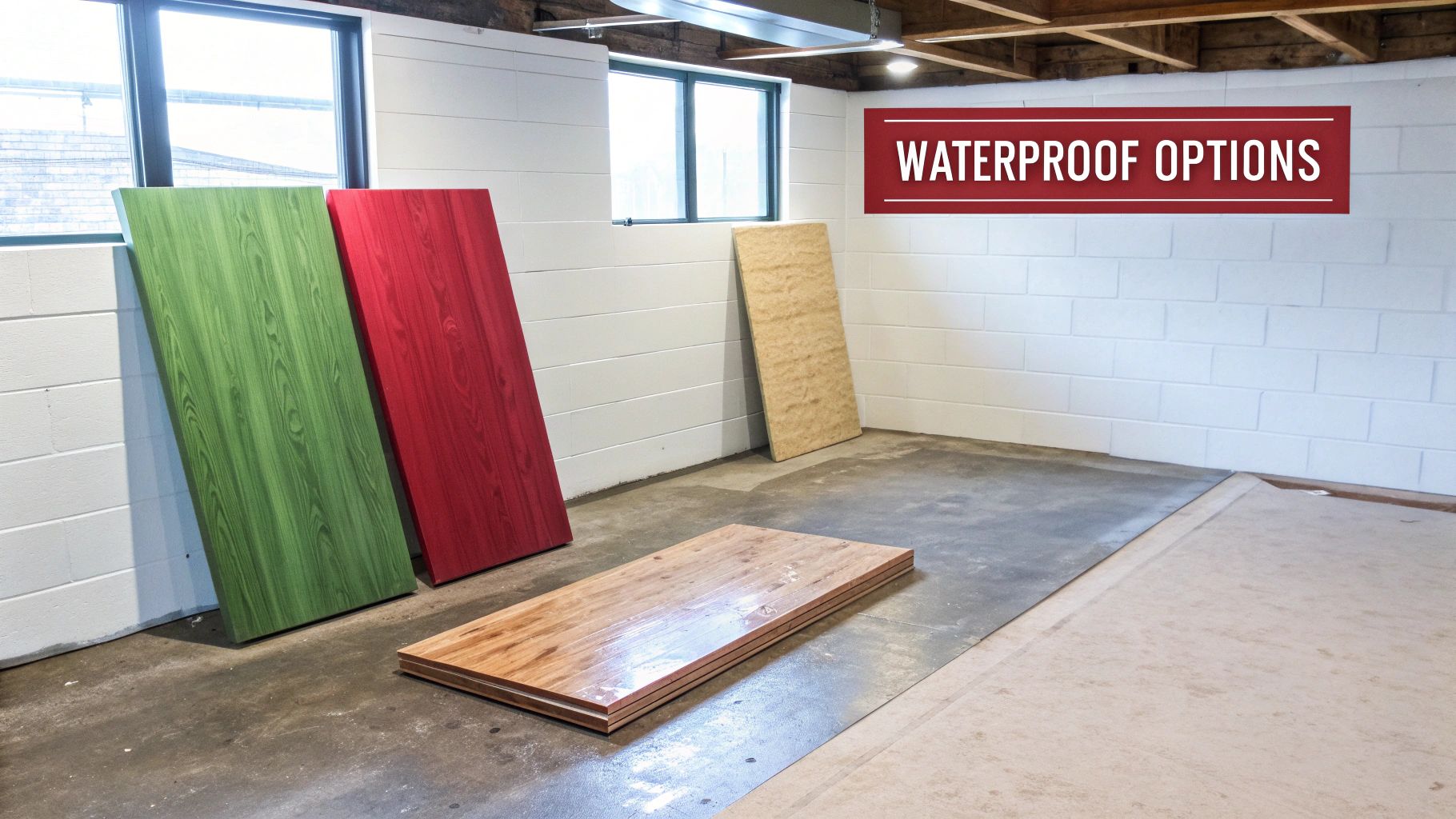
A basement isn't like any other room in your house. It’s below ground, surrounded by soil that is almost always holding moisture. This makes it a natural target for humidity, condensation, and even the occasional leak. Because of this unique environment, your flooring choice is a critical decision that affects the health, comfort, and value of your home for years to come. The concrete slab foundation itself can wick moisture right out of the ground, creating a seriously hostile environment for any material that absorbs water.
That's why the best flooring for a basement has to deliver on a few key fronts:
- Moisture Resistance: It's non-negotiable. The material has to handle constant humidity and potential water exposure without warping, swelling, or becoming a breeding ground for mold.
- Durability: Basements often pull double or triple duty as playrooms, home gyms, or workshops. Your floor needs to stand up to heavy foot traffic, dropped tools, and shifting furniture.
- Comfort and Insulation: Concrete floors are famously cold and hard. The right flooring, especially when paired with a quality underlayment or subfloor, can add much-needed warmth and cushion.
- Cost: Budget always plays a role. Thankfully, basement flooring options range from affordable DIY coatings to premium, professionally installed systems.
A smart basement flooring choice is an investment in preventing future headaches. When you select a material designed for below-grade conditions, you’re saving yourself from the stress and expense of repairs down the road.
The U.S. flooring market has seen a huge shift toward hard-surface options like luxury vinyl tile (LVT), and for good reason. It perfectly balances cost, style, and water resistance. In fact, many LVT products can handle 100% water submersion without damage, completely sidestepping the mold risk you’d get with carpet in a damp basement.
To give you a clear starting point, the table below offers a quick comparison of the leading materials. For a deeper dive into what's available, you can explore the top basement flooring options for 2025. This overview will help you narrow down the field before we get into the details of each option.
Basement Flooring At-a-Glance Comparison
| Flooring Type | Moisture Resistance | Durability | Average Cost (per sq. ft.) | Best For |
|---|---|---|---|---|
| Luxury Vinyl Plank | Excellent (Waterproof) | Very High | $2 – $7 | Finished living areas, gyms, playrooms |
| Porcelain/Ceramic Tile | Excellent (Waterproof) | Highest | $3 – $15 | Bathrooms, laundry areas, any space |
| Epoxy Coating | Excellent (Waterproof) | High | $3 – $12 | Utility rooms, workshops, home gyms |
| Polished Concrete | Good (with sealer) | Highest | $3 – $12 | Modern living areas, utility spaces |
| Rubber Flooring | Excellent (Water-resistant) | Very High | $2 – $8 | Home gyms, workshops, play areas |
Why Basements Demand Specialized Flooring
Before we dive into flooring options, let's get one thing straight: your basement isn't like any other room in your house. It lives underground, completely surrounded by soil that’s almost always holding some amount of moisture. This creates a unique little world down there, one where humidity, water vapor, and temperature swings are the baseline reality.
The concrete slab under your feet might look solid, but it's naturally porous. Think of it like a very dense sponge that can pull moisture right out of the damp ground. This is what experts call hydrostatic pressure—a constant, upward push of groundwater. It's the number one reason flooring that looks great on your main level can warp, peel, and completely fail in a basement.
Even if your basement seems bone-dry, this invisible moisture is always on the move. Over time, it's what leads to that all-too-familiar musty smell, buckled floors, and glue that just gives up.
The Impact of Southwest Michigan's Climate
Living in Kalamazoo or Portage throws another curveball into the mix. Our distinct four-season climate puts basement environments to the test year-round.
- Humid Summers: All that sticky summer air makes its way downstairs. When it hits the cool concrete floors and walls, it condenses, creating the perfect damp breeding ground for mold and mildew.
- Freeze-Thaw Cycles: We all know how harsh our winters can be. The ground freezes solid, expanding and pressing against your foundation. Come spring, it thaws, and all that meltwater looks for the path of least resistance—often seeping through tiny cracks you'd never notice otherwise.
This seasonal rhythm means a basement that feels perfectly fine in October could have moisture issues by April. Your flooring needs to be tough enough to handle these shifts without falling apart.
Essential Prep Work Before Installation
I can't stress this enough: preparing your concrete slab isn't just a "nice-to-have," it's absolutely crucial for the success of your project. Skipping this step is hands-down the biggest and most expensive mistake you can make.
First things first, you have to check for moisture. There’s a simple DIY trick called the plastic sheet test. Just tape down a 2'x2' square of plastic sheeting to the bare concrete, sealing all the edges. Wait a day or two, then peel it back. If you see condensation droplets under the plastic or the concrete looks darker, you’ve got a moisture problem to solve.
A waterproof floor laid over a damp slab is a recipe for disaster. The flooring material might be waterproof, but trapping moisture underneath will lead to mold, mildew, and a breakdown of the adhesives holding everything together.
The solution starts with a good concrete sealer. Some products soak deep into the concrete to block its pores from the inside, while others form a tough waterproof film on the surface. This is your first line of defense.
After that, a vapor barrier or a high-quality underlayment is non-negotiable for most flooring types. This is an impermeable sheet that sits between the concrete and your new floor, creating a physical roadblock for any lingering moisture vapor. Subfloor systems like DRIcore go a step further by creating a small air gap, which not only blocks moisture but also provides a thermal break, making the final floor feel significantly warmer.
Comparing the Top Basement Flooring Materials
Choosing the right floor for your basement isn't like picking one for any other room in the house. Down here, you're fighting a constant battle against moisture, which means practicality has to come first. It’s about more than just looks; it's an investment in a durable solution that won’t become a costly headache down the road. Let's dig into the real-world performance of the top contenders: Luxury Vinyl Plank (LVP), Porcelain Tile, Epoxy, Engineered Hardwood, and Rubber.
This infographic gives you a quick visual on the core challenges your basement floor is up against—hydrostatic pressure from groundwater, humidity, and potential leaks are always part of the equation.
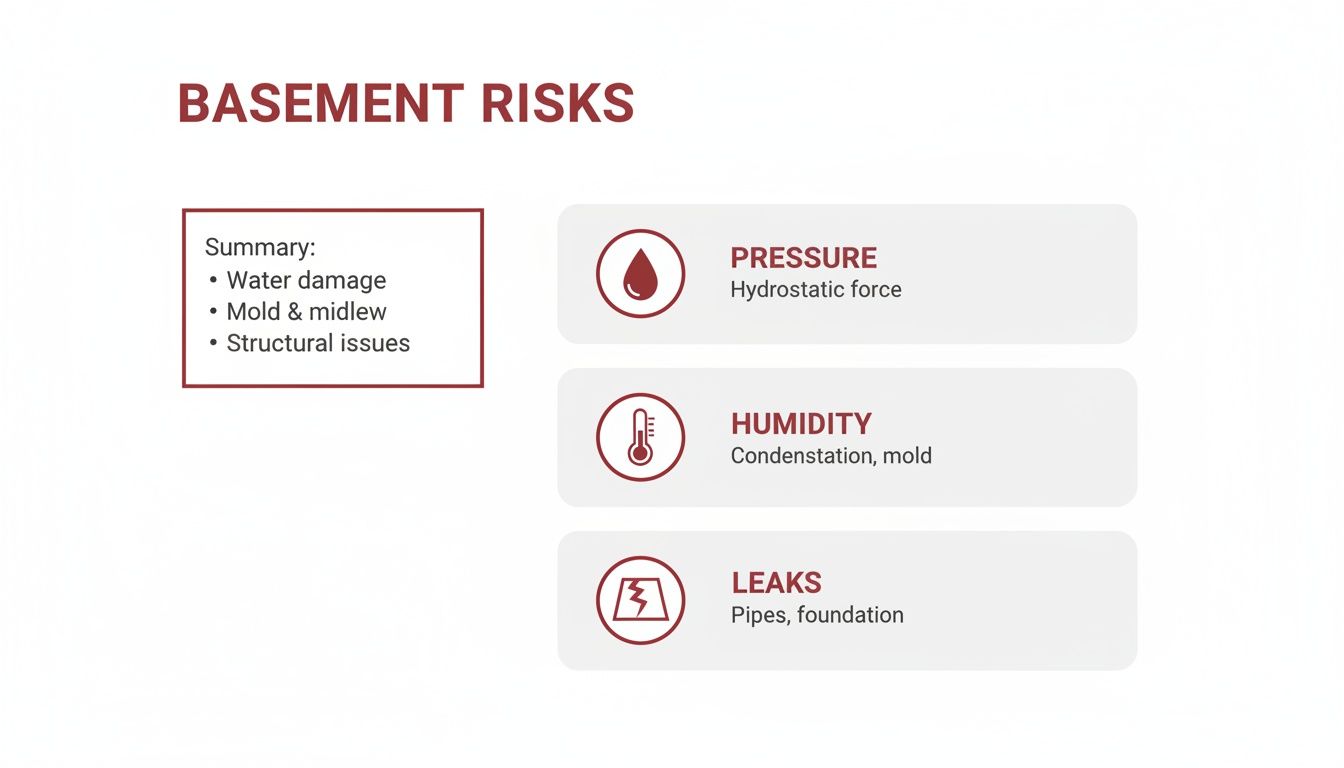
Knowing what you're up against is the first step. Now, let’s find a floor that can actually handle it.
Luxury Vinyl Plank: The All-Around Champion
There's a reason Luxury Vinyl Plank (LVP) has become the undisputed king of basement flooring. Its biggest selling point? It's 100% waterproof. I’m not talking about "water-resistant" where a small spill is okay. I mean you could have a sump pump failure, and once you get the water out, the planks themselves will be perfectly fine—no swelling, no buckling, no delaminating.
That peace of mind is huge. The global market for vinyl flooring is expected to nearly double from USD 33.9 billion in 2025 to USD 63.8 billion by 2035, and its performance in basements is a massive driver of that growth. Modern printing technology has made it nearly impossible to tell LVP from real wood or stone at a glance, all while costing 30-50% less than the materials it imitates. It’s no surprise that 72% of remodelers now recommend waterproof vinyl for any below-grade space.
On top of being bulletproof against water, LVP is also warmer and more forgiving underfoot than something like tile. Plus, with modern click-lock systems, a handy homeowner can often tackle the installation themselves, saving a bundle on labor costs.
Porcelain Tile: The Indestructible Fortress
If your top priority is a floor that is absolutely, positively indestructible, then porcelain tile is your answer. It's made from incredibly dense clay fired at extreme temperatures, which makes it completely non-porous. Water can sit on it for days, and it simply won't penetrate. This makes it a no-brainer for basement bathrooms, laundry areas, or even a mudroom entry.
Tile is also a beast when it comes to durability. It laughs off scratches, dents, and stains, making it perfect for anything from a high-traffic family room to a workshop. The design options are virtually limitless, too.
But it's not perfect for every situation. Tile is undeniably cold and hard, a feeling that isn't always welcome in a cozy living space unless you install radiant floor heating. Installation is also a serious job that's best left to the pros. And while the tile itself is waterproof, the grout lines can be a weak point, requiring sealing and regular cleaning to keep them from getting grimy.
Key Differentiator: While both LVP and tile are waterproof, tile’s weakness is its grout lines, which can stain or degrade over time if not properly sealed and maintained. LVP, with its tight seams, presents a more uniform barrier against surface spills.
Epoxy Coatings: The Seamless Industrial Solution
For a truly modern, industrial vibe that’s all about function, an epoxy coating is a fantastic option. This isn't a floor covering in the traditional sense; it's a thick, resinous coating that's applied directly over your concrete slab. The result is a seamless, non-porous surface that’s completely waterproof and tough as nails against chemicals, oil, and abrasion.
This makes epoxy a perfect fit for a home gym, workshop, or utility space. With no seams or grout lines, cleanup is a breeze. Today's epoxy systems aren't just boring gray, either—they come in a spectrum of colors and can be finished with decorative flakes or metallic pigments for a custom look.
The catch? Everything depends on the prep work. Your concrete slab has to be perfectly clean, patched, and profiled (usually with a diamond grinder) for the epoxy to bond properly. If there's any moisture coming up through the slab, the coating can bubble and peel. This is one job where hiring a pro is almost always the right call.
Engineered Hardwood: The Warmth of Wood, with Big Caveats
Everyone loves the classic, warm look of a real hardwood floor. While you should never, ever put solid hardwood in a basement, engineered hardwood can work—but only in the right conditions. Its layered plywood core gives it more stability against humidity swings than solid wood. It can truly elevate a basement family room or office, making it feel like a true extension of your home.
Here's the crucial part: engineered wood is water-resistant, not waterproof. A burst pipe or serious leak will destroy it, period. It should only ever be considered in a basement with a proven track record of being bone-dry, supported by excellent exterior drainage and a high-quality dehumidifier running 24/7. When you evaluate the pros and cons of vinyl, laminate, and hardwood for your basement, this moisture vulnerability is the single biggest factor to consider. A premium subfloor and vapor barrier are non-negotiable.
Rubber Flooring: The Ultimate in Comfort and Safety
Rubber flooring isn't just for commercial gyms anymore. It's a stellar choice for specific basement zones, offering unmatched comfort, shock absorption, and slip resistance. Whether you're building a home gym, a kids' play area, or a workshop where you're on your feet all day, rubber is a game-changer.
Available in easy-to-install interlocking tiles or large rolls, rubber is highly water-resistant and can take a serious beating. Dropped weights, tools, you name it—it can handle the impact without a scratch. If one of the tiles does get damaged, you can just pop it out and replace it in minutes.
The main downside is its utilitarian look; it might not be the right aesthetic for a polished living room. Some products also have a noticeable rubbery smell when first installed, though this usually fades. In areas prone to spills, it's wise to ensure the seams are very tight to prevent water from wiggling its way underneath.
To put it all together, here’s a head-to-head breakdown of how these materials stack up.
Comprehensive Basement Flooring Feature Showdown
This quick-glance table helps put the key differences into perspective, comparing everything from water resistance to your bottom-line cost.
| Material | Waterproof? | Cost/SF (Material) | Cost/SF (Installed) | Comfort Level | Insulation (R-Value) | DIY Friendly? | Typical Lifespan |
|---|---|---|---|---|---|---|---|
| Luxury Vinyl Plank | Yes | $2 – $7 | $4 – $10 | Medium | Low (can use underlayment) | Yes | 15-25 years |
| Porcelain Tile | Yes | $3 – $15 | $10 – $25 | Low | Low (feels cold) | No | 50+ years |
| Epoxy Coating | Yes | $1 – $5 (materials) | $4 – $12 | Low | None (direct on concrete) | Challenging | 10-20 years |
| Engineered Hardwood | No (Resistant) | $4 – $12 | $8 – $20 | High | Low-Medium | No | 20-30 years |
| Rubber Flooring | Yes (Resistant) | $2 – $8 | $4 – $12 | High | Medium | Yes | 20+ years |
As you can see, each of these top-tier basement flooring options has its place. The best choice ultimately comes down to a careful balance of moisture defense, your plans for the space, your design vision, and your budget.
How to Match Flooring to Your Basement's Function
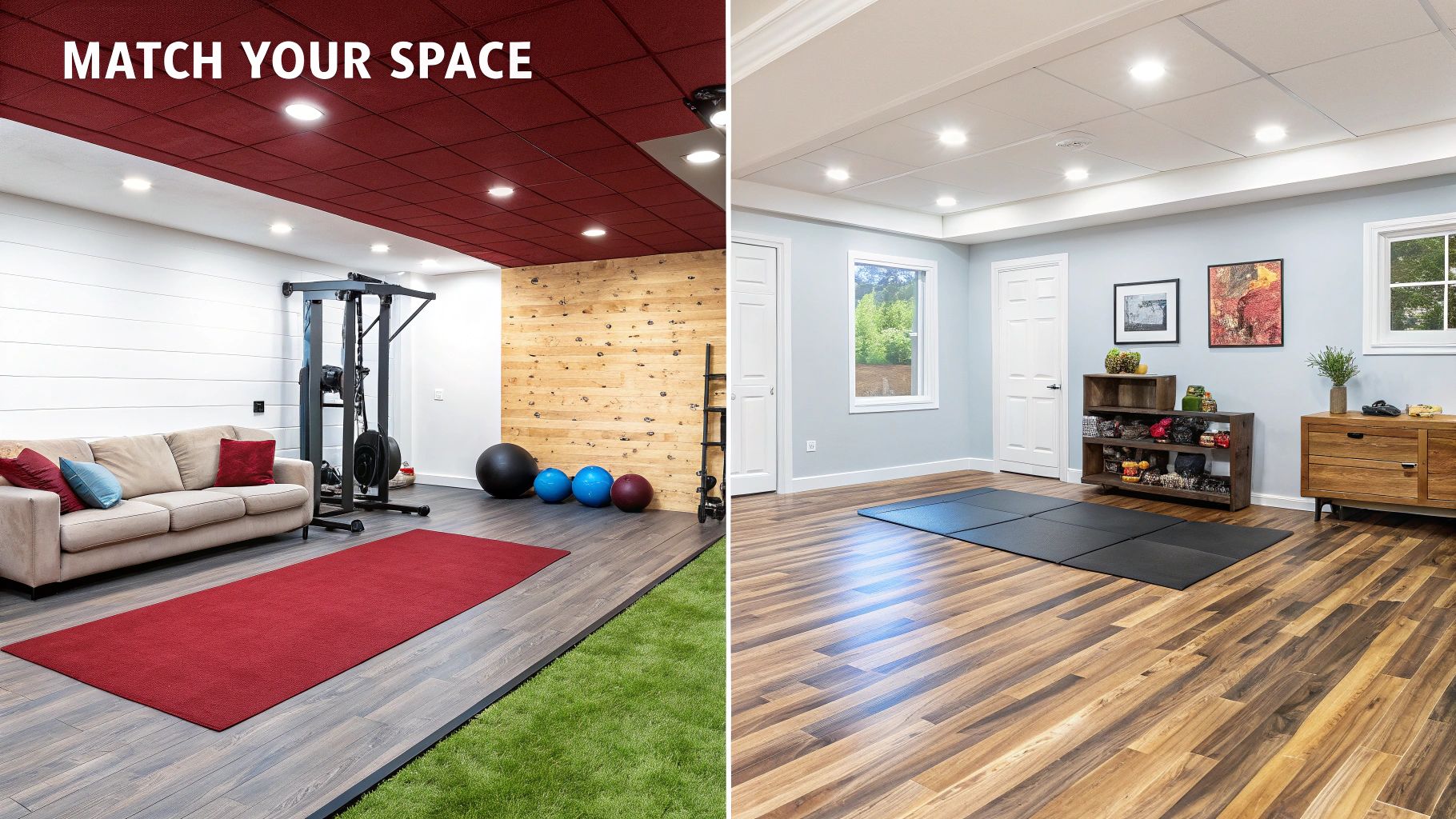
Choosing the best flooring for a basement isn't just about moisture ratings and installation specs. The real test is how well it works for the way you actually plan to use the space. A floor that's perfect for a weight room is almost never the right call for a family movie night.
When you start by thinking about function, you can connect the dots between a material’s features and your everyday life. This practical mindset ensures your new basement floor isn't just tough but also perfectly suited to its job, making the whole room more useful and enjoyable.
Let's look at a few common basement scenarios and the flooring that fits them best.
For the Family Entertainment Hub
When you're turning the basement into a cozy living area, family room, or home theater, comfort is king. You need a floor that feels warm underfoot, helps quiet down the room, and can stand up to daily family life.
Luxury Vinyl Plank (LVP) is a real star here. It gives you the warm look of hardwood without the moisture headaches, and its surface has a bit more give than tile—a nice bonus when you have kids playing on the floor. For an extra dose of warmth, we often pair LVP with a premium underlayment or a subfloor system like DRIcore to cut out that classic concrete chill.
Carpet tiles are another fantastic option for living spaces. Unlike old-school wall-to-wall carpet, these modular squares are much more practical for a below-ground room. If a drink gets spilled or a small leak happens, you just pop out the damaged tile and replace it. No need to rip up the whole floor.
For a finished living area, you have to balance warmth and comfort with solid moisture defense. A floor that feels good to walk on is what will actually draw your family into the space and make the renovation a worthwhile investment.
For the High-Impact Home Gym
A home gym floor has a tough job. It needs to absorb the impact of dropped weights, give you a stable footing for workouts, and hold up under heavy equipment without getting all scratched and dented. On top of that, it has to handle sweat and spilled water bottles like a pro.
Rubber flooring is the undisputed champ for this. It comes in interlocking tiles or big rolls and does an incredible job of absorbing shock, which protects both your joints and the concrete slab underneath. It also has a natural grip that provides excellent traction, cutting down on the risk of slipping during a workout.
Epoxy coatings are another great choice, especially for a multi-purpose gym. This seamless finish is unbelievably tough, resistant to chemicals, and super easy to wipe clean. It doesn’t have the cushion of rubber, but it creates a bulletproof surface for weight machines and cardio equipment.
For the Workshop and Utility Space
In a workshop, laundry room, or storage area, the flooring needs to be all business. It has to shrug off stains from oil or paint, support heavy tool chests, and be a breeze to sweep or mop. Looks take a backseat to pure, rugged performance.
This is where those tough, industrial-style finishes really prove their worth:
- Epoxy Floor Coatings: A good epoxy coating seals the concrete completely, creating a non-porous barrier that's 100% waterproof and resistant to chemicals, scuffs, and impacts.
- Polished Concrete: If your concrete slab is in decent shape, we can grind and polish it to a modern, high-gloss finish that’s incredibly durable and low-maintenance. A quality sealer is key to keeping out moisture and stains.
Either one gives you a no-nonsense surface that can take a beating for decades with very little upkeep.
For Any High-Moisture Basement
If your basement has a known dampness problem—or you just want the ultimate peace of mind—your choice needs to be a material that is completely inorganic and 100% waterproof. This is a hard-and-fast rule for any space with moisture issues.
Porcelain tile is the absolute safest bet in these situations. It’s made from incredibly dense, non-porous clay, which means water simply can't damage it, no matter how long it's exposed. It’s also so durable that it will probably outlast every other part of your home, making it the perfect failsafe solution for basement bathrooms, laundry rooms, or any basement that just can't take chances with water.
What Flooring Should You Never Put in a Basement?
Knowing what works is only half the story. The real secret to a successful basement renovation is knowing what to avoid. Choosing the wrong material isn't just a style misstep; it’s a costly mistake that often ends with mold, warped planks, and a complete do-over in just a few years.
Sure, with enough subfloor prep and a prayer, you can make almost anything work. But some materials are just fundamentally at odds with a basement's environment. They fight a losing battle against moisture and humidity, making them a terrible long-term investment. Steer clear of these from the get-go to save yourself a massive headache.
Solid Hardwood Flooring
We all love the classic, timeless look of solid hardwood, but it has absolutely no business in a basement. Period. Each plank is a single, solid piece of wood, and wood acts like a sponge. It will inevitably soak up moisture from the concrete slab below and the humid air around it, causing the planks to swell, cup, and warp.
Even in a basement that feels bone-dry, the natural humidity fluctuations are enough to wreck a hardwood floor. That constant expansion and contraction will create ugly gaps, cause the floor to buckle, and ruin the smooth surface. No amount of vapor barrier or dehumidifying can completely stop this natural process, which is why solid hardwood is a definite "no" for any below-grade space.
Traditional Laminate Flooring
This is a big one, so pay close attention. There's a world of difference between modern waterproof laminate and the traditional stuff. Older, cheaper laminate is built on a high-density fiberboard (HDF) core, which is really just glorified pressed sawdust. Once that fiberboard gets wet, it swells up like a biscuit in gravy and never goes back to its original shape.
The seams are the weak point. Even a small leak or a bit of moisture wicking up from the concrete can get in, causing the edges to bubble and peel apart—a problem called delamination. While many new laminates are fantastic, you have to be certain the product you choose has a fully waterproof core, not just a water-resistant top layer.
The core is everything. If the core of a flooring plank is made from wood fiber or any other organic material, it’s fundamentally mismatched for the damp reality of most basements.
Wall-to-Wall Carpet with the Wrong Padding
Wall-to-wall carpet can instantly make a basement feel cozy, but it’s a gamble. Traditional carpet—and more importantly, its standard organic fiber or urethane foam padding—is a moisture trap waiting to happen. It holds dampness against the concrete, creating the perfect breeding ground for mold and mildew. That’s where that classic musty basement smell comes from.
If you’re dead set on having that soft feel underfoot, choose carpet tiles that have a waterproof backing. These are made from synthetic, inorganic materials that won't feed mold. Plus, if you have a spill or a leak in one area, you can just pop out the damaged tiles and replace them. It’s a much smarter, more practical approach for a space that’s prone to moisture.
Ready to Transform Your Basement? Let's Get Started.
Choosing the right flooring for your basement is a big decision. It’s all about finding that perfect sweet spot between fighting off moisture, fitting your family’s needs, and sticking to a budget. We've walked through the options, but making the final call and getting it installed correctly is where the real work begins.
That’s where we come in. At Trademaster Construction, we don't just put down floors—we build finished basements from the ground up right here in Southwest Michigan. We know exactly what our local climate throws at foundations, from lake-effect snow to humid summers, and we know the local codes inside and out. Our job is to make sure your new space isn't just beautiful, but also durable, dry, and built the right way.
A great basement floor is the foundation for a great basement. Get it right, and you've created a comfortable, valuable space that your family will love for years to come.
From the critical first step of prepping the concrete slab to laying the final plank or tile, we manage every single detail. We'll help you navigate the material choices and turn your vision into a finished room you can be proud of.
Ready to see what’s possible for your home? Schedule your free, no-obligation consultation with the Trademaster team today. Let's talk about your project, answer your questions, and map out a plan.
Answering Your Basement Flooring Questions
After walking through all the options, you probably have a few specific questions bouncing around in your head. Let's tackle some of the most common ones we hear from homeowners. Getting these answers straight is key to making a final decision you’ll be happy with for years.
What Is the Most Cost-Effective Waterproof Flooring?
If we're talking purely about the cheapest way to seal a concrete floor, an epoxy coating is hard to beat, especially if your slab is already in good shape. But "cost-effective" is about more than just the initial price tag.
For the best all-around value—balancing cost, looks, durability, and comfort—Luxury Vinyl Plank (LVP) is our go-to recommendation. While the material might cost a bit more than a DIY epoxy kit, its click-lock system can save a bundle on installation labor. Plus, you get a floor that feels warmer underfoot and comes in countless styles, making it a far better long-term investment for a finished space.
Do I Always Need a Subfloor in My Basement?
Honestly, it depends on what you're trying to achieve. A subfloor isn't a strict requirement for every single basement, but it's a game-changer if you want a space that actually feels warm, dry, and comfortable.
We often recommend systems like DRIcore because they do two critical jobs at once. First, they create a thermal break, stopping that penetrating cold from the concrete slab from seeping into your room.
Think of a subfloor as more than just a layer of wood. It's an engineered system that creates an essential air gap. This gap lets any moisture that comes through the concrete evaporate harmlessly instead of getting trapped under your floor, where it can feed mold and mildew.
So, for a simple workshop with an epoxy floor? You can probably skip it. But for a family room with LVP or carpet tiles where you'll be spending real time? A proper subfloor is one of the smartest investments you can make for comfort and protecting your flooring.
Can I Install New Flooring Over My Old Floor?
Sometimes, yes—but you have to be careful. You can often lay a floating LVP floor right over an existing layer of sheet vinyl or even ceramic tile, provided the old floor is perfectly level, clean, and securely bonded to the concrete.
However, you should never install new flooring over old carpet, cracked tiles, or vinyl that is peeling up. Any flaws in the base layer will eventually telegraph right through to your new floor, causing lumps and bumps. More importantly, you risk trapping moisture and creating a hidden mold problem. When in doubt, tearing out the old floor is always the safest and most professional approach. A solid foundation is everything.
Ready to turn your basement into a beautiful, functional living space with the right flooring? The team at Trademaster Construction has been transforming basements across Southwest Michigan for years. Let's talk about your project—schedule your free consultation today to get started.

