
You know that musty smell that hits you when you open the basement door after a heavy rain? Or maybe you’ve noticed a dark, damp stain creeping up a concrete wall. That’s more than just an annoyance—it's your home’s foundation sending out an SOS.
Concrete wall waterproofing isn’t just about patching a leak. It’s a comprehensive system designed to completely block water from ever getting inside, protecting your home’s structure, your family’s health, and your peace of mind.
Why Your Concrete Walls Need Waterproofing
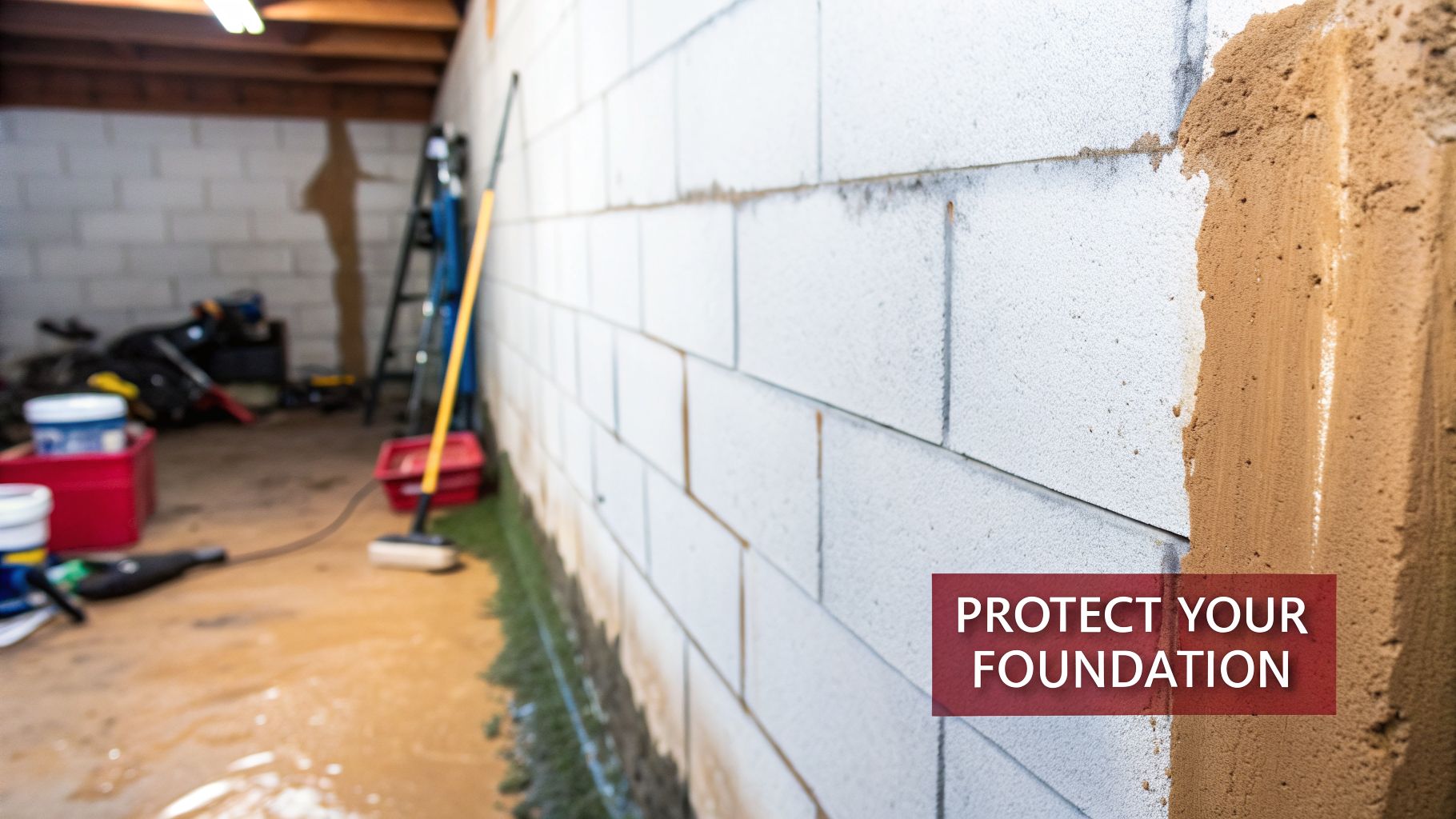
It’s natural to think of concrete as a solid, rock-hard barrier. The truth is, it acts more like a very dense sponge. Concrete is full of tiny, interconnected pores that can wick moisture straight from the damp soil outside right into your basement.
This happens because of something called hydrostatic pressure. When the ground gets saturated from rain or melting snow, all that water pushes against your foundation walls. This immense pressure forces moisture through any path it can find, from microscopic pores to tiny cracks you can't even see. Here in Southwest Michigan, where the water table can be high, that pressure is a constant threat.
The True Cost of a Leaky Foundation
Ignoring a little dampness can quickly spiral into major, expensive problems that affect your home’s health, safety, and value.
- Structural Damage: Constant moisture slowly eats away at concrete. This can lead to widening cracks, bowing walls, and even a settling foundation, putting the integrity of your entire home at risk.
- Toxic Mold Growth: A damp, dark basement is a five-star resort for mold and mildew. As they grow, they release spores into the air that can trigger allergies, asthma, and other serious respiratory problems.
- Ruined Belongings: Anything you store in a wet basement is on borrowed time. Water can destroy furniture, electronics, and priceless memories like photo albums and family heirlooms in an instant.
- Reduced Property Value: A leaky basement is one of the biggest red flags for homebuyers. On the flip side, professional waterproofing not only fixes the issue but can significantly increase your home’s resale value.
A dry, secure foundation is the cornerstone of a healthy home. By stopping moisture at its source, concrete wall waterproofing transforms a problematic basement into a safe, usable living area, protecting your investment and your family.
This proactive approach is why the waterproofing industry is booming. The global market for the chemicals used in these systems is expected to reach $29.03 billion in 2026. Closer to home, the U.S. basement waterproofing market is projected to hit $7.6 billion by 2030. For homeowners in Kalamazoo, it's a smart investment—adding waterproofing during a remodel often adds far more to your property value than it costs. You can discover more about these market trends and their impact on construction.
Curious about what it might take to secure your own home? For a quick idea of what your project might cost, our instant pricing tool can give you a preliminary quote. It’s a great first step toward budgeting for a permanently dry and healthy basement.
How to Spot the Warning Signs of Water Intrusion
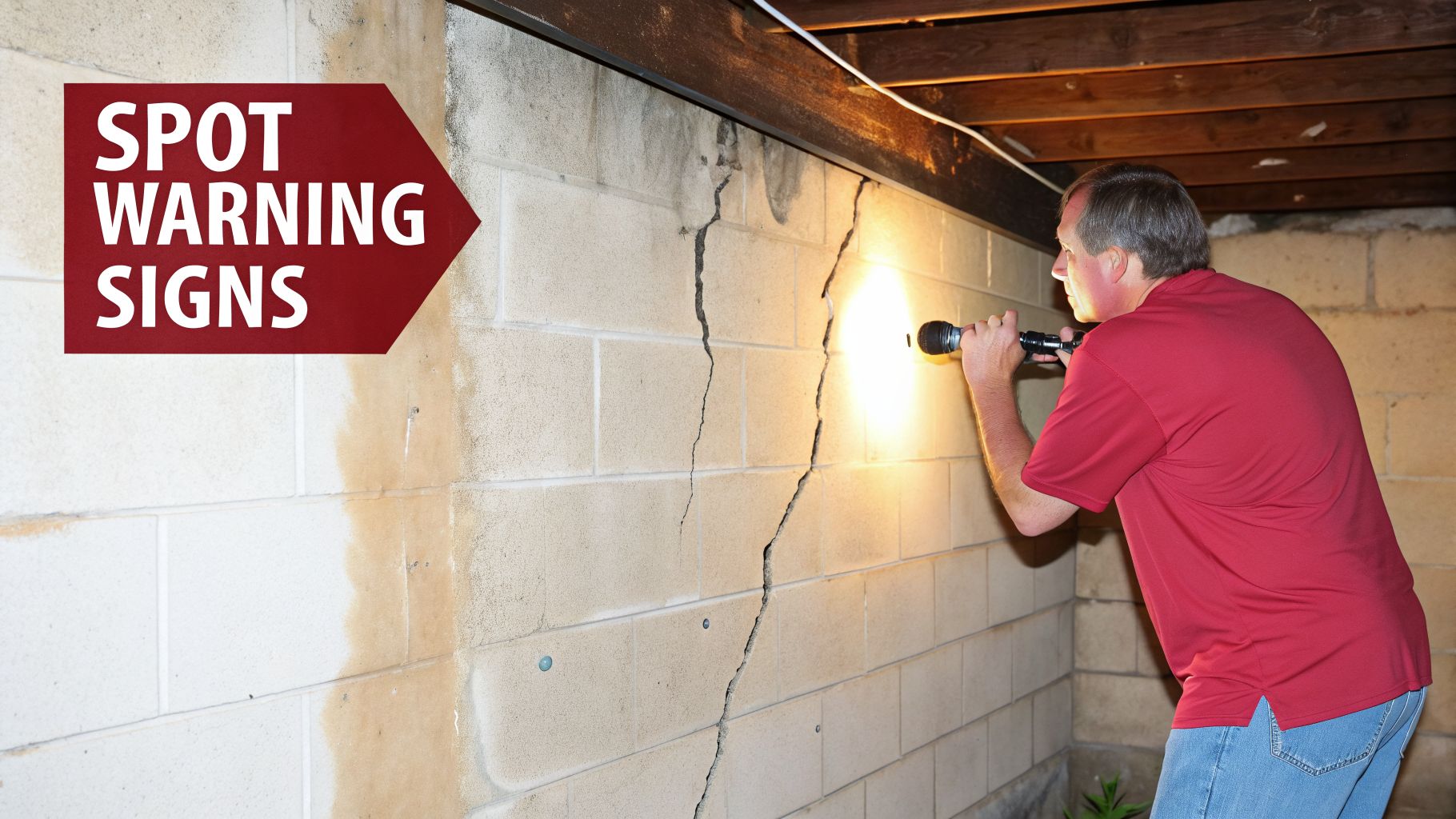
Most people think a basement water problem starts with a dramatic puddle on the floor. In reality, the trouble usually begins much more quietly. Your concrete walls will often give you subtle clues long before a real flood happens, and learning to spot them is the key to protecting your home.
Ignoring these early warnings gives moisture a free pass to keep working away at your foundation. This almost always leads to bigger, more expensive headaches down the line. Catching the problem early puts you in control.
What to Look For
Your best bet is to do a quick visual check of your basement walls every so often. Keep an eye out for any changes, no matter how small they seem.
One of the most common signs we see is efflorescence. It's a fine, white, chalky powder that shows up on the concrete. Many homeowners mistake it for mold, but it's actually salt deposits left behind as water seeps through the wall and then evaporates. Think of it as your wall's way of telling you there's a moisture problem.
Here are a few other visual red flags:
- Peeling or Bubbling Paint: If the paint on your basement walls is flaking or blistering, it's a dead giveaway that moisture is pushing through from the other side.
- Dark Stains or Damp Spots: These patches are exactly what they look like—areas where water is actively coming through or has recently saturated the concrete. They might even feel damp to the touch.
- Cracks in the Wall: While tiny hairline cracks can be normal as a house settles, you need to pay attention to horizontal cracks or stair-step patterns in a block wall. These often signal serious hydrostatic pressure building up outside.
Don't Ignore What You Smell and Feel
Sometimes you can smell or feel a water issue before you ever see a stain. A persistent musty, earthy smell is the classic signature of mold or mildew, which thrive in damp environments. Even if you can’t see the growth, that smell is a sure sign it's there, which can be a real problem for your home's air quality.
Likewise, if the air in your basement feels heavy, clammy, or noticeably more humid than the rest of your house, your instincts are probably right. That’s a strong indicator that excess moisture is coming from somewhere.
That damp, musty smell isn't just unpleasant—it's a direct warning that your basement’s environment is becoming unhealthy. It’s a cue that you need to take action.
Keeping a regular eye on your basement is one of the smartest things you can do as a homeowner. Use these clues as a simple checklist to assess your foundation. Understanding what you're seeing is the first step toward finding the right fix.
If you spot any of these warning signs, it’s time to start thinking about a solution. Budgeting for a professional concrete wall waterproofing project might feel overwhelming, but figuring out the potential cost is simpler than you might think. For a no-pressure estimate based on your home’s needs, try our instant pricing tool to help you plan your next steps.
Interior vs. Exterior Waterproofing Methods Explained
When you’re facing a wet basement, choosing the right waterproofing approach can feel overwhelming. Do you attack the problem from the outside, or do you manage it from the inside? Both interior and exterior methods can give you a dry, healthy space, but they get there in completely different ways.
Think of it this way: exterior waterproofing is like a fortress wall, proactively stopping water from ever reaching your home. Interior waterproofing, on the other hand, is a sophisticated drainage system that manages water once it’s already inside. Understanding the pros and cons of each is the key to making the right call for your Southwest Michigan home.
Exterior Waterproofing: The Proactive Shield
If you want to stop water dead in its tracks, before it even has a chance to touch your foundation, you’re talking about exterior waterproofing. This is the most thorough solution out there. It involves digging a trench around your home's foundation to expose the concrete walls.
Once the walls are clear, they get cleaned and prepped for a special waterproof membrane. This creates a seamless, rubber-like barrier that’s completely impenetrable to moisture. It’s like giving your foundation a perfect, high-tech raincoat—it stops water from soaking into the concrete and relieves the heavy hydrostatic pressure that causes cracks and leaks.
The process usually includes a few key components working together:
- Waterproof Membranes: These can be liquid-applied coatings that cure into a flexible barrier or thick, self-adhering sheets. Either way, the goal is a continuous seal around the foundation.
- Drainage Boards: After the membrane is on, we often install a dimpled plastic board. This creates a small air gap, giving water a clear path to flow down and away instead of pressing against the wall.
- Foundation Drains (Weeping Tile): At the very bottom, a brand new or fully flushed-out drainage pipe is installed to collect all that water and channel it safely away from your home.
The whole point of exterior waterproofing is to keep your foundation completely dry from the outside. It’s the only method that tackles the root cause of water intrusion, offering the best possible protection for the structural integrity of your concrete.
Interior Waterproofing: The Management System
On the flip side, interior waterproofing is designed to manage water after it has already made its way through the concrete. This approach doesn't stop your foundation from getting wet, but it's incredibly effective at capturing that water and getting it out of your house before it can cause any damage.
Think of it less like a raincoat and more like a high-tech gutter system installed in your basement. This method is far less disruptive because there’s no major digging outside, making it a great option when excavation isn't practical or is outside the budget.
A typical interior system usually relies on these elements:
- Interior Sealants and Coatings: We can apply waterproof coatings to the inside of your basement walls. These are great for blocking minor dampness and efflorescence, but they can't hold back serious water pressure on their own.
- Interior Drainage Systems: This is the heart of the system. A small channel is created around the inside perimeter of your basement floor, right where it meets the wall. A perforated drain pipe is laid in the channel to collect any water that seeps through.
- Sump Pumps: This is the engine that makes it all work. Water from the drainage channel flows into a basin (the sump pit) where a pump automatically activates, pumping the water up, out, and away from your home.
Comparison of Concrete Wall Waterproofing Methods
So, which path is right for you? It really comes down to the source and severity of your water problem, your property's layout, and your budget. This table breaks down the core differences to help you see where each method shines.
| Method | Best For | Pros | Cons |
|---|---|---|---|
| Exterior Waterproofing | Stopping severe water intrusion, new construction, protecting foundation integrity. | Completely stops water from entering concrete, relieves hydrostatic pressure, long-term structural protection. | More expensive, requires excavation which can disrupt landscaping, more labor-intensive. |
| Interior Waterproofing | Managing existing leaks, situations where excavation is impossible, budget constraints. | Less expensive, less disruptive to your property, effective at keeping the basement dry. | Does not stop water from entering the concrete wall, relies on a sump pump to function. |
Making this kind of investment in your home is a big decision, but you're not alone. The global waterproofing membrane market was valued at $28.6 billion in 2023, and it’s growing fast. That's because homeowners and builders are realizing that water intrusion is a massive problem, damaging an estimated 40% of buildings worldwide.
Here in Southwest Michigan, our humid climate and freeze-thaw cycles put concrete walls under constant stress. A professionally installed system can handle that pressure and protect your home for decades. You can dig into more waterproofing industry statistics to understand the market better.
Ultimately, a professional assessment is the best way to determine the ideal solution for your unique situation. A great first step is getting a handle on potential costs. Our instant pricing tool can give you a solid estimate based on your home's details, so you can start planning with confidence.
Deciding Between DIY Fixes and Professional Solutions
So you’ve spotted a damp patch or a thin crack in your basement wall. It’s natural to think, "Can I just fix this myself?" Head to any home improvement store, and you'll find shelves packed with hydraulic cements and waterproof paints that promise an easy, one-and-done solution.
For a tiny, non-structural hairline crack or a bit of minor dampness, those products can work. Think of them as the first-aid kit for your foundation—perfect for a small scrape. They offer a quick, temporary patch.
But it's incredibly important to know where their effectiveness ends. The reality is, most water issues aren't just surface-level annoyances. Making the right call between a weekend project and calling in the pros is a major decision. While there are pros and cons to both DIY vs Professional foundation installation, the stakes are even higher when you're dealing with water. A DIY patch is just a bandage; a professional solution is the surgery that fixes the underlying problem for good.
When Professional Expertise Is Non-Negotiable
That small tub of cement patch you bought can’t fight back against the thousands of pounds of hydrostatic pressure pushing water through your foundation wall. And that's really where the line is drawn between a DIY fix and a job that absolutely requires an expert.
If you see any of the following, it’s time to put down the tools and pick up the phone. These are red flags that the problem is way bigger than a simple patch can handle:
- Significant or Horizontal Cracks: Any crack you can slide a credit card into is a concern. But if you see cracks running horizontally across the wall? That’s a serious warning sign of extreme external pressure.
- Bowing or Buckling Walls: If your concrete wall is starting to curve or bow inward, you’re looking at a potential structural failure. This needs immediate, professional intervention.
- Recurring Water Issues: You patched a leak, but a few months later, it’s back. Or worse, water is now seeping in from a different spot. This tells you the issue is systemic—it's the whole system that's failing, not one isolated spot.
This flowchart can help you trace the issue back to its source, which is the key to figuring out whether an interior or exterior solution is needed.
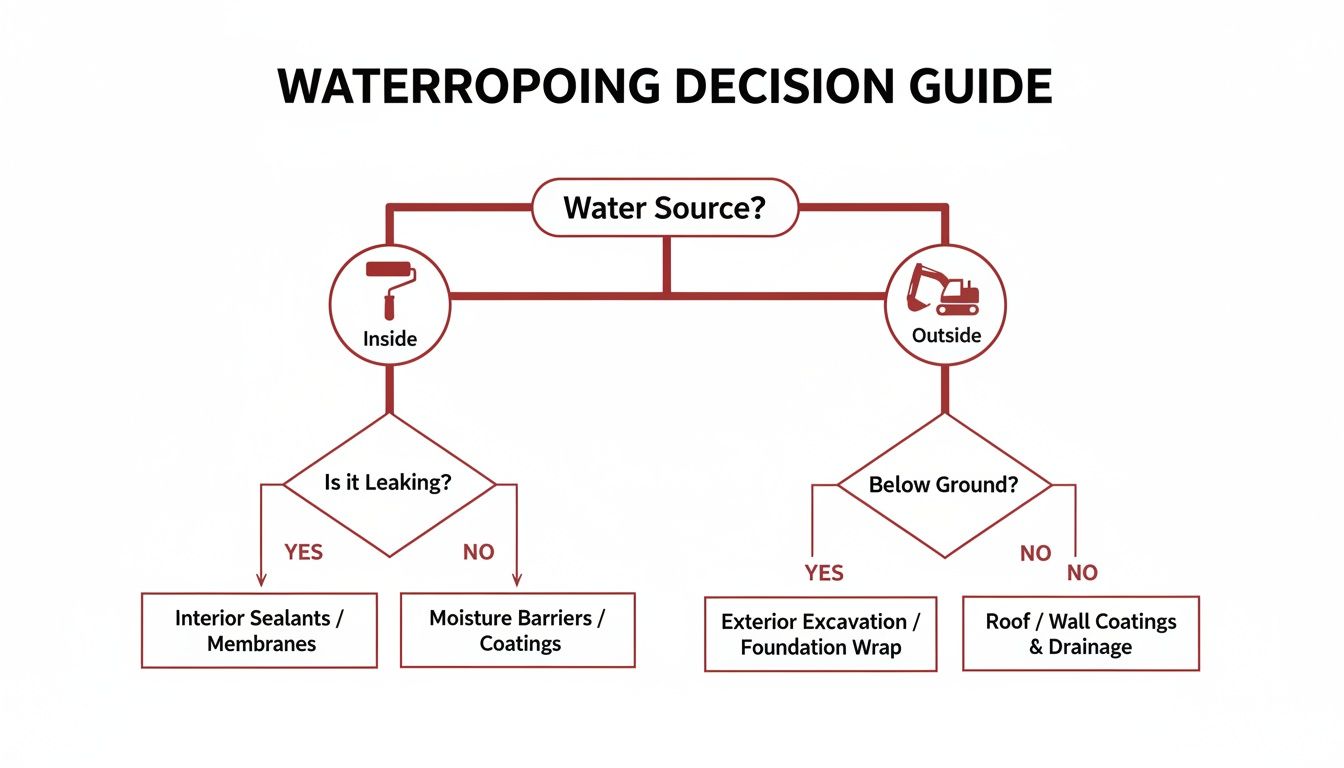
As you can see, when the water is coming from outside the foundation, a simple interior patch is rarely the right answer. You have to stop the water at its source, and that almost always means calling in a professional.
The Professional Advantage
A professional crew brings a whole different level of expertise, equipment, and materials to the job—things you just can’t replicate with a trip to the hardware store. They have the experience to correctly diagnose the root cause, whether it's poor soil grading, a high water table, or clogged drainage systems, and then design a permanent solution.
This expertise is why the commercial-grade construction waterproofing market is projected to hit $79.82 billion by 2025. Since the 1980s, the evolution of these advanced materials and techniques has caused failure rates in professionally waterproofed concrete walls to drop from a staggering 25% to under 5%.
A professional doesn't just patch a leak; they implement a system designed to protect your home's structural integrity for the long haul, preventing catastrophic and costly damage down the road.
Yes, a professional job has a higher upfront cost. But it’s not an expense—it’s an investment in your home’s safety, stability, and value. Instead of guessing, get a clear idea of what a real solution might cost. Our instant pricing tool can give you a preliminary estimate right away, helping you budget for a fix that actually lasts.
How to Budget for Your Waterproofing Project
Let's talk about the bottom line. Figuring out the cost of waterproofing your concrete walls is probably the biggest question on your mind, and it's a crucial part of turning a damp, musty basement into a space you can actually use. The good news is, that you don't have to guess.
A waterproofing project can range from a few hundred dollars for a quick fix to a much larger investment for a full-scale system. Think of it less as a cost and more as an investment in your home's health and value. Getting it right the first time saves you from bigger, more expensive headaches down the road.
Key Factors That Influence Cost
No two waterproofing jobs are exactly alike, so the final price tag will always be specific to your home. A professional contractor isn't just pulling a number out of thin air; they're calculating a quote based on a few key ingredients that determine the scope of the work.
Here’s what a pro will be looking at when they assess your situation:
- Size of the Area: This is a big one. The cost is directly tied to the linear footage of the walls that need attention. A single crack in a corner is a very different project than treating the entire perimeter of a 1,500-square-foot basement.
- Severity of the Water Issue: Are we talking about a little moisture and some white, chalky powder on the walls? Or are you getting puddles on the floor every time it rains? The more aggressive the water problem, the more robust—and therefore, more expensive—the solution needs to be.
- Chosen Waterproofing Method: As we've covered, the method matters. Injecting a single crack is the most affordable option. An interior drainage system is a highly effective, mid-range solution, while excavating the outside of your foundation is the most intensive and costly approach.
- Foundation Accessibility: An unfinished basement with bare concrete walls is a straightforward workspace. A finished basement, on the other hand, adds complexity. We may have to remove drywall, flooring, or custom-built shelves just to get to the foundation, which adds to the labor and cost.
Typical Cost Ranges for Homeowners
To help you get a better handle on potential costs, here are some general price ranges. Remember, these are ballpark figures, and every project right here in Southwest Michigan has its own unique set of circumstances.
- Crack Injection: For an isolated, non-structural crack, we can often use a polyurethane or epoxy injection. You can generally expect this to cost $300 to $800 per crack.
- Interior Drainage System: This is a very popular and reliable solution that involves installing a drainage channel and a sump pump. For a typical basement, the cost often falls between $3,000 and $10,000, sometimes more depending on the total length and the sump pump system you choose.
- Exterior Excavation and Membrane: This is the most comprehensive, all-out approach. Because it involves digging up the entire foundation perimeter with heavy equipment, costs usually start at $10,000 and can easily climb past $20,000 for a full-perimeter job.
While the upfront cost can seem high, remember that effective concrete wall waterproofing is an investment. It protects your home's structural integrity, prevents thousands in future damage, and can significantly increase your property value.
Instead of trying to guess, the best first step is to get a personalized estimate without any high-pressure sales tactics. Our instant pricing tool is a great way to get a preliminary quote based on your home's specific details. It’s a simple way to start aligning your budget with the right long-term solution.
Maintaining a Dry and Healthy Basement
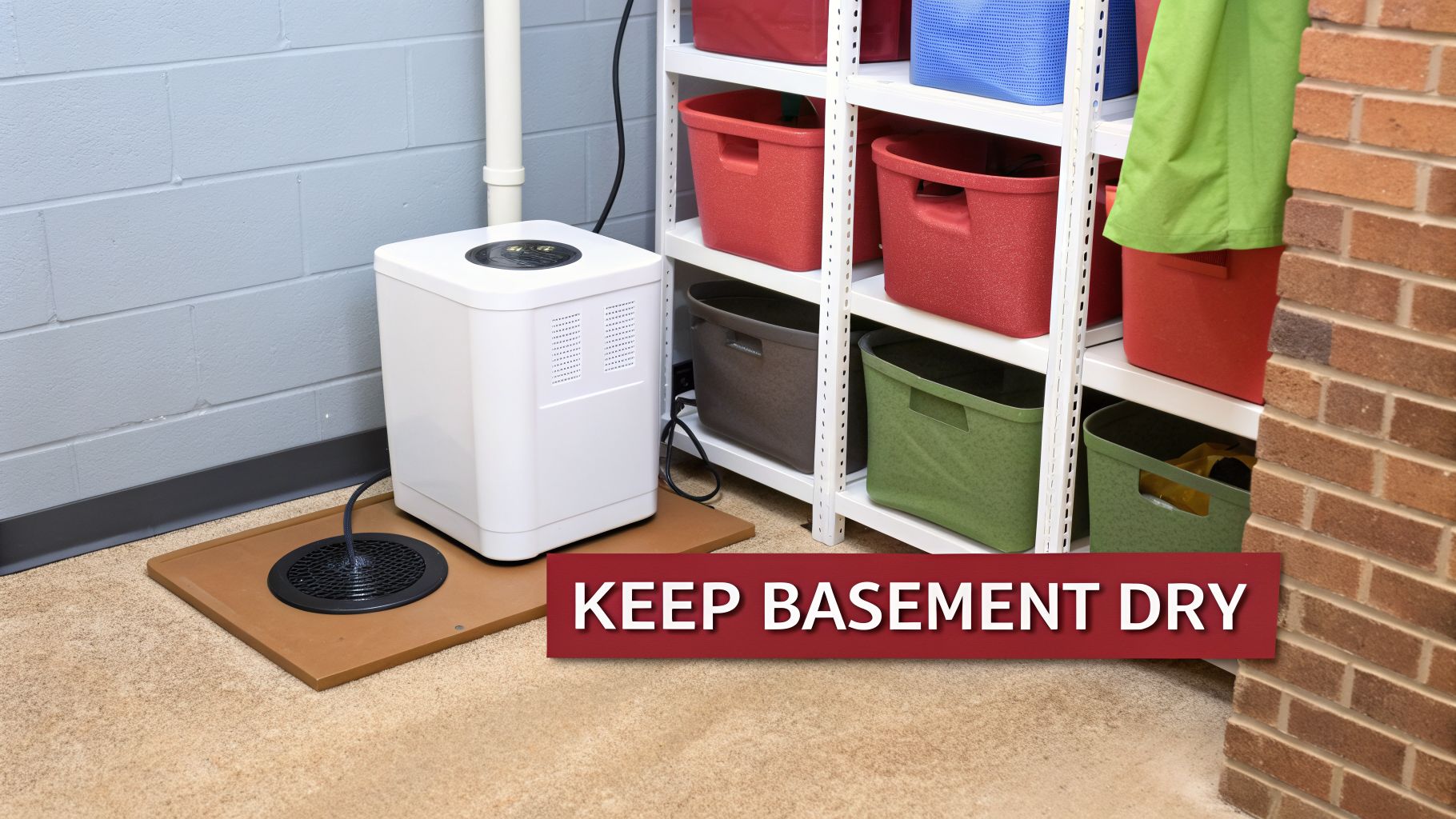
Getting a professional waterproofing system installed is a fantastic step toward protecting your home, but the job doesn't stop there. Think of it like a brand-new car—you wouldn’t dream of driving it for years without ever changing the oil or checking the tires. Your waterproofing system needs a little bit of ongoing attention to keep it working perfectly.
This simple, proactive maintenance is your part of the partnership. It protects your investment, reinforces the work that was done, and makes sure your basement stays dry and healthy for the long haul.
Your Annual Maintenance Checklist
To keep things simple, we recommend setting up a basic annual routine. Just a few hours of preventative work each year can save you from the headache and expense of unexpected water issues, ensuring your system is ready to perform when the next big storm hits.
Here's a practical checklist we've developed from years of experience:
- Clean Your Gutters and Downspouts: This is, without a doubt, the most important task. Gutters clogged with leaves and debris will overflow, sending a flood of water right down next to your foundation. Clean them out every spring and fall to keep rainwater flowing safely away from your home.
- Check Your Yard's Grading: After a good rain, take a walk around your property. Do you see puddles forming near the foundation walls? The ground should always slope away from the house. If it doesn't, you can often fix it by adding some dirt to build up the grade—it’s a simple fix with a huge impact.
- Test Your Sump Pump: Don't wait for a flood to find out your sump pump isn't working. A couple of times a year, just pour a five-gallon bucket of water into the sump pit. You should see the float rise and hear the pump kick on immediately.
- Inspect for New Cracks: Get in the habit of scanning your foundation walls, both inside and out. Catching a small hairline crack early means you can get it sealed before it has a chance to grow into a major leak.
Protecting Your System and Your Home
Beyond that yearly checklist, a few other habits can really make a difference. If your home has window wells, keep them clear of leaves, dirt, and other debris. Clogged window wells are notorious for trapping water right against your basement windows, creating a common and frustrating leak point.
Maintaining your home's exterior water management is just as important as the waterproofing system itself. A clean gutter system and proper grading act as a protective shield, lessening the burden on your foundation.
These maintenance tasks don't take a lot of time or require fancy tools, but their value is immense. By making them a regular part of your homeownership routine, you're guaranteeing that your waterproofing system can do its job effectively. This keeps your basement a dry, healthy, and valuable space for many years to come.
Thinking about a bigger project and want to get a feel for the budget? A great place to start is with a free estimation resource. For a quick quote on your remodeling project, try our instant pricing tool to get a reliable ballpark figure.
Common Questions About Concrete Waterproofing
It's completely normal to have a few final questions rattling around before you commit to a big project like waterproofing. Let's tackle some of the most common ones we hear from homeowners to give you that last bit of confidence.
Think of it as the final check-in before you move forward, where we clear up any lingering doubts about the longevity of the work and the real-world value it adds to your home.
How Long Does Concrete Wall Waterproofing Last?
This is the big one, isn't it? And the honest answer is: it depends entirely on the method you choose.
- DIY Patches and Sealants: Think of those hydraulic cement patches or special waterproof paints you see at the hardware store. They're best seen as temporary band-aids. You might get a year or two out of them, but constant water pressure will eventually win.
- Professional Interior Systems: A professionally installed interior drainage system, when paired with a quality sump pump, is truly a "for the life of your home" solution. The drainage components are incredibly durable, though the sump pump itself will likely need to be replaced every 7-10 years to keep the system running optimally.
- Professional Exterior Membranes: This is the most robust, long-term fix available. A high-quality exterior membrane, applied by a pro, stops water before it even has a chance to touch your foundation. This kind of protection can easily last for decades, often 20 years or more.
Will Waterproofing Increase My Property Value?
Without a doubt. A damp, musty basement is a massive red flag for any potential homebuyer and can tank your home’s value. Professional concrete wall waterproofing isn't just a repair; it’s a powerful investment.
When you have a certified, warrantied waterproofing system, you're not just selling a house—you're selling peace of mind. It turns the basement from a liability into a usable, valuable asset, which not only recovers lost value but can add a serious premium, especially here in Southwest Michigan where wet basements are a known headache.
A dry basement is a key selling point. It directly translates to a higher appraisal value and a faster sale, making it one of the smartest home improvement investments you can make.
Can I Finish My Basement After It's Waterproofed?
Yes! This is one of the best reasons to get the job done right in the first place. Once you have an effective interior or exterior waterproofing system installed, you can finally move forward with your basement finishing project.
You can invest in that new drywall, flooring, and furniture with confidence, knowing it won't be ruined by the next heavy rain. A properly waterproofed foundation is the essential first step to creating that guest bedroom, home gym, or family room you've been dreaming of.
Of course, maintaining a dry, healthy basement also involves smart preventative measures. For some great tips on stopping water before it becomes a crisis, check out this guide on how to prevent basement flooding. This kind of proactive thinking is key to protecting your newly finished space for years to come.
Before you start picking out paint colors, get a clear picture of what your project might cost. For a no-pressure way to estimate expenses and plan your budget, try our instant pricing tool to get a solid ballpark figure for your project. It's the perfect first step toward creating the basement of your dreams.

