
Picking the right kitchen countertop is about so much more than just what looks good. It’s a gut-level decision about how the heart of your home functions every single day. The secret is to start by getting real about how you actually use your kitchen, and only then find a material that can keep up.
Figure Out What Your Kitchen Really Needs
Before you even think about stepping into a showroom or getting lost in Pinterest boards, the most critical work happens right where you are. A successful countertop project starts with a brutally honest look at your daily habits, your real-world budget, and the style you genuinely love—not just what’s trending this week.
Taking a moment to nail this down first saves a ton of headaches and potential regret later. It’s like creating a practical blueprint that will guide every other choice you make.
How Do You Actually Use Your Kitchen?
Forget color and pattern for a minute. The first question you need to answer is about function. How does life unfold in your kitchen day in and day out? A little self-awareness here will instantly point you toward the right materials.
Think about which of these sounds most like your household:
-
The Serious Home Cook: Is your kitchen a creative battleground of hot pans, splattering sauces, and constant chopping? If so, you absolutely need a workhorse surface. Heat, scratch, and stain resistance aren't just nice-to-haves; they're essential.
-
The Busy Family Command Center: Does your counter double as a drop zone for backpacks, a homework station, and a staging area for frantic breakfasts? You'll want a low-maintenance, non-porous material that won't stain from spilled juice and can take a beating.
-
The Social Hub: Maybe your kitchen is less about cooking and more about gathering. If it's the spot where everyone hangs out with a glass of wine, aesthetics might be your top priority. You might be willing to baby a more delicate surface like marble for its show-stopping beauty.
Set a Budget for the Entire Project
That price per square foot you see advertised? It's just the tip of the iceberg. One of the biggest mistakes I see homeowners make is forgetting about all the other costs involved in a countertop replacement.
Be prepared: The final installed price is often 30-50% higher than the material cost alone. Your "all-in" budget needs to cover the slab, fabrication (cutting holes for the sink and cooktop), delivery, edge profiles, tearing out your old tops, and the final installation.
Thinking in terms of the total project cost is the only way to make a true apples-to-apples comparison between materials. It’s also during this planning phase that you’ll want to finalize other key decisions, like choosing your ideal cooktop type, as that directly impacts your countertop layout. Get this foundation right, and everything else falls into place much more easily.
A Real-World Guide to Countertop Materials
Once you have a clear picture of your needs, you can get to the fun part—exploring the materials that will become the centerpiece of your kitchen. This isn't just about picking a color; it's about finding that sweet spot where durability, style, and your budget all come together. Let's look at how these popular options actually perform in a busy home.
You'll find it's all about practical trade-offs. For example, you might be dreaming of the timeless elegance of marble, but its porous nature can be a constant source of stress if you have kids who are prone to spilling grape juice. On the other hand, an engineered quartz can give you a very similar high-end look without the nagging worry of stains and etching.
This decision tree is a great way to see how your lifestyle, budget, and design taste can point you toward the right family of materials.
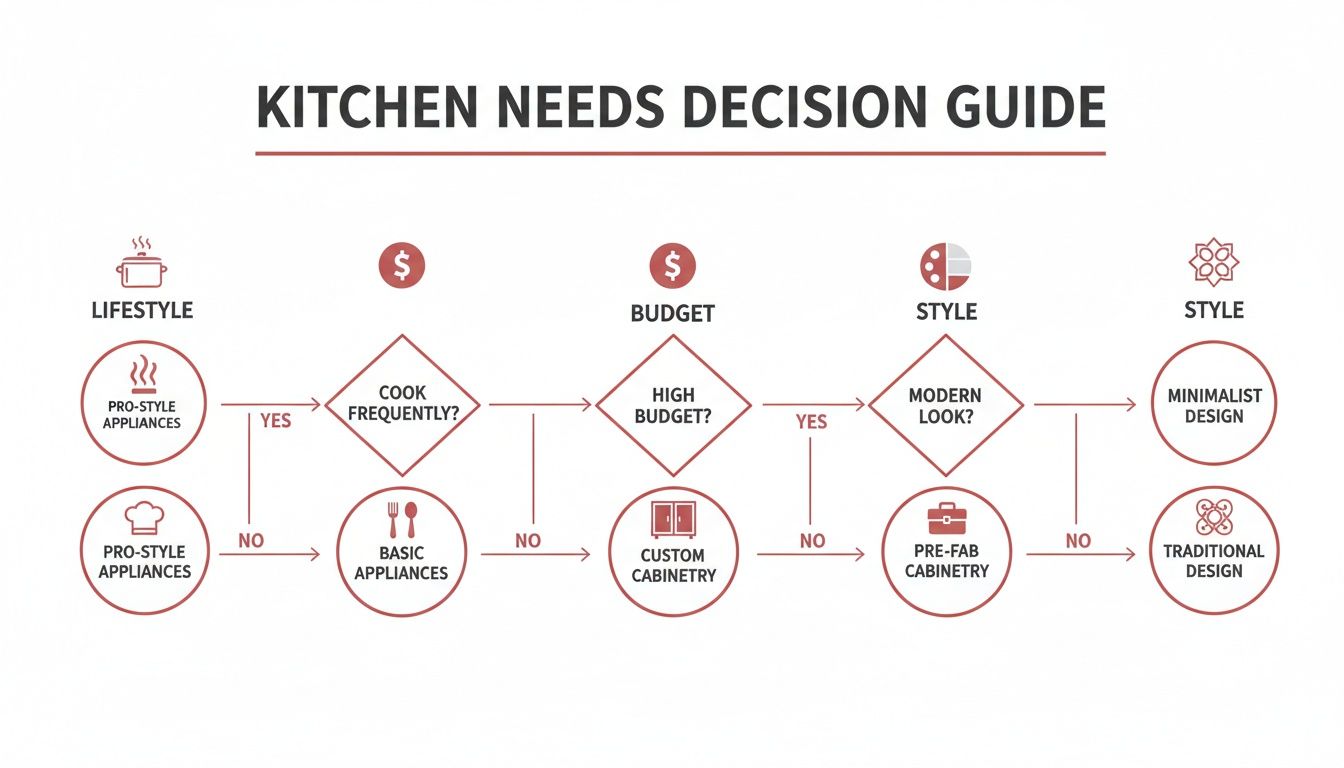
The main takeaway here is to let your daily habits and financial comfort zone do the heavy lifting. They are the best filters to apply before you fall in love with a particular look.
To make this easier, here’s a quick-glance comparison of the most common countertop choices we see homeowners considering.
Kitchen Countertop Material Comparison
| Material | Average Cost (Per Sq. Ft. Installed) | Durability & Scratch Resistance | Heat Resistance | Maintenance & Sealing Needs | Best For |
|---|---|---|---|---|---|
| Granite | $40 – $100+ | Very High | Excellent | Requires annual sealing | Busy kitchens; homeowners wanting unique, natural patterns. |
| Marble | $60 – $150+ | Low | Good | Requires frequent sealing; prone to etching | Low-traffic areas; homeowners who love its classic look and don't mind the upkeep. |
| Quartz | $50 – $120+ | Excellent | Good (use trivets) | None required | Families; anyone seeking a low-maintenance, consistent look. |
| Butcher Block | $50 – $100+ | Low (can be sanded) | Poor | Requires regular oiling or sealing | Kitchens with a warm, rustic, or traditional aesthetic; bakers. |
| Laminate | $20 – $50 | Low to Moderate | Poor (will melt) | None required | Budget-conscious projects; rental properties; quick cosmetic updates. |
This table gives you a starting point, but let’s dig a little deeper into what it’s like to live with each of these materials day in and day out.
The Natural Stone Contenders: Granite and Marble
When people think of high-end countertops, granite and marble are usually the first to come to mind. A huge part of their appeal is that every single slab is completely unique, sculpted by nature itself.
Granite is a fantastic all-around workhorse. It's incredibly resistant to heat, so you can set a hot pan down in a pinch without panicking. It's also very hard and stands up well to scratches. The main thing to remember is that it's a porous natural stone, which means it must be sealed periodically (usually once a year) to keep stains from seeping in.
Marble, on the other hand, is the definition of luxury for many. Its soft, veined look is simply unmatched. The trade-off? It’s much softer and more porous than granite. It can scratch easily and, more importantly, it will etch when it comes into contact with anything acidic—think lemon juice, wine, or even tomato sauce. For homeowners who need a pristine surface, marble can be a high-maintenance heartbreaker.
Engineered Excellence: Quartz and Sintered Stone
Engineered surfaces have absolutely exploded in popularity, and for one simple reason: they were designed to solve the real-world problems of natural stone. Engineered quartz, the clear market leader, is made of about 90-95% ground natural quartz blended with resins and pigments.
This process creates a completely non-porous surface. For you, that means:
- No sealing is ever required.
- It’s highly resistant to stains, scratches, and bacteria.
- You get consistent color and patterning from slab to slab.
Expert Insight: While quartz is incredibly durable, it's not indestructible. An extreme, sudden temperature change—like setting a scorching-hot pan directly on the surface—can cause thermal shock and crack it. We always tell our clients to use trivets for peace of mind.
The market data backs this up. The U.S. countertop market is projected to hit roughly $32.44 billion by 2030, with quartz and newer materials leading that growth. While granite and marble still have a strong foothold, non-porous surfaces are gaining ground because they often come with warranties and eliminate the risk of staining. You can dive deeper into the full analysis of countertop market trends to see where the industry is heading.
Warm and Inviting: Butcher Block and Wood
For a cozier, more traditional, or rustic vibe, nothing beats the feel of real wood. Butcher block countertops, usually made from maple or oak, bring a natural warmth into the kitchen that stone just can't replicate. They’re also a chef’s favorite because they are gentle on knives.
The main consideration is maintenance. Wood is vulnerable to water damage, so you have to be diligent about wiping up spills immediately, especially around the sink. It also needs to be treated regularly with mineral oil or another food-safe sealant to keep it from drying out and cracking. The upside? Minor scratches and dings can be sanded right out, which many people feel just adds to the countertop’s character over time.
The Budget-Friendly Workhorse: Laminate
Forget the laminate from your grandma’s house. Today's high-pressure laminates (HPL) come in an unbelievable range of designs, including incredibly convincing mimics of natural stone, wood grains, and modern patterns. The biggest draw, of course, is its unbeatable price point, making it a fantastic choice for a stylish remodel on a tight budget.
Modern laminate is easy to clean and fairly stain-resistant. Its kryptonite is heat and sharp objects. A hot pan can melt or scorch the surface, and a slip of a knife can leave a permanent cut. You’re also limited to drop-in sinks rather than the more popular undermount style. Still, for the price, you get a lot of look, making laminate a very strong contender.
Budgeting for the Total Cost of Your Countertops
When you're walking through a showroom and see a price per square foot on a beautiful countertop sample, just know that’s only the beginning of the story. One of the biggest mistakes I see homeowners make is underestimating the total project cost. The final bill for that stunning, professionally installed countertop is a lot more than just the price of the stone.
To get this right, you need a realistic budget that covers everything from the initial measurements all the way to the final cleanup. Without thinking it all through, you can get hit with unexpected expenses that throw your whole renovation off track. Let's break down the full financial picture so you can make a smart decision that actually fits your wallet.
Deconstructing the Final Price Tag
So, what are these so-called "hidden" costs? They aren't really hidden; they're just separate services that are absolutely essential for a professional finish. A proper countertop quote is a bundle of both material and labor costs that covers the entire job from start to finish.
Your total investment will almost always include these line items:
- Templating: Before a single cut is made, a technician comes out to create an exact digital or physical template of your cabinets. This is a critical step that ensures a perfect, seamless fit, accounting for every single corner and curve.
- Fabrication: This is the real artistry, where the raw slab is turned into your custom countertop. It involves cutting the slab to your template's dimensions, making cutouts for your sink and cooktop, and finishing the edge profile you chose. Keep in mind, more complex edges or multiple cutouts will bump up the fabrication costs.
- Material Transportation: That heavy slab of granite or quartz isn't going to get to your home on its own. Delivery fees are standard and cover moving the material from the supplier to the fabricator, and then to your house.
- Removal and Disposal: Unless you plan on tackling the demo yourself, your installer will tear out and haul away your old countertops. This service adds to the labor cost, but trust me, it saves you a ton of work and a trip to the dump.
- Installation: This is the final, skilled work of carefully setting, leveling, and securing your new tops. For heavy materials like stone, this is a job you want experienced pros to handle. A mistake here can be incredibly costly.
Here’s a Real-World Scenario: Let's say you've budgeted $3,000 based on a material price of $60 per square foot for 50 square feet of quartz. But then you add templating ($300), a sink cutout ($200), removal of the old laminate ($150), and the final installation labor ($850). Suddenly, your total is closer to $4,500. That 50% jump is something we see all the time.
The Financial Spectrum of Materials
Getting a handle on the cost ranges for different materials is the key to building an accurate budget from the get-go. There’s a massive cost spectrum out there.
For instance, you can find entry-level laminates for under $20–$40 per square foot (for the material alone). On the other end of the spectrum, premium natural stones and high-end engineered surfaces can easily soar past $100–$200+ per square foot once you factor in installation.
The popularity and demand for certain materials also play a big role in pricing. Since updated kitchens are one of the main drivers of home renovations, the countertop market is competitive, which is good news for you. To get a better feel for what's driving prices, you can dig into the economics of the kitchen countertop market and see how trends affect what you pay.
Balancing Cost with Return on Investment
It's smart to think beyond the initial price tag and consider the long-term value your new countertops bring to your home. A kitchen remodel consistently offers one of the highest returns on investment (ROI) of any home improvement project, and the countertops are the star of the show.
While a budget-friendly laminate is great for a quick refresh, it won't boost your home's resale value like a durable, high-end stone will. Industry reports on remodeling costs consistently show that homeowners often get back a big chunk of their investment on mid-to-upper-range materials like engineered quartz. Buyers see it as a premium feature—it’s beautiful, tough, and low-maintenance—and that can make your home stand out from the competition.
Thinking about ROI helps you see your countertops as an investment, not just an expense. It’s all about finding that sweet spot where your budget, your long-term needs, and your home’s future value all come together perfectly.
Making Sure Your New Countertops Fit Your Kitchen's Style
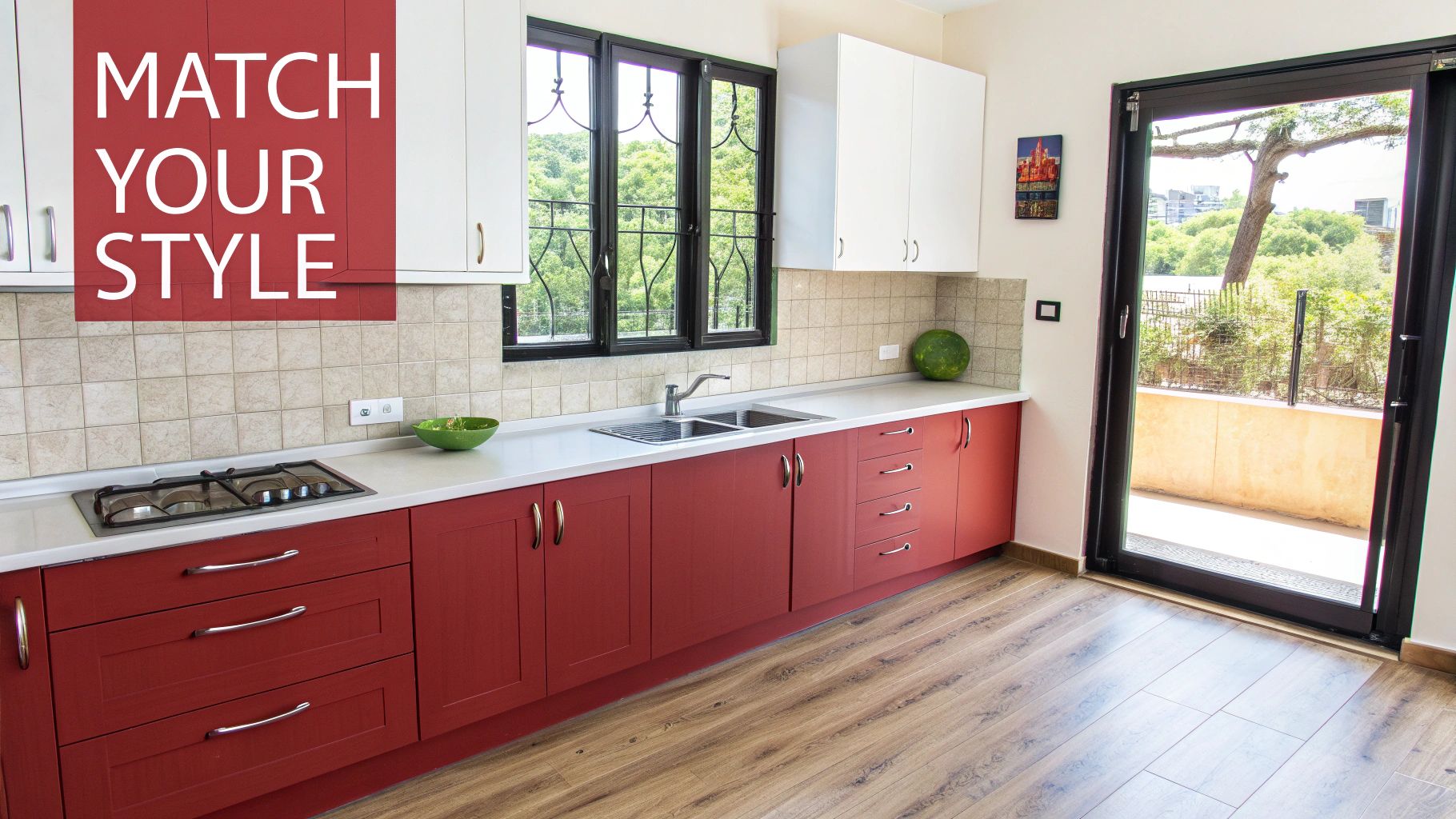
A countertop might be the star of your kitchen, but it doesn't perform alone. For a truly stunning result, your new surface has to work with the supporting cast: your cabinets, backsplash, flooring, and paint. This coordination is what turns a collection of nice materials into a cohesive, intentional design.
The goal isn't necessarily to make everything match. It's about creating a balanced visual story. Whether you love a bold, high-contrast kitchen or prefer a more serene, monochromatic flow, a few basic principles can guide you to a choice that ties the whole room together.
Nailing the Color Palette
The relationship between your countertops and cabinets is the most critical one in the kitchen. If you get this pairing right, everything else seems to fall into place. First, decide on the overall feeling you want. Are you aiming for airy and bright, dramatic and moody, or warm and earthy?
Here are a few classic approaches we see work time and time again:
- Go for High Contrast: This timeless strategy creates instant visual energy. Think dark espresso cabinets with a light Calacatta quartz or classic white cabinets with a deep charcoal granite.
- Find a Complementary Flow: This is all about pairing colors that are different but work beautifully together. For instance, mid-tone wood cabinets feel incredibly welcoming when paired with a creamy, beige-toned quartz.
- Create Monochromatic Harmony: For a sleek, modern look, choose a countertop in a similar shade to your cabinets. The key is to pick one with subtle veining or a different texture to add depth and keep it from looking flat.
An Expert Tip: Pay close attention to undertones. A countertop with cool, blue-gray undertones will likely clash with cream-colored cabinets that have warm, yellow undertones. Always place samples next to each other in your kitchen to make sure their base tones are compatible.
Don't Overlook the Finish
The texture of your countertop's surface—its finish—plays a massive role in the final look and feel of your space. Polished is what most people think of. It's glossy, reflects a ton of light, and really makes the colors in the stone pop. But it’s not your only option.
A honed finish gives you a soft, matte look with very little shine. It’s fantastic for hiding fingerprints and smudges, creating a more subtle and contemporary vibe. Just be aware that honed finishes on darker stones can sometimes show oil marks more easily, so they might require a bit more diligence.
If you want something more tactile and rustic, a leathered finish adds a subtle texture that you can actually feel. This finish is amazing at concealing daily wear and tear and is becoming a popular choice for its unique, sophisticated appearance. It’s all about balancing the look you love with the maintenance you’re willing to do.
You Must Test Samples in Your Own Kitchen
I can't stress this enough: you cannot finalize your countertop choice based on a picture or a small sample under harsh showroom lights. Lighting is everything. A slab that looks perfectly gray in the store might suddenly show weird green or blue undertones in the natural morning light of your kitchen.
Always, always bring home large samples of your top contenders. Place them right on your current counters and watch how they change throughout the day:
- In the bright morning sun.
- During the softer afternoon light.
- Under your kitchen's artificial lighting at night.
See how the material actually looks next to your specific cabinet color, backsplash tile, and wall paint. This is a non-negotiable step that prevents expensive mistakes and ensures the countertop you choose is one you'll love in your real home, not just in theory.
Getting the Details Right: Finishes, Edges, and Thickness
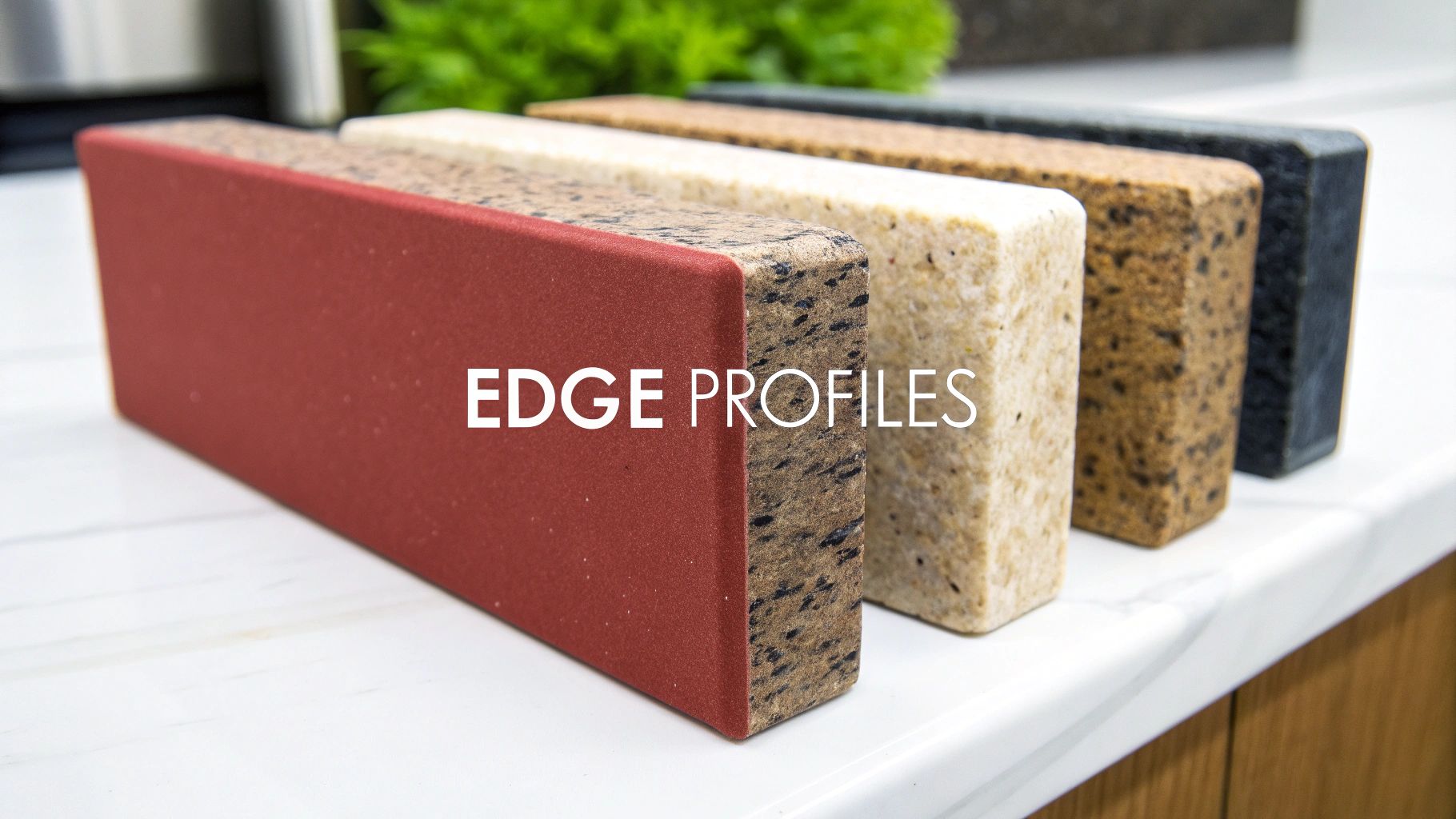
Once you’ve landed on the perfect material, it’s time to dial in the details that really make a countertop yours. The edge profile, surface finish, and slab thickness are what elevate your kitchen from just another project to a truly custom space.
These aren't just minor aesthetic choices, either. They affect how your countertops look, feel, and function every single day. Thinking through these elements now ensures the final result matches your vision, whether you're aiming for a sleek, modern vibe or something warm and traditional.
Choosing an Edge Profile That Fits Your Life
The edge of your countertop is more than just a decorative flourish; it impacts safety, cleaning, and the overall style of your kitchen. While there are countless custom options out there, most homeowners find exactly what they need in one of these popular styles.
- Eased Edge: This is basically a square edge with the sharpness ever-so-slightly sanded down. It’s clean, simple, and the go-to for modern or minimalist kitchens.
- Bullnose Edge: A classic, fully rounded edge. If you have young kids running around, this is a fantastic choice—no sharp corners mean fewer bumps and bruises.
- Ogee Edge: With its elegant S-shaped curve, the ogee profile adds a touch of formal, traditional luxury. You’ll often see this in high-end, classic kitchen designs.
Think about your daily routine. A busy, high-traffic kitchen benefits from the practicality of a rounded bullnose or a simple eased edge. They’re durable and easy to wipe down. A more intricate ogee edge is stunning but can be more susceptible to chipping and a bit tougher to clean around the curves.
How Thick Should Your Countertops Be?
When you’re looking at stone countertops, the decision on thickness usually comes down to two standards: 2 centimeters (about 3/4 of an inch) and 3 centimeters (about 1 1/4 inches). What's right for you often depends on your budget, regional trends, and the final look you're after.
A 3cm slab is often considered the industry standard in many areas. It gives you a substantial, high-end look and is strong enough to be installed directly on your cabinets without any extra support underneath.
A 2cm slab is a bit thinner and generally more budget-friendly. To create the illusion of a thicker profile, fabricators will often laminate a second strip of stone along the edge. This approach also requires a plywood sub-top for support, which is something to keep in mind as it can affect the final counter height.
Insider Tip: Want a really bold, chunky look? Ask your fabricator about a mitered edge. This clever technique involves cutting slabs at a 45-degree angle and joining them to create a seamless edge that looks much thicker—sometimes 2, 3, or even 4 inches—without the weight of a solid block.
Picking the Perfect Surface Finish
The finish is all about how your countertop looks and feels to the touch. It can completely change the character of a stone and has a big impact on maintenance.
- Polished: This is the most popular choice by far. It's a glossy, reflective surface that makes colors look deep and vibrant.
- Honed: Here, the stone is sanded to a smooth, matte finish with little to no shine. It’s great for hiding smudges and fingerprints, but on darker stones, it can be more prone to showing oil spots.
- Leathered: This finish adds a soft, subtle texture to the stone, almost like worn leather. It has a sophisticated, low-sheen look and is fantastic at concealing daily wear and tear.
Each of these choices—the edge, the thickness, and the finish—comes together to define the final personality of your countertops. Getting them right is key to creating a kitchen you'll love for years.
Bringing It All Home: Your Countertop Installation Guide
You've done the hard work of picking the perfect material, color, and finish for your countertops. Now for the exciting part: installation. This is where that heavy, beautiful slab transforms into the true heart of your kitchen. Knowing what to expect makes this final step smooth and stress-free.
The whole process kicks off with something called templating. A technician will visit your home to create an exact pattern of your cabinets, either digitally or with a physical template. This is a crucial step for a perfect fit, and it can only happen after your base cabinets are fully installed, leveled, and screwed into place. Don't skip this!
Your Pre-Installation Checklist
A bit of prep work from you can make a world of difference for the installation crew and help everything go off without a hitch.
Before they arrive, make sure you've handled these key tasks:
- Clear the way. The crew needs an unobstructed path from the front door to the kitchen. Remember, they're carrying extremely heavy, awkward pieces.
- Empty your cabinets. Take everything out of the base cabinets where the new countertops will go. This protects your belongings from dust and gives the team room to work.
- Have your new hardware ready. Your new sink, faucet, and cooktop need to be on-site. The installers need them to confirm the cutout sizes and drill the holes in exactly the right spots.
A quick word of advice: your old countertops have to go before the new ones come in. While you can save a little on labor by doing the demolition yourself, we usually recommend letting the pros handle it. It's surprisingly easy to damage your cabinets during removal, which can cause major headaches and extra costs.
What to Expect on the Big Day
The installation itself is a masterclass in precision. The team will carefully bring in the countertops, lay them onto the cabinets, and use a powerful adhesive to bond everything together. If your kitchen requires seams, they'll mix a custom color-matched epoxy to make them blend in as seamlessly as possible.
It's a booming industry. The global countertops market is expected to hit USD 185.4 billion by 2032, fueled by new materials and better manufacturing. This growth, especially in the Asia-Pacific region, has a direct impact on you—it affects material availability and can influence how long it takes to get your slab. You can dive deeper into these trends by checking out the full countertop market analysis.
From the day the templating is done to the final polish, you're typically looking at a two-to-four-week timeline. This gives the fabricator enough time to cut your stone and get you on the installation schedule. Good communication is everything here, so stay in touch with your installer to keep your project on track for a perfect finish.
Got Lingering Countertop Questions? We've Got Answers.
Even after you've narrowed down your choices, a few last-minute questions always seem to pop up. That's completely normal. Getting clear answers to these final details is what gives you the confidence to pull the trigger on such an important investment. Let's walk through some of the most common questions we get from homeowners.
What’s the Toughest, Easiest Countertop to Live With?
If you're looking for a surface you can practically install and forget about, engineered quartz is hands-down the winner. It's a non-porous material, which is a technical way of saying it won't soak up spills. Coffee, red wine, olive oil—they all wipe away without a trace, and you never have to seal it.
On top of that, it’s incredibly hard and stands up to scratches and chips from daily life. While a beautiful natural stone like granite is also very durable, it is porous. That means it needs to be sealed every so often to keep it from staining. For the ultimate combination of high performance and low maintenance, quartz is king.
How Do I Get Samples That Actually Look Like My Future Countertop?
This is a critical step that too many people skip. You have to see the material in your own home. When you request samples, insist on getting them from the specific slab or batch you're considering. This is especially important with natural stone, where the color and veining can vary wildly from one slab to the next.
Take those samples home. Look at them in the morning light, see how they feel in the afternoon, and check them under your kitchen lights at night. Hold them right up against your cabinets and backsplash. This simple test is the single best way to avoid a costly mismatch.
For more expert advice and to see what's trending, the TitanEdge Titanium blog for more tips is a great resource.
Should I Go With a 2cm or 3cm Thick Countertop?
The decision between a 2cm (roughly 3/4 inch) and a 3cm (about 1 1/4 inch) slab really boils down to three things: aesthetics, budget, and regional standards.
- 3cm Slabs: This is the thicker, more substantial option that gives you that high-end, solid look. It's strong enough to sit directly on your cabinets without needing a plywood base, which can make for a cleaner installation.
- 2cm Slabs: The thinner profile is a bit more budget-friendly. To get a thicker look, fabricators will often add a laminated edge. It almost always requires a plywood sub-top for support.
While 3cm is the go-to standard for stone in many areas, it's always a good idea to chat with your fabricator about the pros and cons for your specific kitchen design.
Ready to make it happen? The team at Trademaster Construction is here to guide you from picking the perfect slab to the final, flawless installation. We’re committed to making sure your new kitchen is everything you dreamed it would be.

