
Picking a new kitchen countertop is a big deal. It's one of those decisions that really sets the tone for the entire room, not just in how it looks, but how it works for you every single day. The choice usually boils down to two main camps: gorgeous, one-of-a-kind natural stone like granite, or super-durable, consistent engineered surfaces like quartz. The trick is finding the sweet spot where looks, performance, and your budget all line up.
A Guide to Choosing Your Countertop
With so many materials on the market, it's easy to get lost in the options. This guide is here to cut through the noise. We'll break down the most popular choices, from classic natural stones to modern engineered slabs, and talk about how they actually hold up in a real-world kitchen. By looking at the stuff that really matters—durability, maintenance, cost, and style—you'll get the confidence you need to pick a material that truly fits your life.
Our goal is to get into the nitty-gritty differences. Take granite, for instance. It’s been a top contender for years for a good reason. Granite still commands nearly 30% of the global countertop market because it's incredibly durable and stands up to heat and scratches like a champ. You can dive deeper into these market trends with research from the IMARC Group.
Key Factors in Your Decision
Before we jump into a side-by-side comparison, let's think about your specific situation. What works for one kitchen might be a disaster in another.
- Your Lifestyle and Use: How hard do you work your kitchen? A family cooking three meals a day needs something tougher than a single person who mostly eats out.
- Maintenance Commitment: Be honest with yourself. Are you the type to diligently seal your countertops every year, or do you need something you can just wipe and forget?
- Aesthetic Vision: What’s the vibe you're going for? An industrial-chic loft needs a different surface than a cozy modern farmhouse.
- Your Budget: Figure out what you're willing to spend per square foot—and don't forget to factor in fabrication and installation costs.
To get you started, here’s a quick-glance table at some of the heavy hitters.
| Material | Key Feature | Best For |
|---|---|---|
| Granite | Unique, natural patterns and excellent heat resistance. | Traditional or high-end kitchens where natural beauty is a priority. |
| Quartz | Non-porous, highly durable, and maintenance-free. | Busy families and modern kitchens needing consistent color and pattern. |
| Marble | Unmatched luxury and a cool surface ideal for baking. | Homeowners who appreciate its patina and are diligent with care. |
| Laminate | Most budget-friendly option with a vast range of designs. | Cost-conscious renovations, rental properties, or secondary kitchens. |
Comparing Countertop Materials At A Glance
Choosing new kitchen countertops can feel overwhelming. With so many options, each with its own unique blend of style, toughness, and price, where do you even start? Before we dive deep into the pros and cons of every single material, this quick overview will help you get your bearings. Think of it as a first pass to help you zero in on the options that actually make sense for your home, your lifestyle, and your wallet.

The image above nails the fundamental process. It really comes down to balancing three things: your personal style, how you actually use your kitchen, and what you’ve budgeted for the project. The best countertop for you sits at the intersection of all three.
To help you find that sweet spot, the table below puts some hard numbers and real-world performance ratings side-by-side. Use it to get a quick feel for the frontrunners for your Southwest Michigan kitchen.
Quick Comparison of Popular Countertop Materials
Here's a snapshot of the most popular choices, giving you a baseline for cost, durability, and daily performance.
| Material | Average Cost / Sq. Ft. | Lifespan | Heat Resistance | Scratch Resistance | Stain Resistance |
|---|---|---|---|---|---|
| Granite | $40 – $100 | 100+ Years | Excellent | Excellent | Good (w/ Sealant) |
| Quartz | $50 – $150 | 50+ Years | Good | Excellent | Excellent |
| Laminate | $20 – $50 | 10-20 Years | Poor | Poor | Good |
| Butcher Block | $40 – $100 | 20+ Years | Poor | Poor | Poor (w/o Oiling) |
| Solid Surface | $40 – $100 | 30-50 Years | Poor-Fair | Fair | Good |
| Porcelain | $60 – $100 | 50+ Years | Excellent | Excellent | Excellent |
| Soapstone | $70 – $120 | 100+ Years | Excellent | Poor | Excellent |
| Stainless Steel | $80 – $200 | 100+ Years | Excellent | Fair | Excellent |
As you can see, there’s a clear trade-off between price and performance. Laminate is incredibly budget-friendly, but you can’t set a hot pan on it, and it scratches easily. On the other hand, materials like porcelain or granite can handle just about anything you throw at them, but they come with a higher price tag. This table helps you see exactly where your budget meets your practical needs.
Materials like quartz and porcelain are true workhorses, delivering top-notch performance but requiring a larger upfront investment. Meanwhile, something like butcher block brings a warm, unique look but demands consistent care to keep it looking its best. This high-level comparison is the perfect first step toward finding a countertop that not only looks fantastic on day one but will stand up to the rigors of your family’s life for years to come.
A Detailed Look at the Top Countertop Choices
The quick comparison chart is a great starting point, but the real story of a countertop unfolds in the day-to-day grind of a busy kitchen. Now it's time to move beyond the high-level numbers and dig into the nuanced reality of living with today's most popular materials. This deep dive will explore how granite, quartz, marble, laminate, and butcher block actually perform when faced with the rigors of real life.
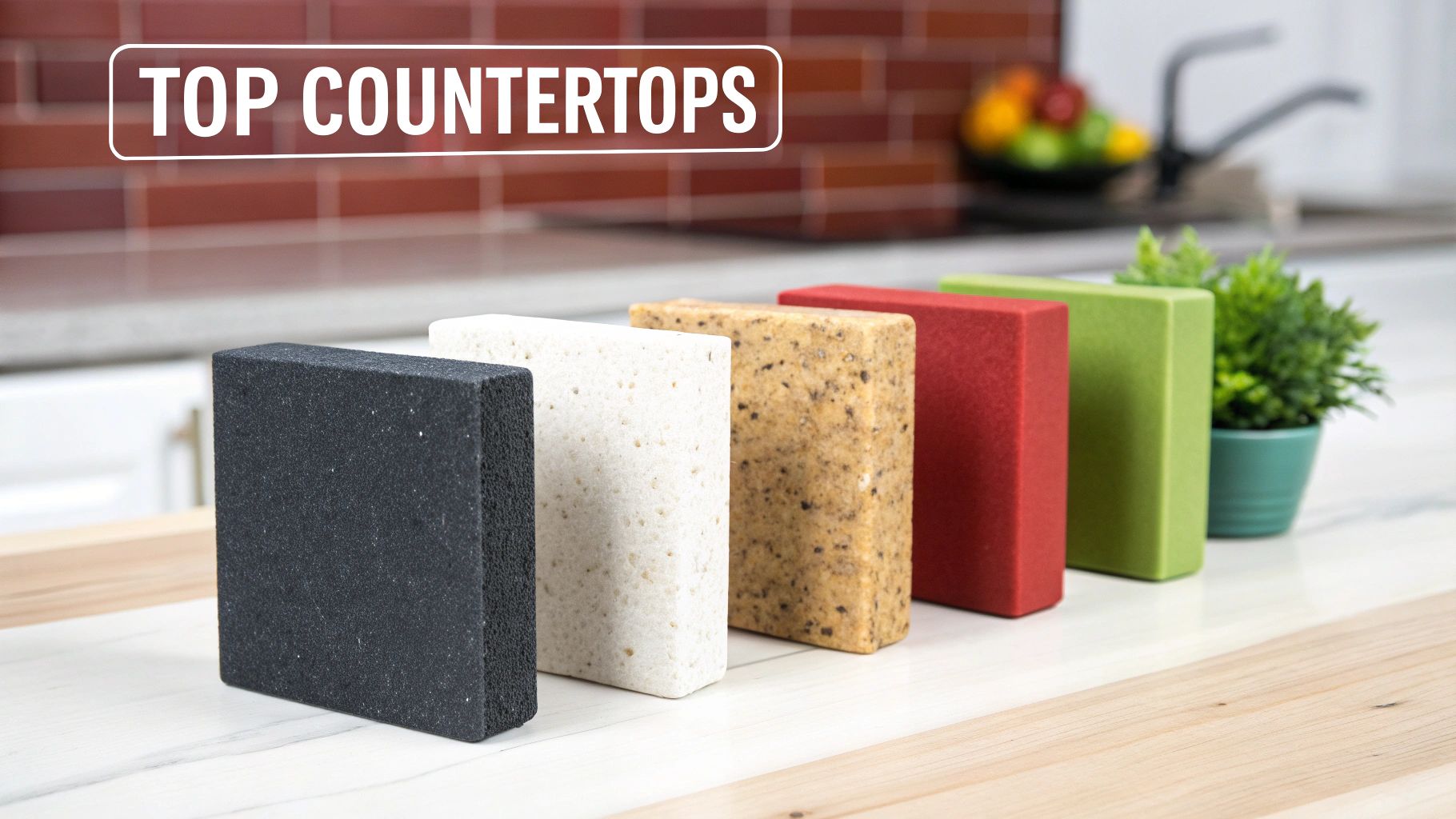
We're talking about everything from spilled coffee and sizzling pans to the constant wear and tear of meal prep. Understanding these subtleties is the key to making a choice you'll still love years down the road, not just on the day of installation.
Granite: The Timeless Natural Stone
For decades, granite has been the gold standard in high-end kitchens, and for good reason. Every single slab is a unique piece of art, quarried directly from the earth. This means no two granite countertops are ever truly identical, a huge draw for homeowners wanting a one-of-a-kind centerpiece for their kitchen.
Its performance is just as compelling. Granite is one of the most heat-resistant materials you can buy; you can set a hot pot right on the surface without a second thought. It’s also incredibly hard, making it tough to scratch with knives or everyday kitchen tools.
The catch? Granite is a porous stone. Without a proper seal, it can soak up liquids like a sponge, leading to stubborn stains from wine, oil, or juice. Modern sealants are fantastic, but they do need to be reapplied—typically every one to three years, depending on the specific stone and how you use your kitchen. This is a non-negotiable step if you want to keep it looking its best.
Key Insight: While some granite varieties have absorption rates as low as 0.06%, making them less absorbent than even some engineered stones, sealing is still considered essential. It's the best insurance policy against an accidental spill becoming a permanent mark.
Quartz: The Engineered Powerhouse
Engineered quartz has stormed the market, directly challenging natural stone's long-held dominance. Unlike granite, quartz countertops are a manufactured blend, typically around 90-93% ground natural quartz combined with 7-10% polymer resins and pigments. The result is an incredibly durable, non-porous surface.
That non-porous nature is its biggest selling point. It never needs to be sealed and is almost impossible to stain. This makes quartz a dream for busy families or anyone who puts low maintenance at the top of their list. A simple wipe with soap and water is all it takes for daily care. The manufacturing process also unlocks a massive range of consistent colors and patterns, from pure whites to designs that beautifully mimic natural marble or concrete.
This consistency is a huge advantage for large kitchens that need multiple slabs, as it guarantees a perfect match without the natural variations of stone. In fact, its popularity is booming, with projections showing engineered stone will capture around 30% of the global kitchen countertop market by 2031, according to market analysis from Valuates Reports.
Quartz does have an Achilles' heel, though: heat. The resins in its composition can be damaged by high temperatures. Placing a screaming-hot pan directly from the stove onto a quartz surface can cause permanent discoloration or even cracking. Using trivets is an absolute must. It's also not as UV-resistant as natural stone, which makes it a poor choice for outdoor kitchens where the sun can cause fading over time.
Marble: The Luxurious Classic
Nothing whispers "luxury" quite like marble. Its soft, luminous quality and elegant, sweeping veins have made it a symbol of timeless beauty for centuries. For those who prioritize aesthetics above all else, marble is often the only option that will do. Bakers also adore its naturally cool surface, which is perfect for rolling out pastry and dough.
But all that beauty comes at a price, and I don't just mean the cost. In a kitchen, marble is high-maintenance. It's a relatively soft, porous stone made of calcite, which leaves it vulnerable to scratching, chipping, and staining. Even more critically, it's extremely sensitive to acid.
Common Culprits for Marble Damage:
- Etching: Acidic things like lemon juice, vinegar, wine, or even tomatoes will react with the stone, dissolving a microscopic layer and leaving a dull, whitish mark called an "etch." Sealers can help prevent stains, but they can't stop etching.
- Staining: Because it’s porous, spills that aren’t wiped up immediately will sink in, leaving a permanent stain. You have to be diligent.
- Bruising and Chipping: Drop a heavy can or pan, and you might get a "stun"—a bright white mark just under the surface—or an outright chip on the edge.
Homeowners who choose marble often do so with the full understanding that it will age and develop a patina. They embrace the etches and marks as part of the stone’s evolving story. If you need a surface that stays flawless, marble is probably not for you.
Laminate: The Budget-Friendly Champion
Today’s laminate is a world away from the countertops of the 70s. Modern high-pressure laminates (HPL) offer a truly staggering array of designs, including incredibly convincing lookalikes of stone, wood, and concrete, all at the lowest price point you'll find. For a budget-conscious remodel, laminate provides maximum style for minimum investment.
It's also surprisingly tough in some respects. Laminate is completely non-porous, so it resists stains and is a breeze to clean. There's no sealing or special care required beyond a simple wipe-down.
The main weaknesses are heat and scratches. A hot pan will melt the surface, leaving a permanent scar, and a wayward knife will slice right through the decorative layer. Water can also be its undoing. If moisture finds its way into the particleboard core through a bad seam or a nicked edge, the material will swell and delaminate. This is why undermount sinks are a no-go with laminate.
Butcher Block: The Warm and Natural Choice
Butcher block countertops bring an undeniable warmth and organic charm to a kitchen. Made from pieces of wood bonded together, they offer a soft, forgiving surface that’s easy on your dishes and quiet to work on. A huge part of the appeal is the ability to sand down and re-oil the surface, effectively erasing scratches and stains and renewing the countertop throughout its life.
How it performs, however, depends entirely on the finish and your commitment to maintenance.
- Oiled Finish: A food-safe mineral oil finish lets you chop directly on the wood. The trade-off is that it offers very little protection against stains and water. You'll need to reapply the oil frequently—sometimes as often as once a month—to keep the wood from drying out, cracking, or absorbing spills.
- Sealed Finish: Applying a varnish or polyurethane creates a durable, protective film that's great against stains and water. But, you can no longer use it as a cutting surface, and if you scratch that finish, the repair is much more involved than just rubbing on some more oil.
Wood can also be scorched by hot pans and dented by heavy impacts. Here in Southwest Michigan, humidity is another factor. Wood naturally expands and contracts with moisture changes in the air, which can put stress on seams over time if the countertop wasn't installed and maintained perfectly.
Stepping Up: A Look at Specialty and Luxury Countertops
While you'll see granite and quartz in most kitchens, there's a whole other world of materials out there for homeowners who want something truly unique. When you're after a specific look or performance, options like soapstone, concrete, and stainless steel enter the conversation.
These aren't just work surfaces; they're statement pieces that define the character of a room. But because they're less common, you need to understand exactly what it's like to live with them day-to-day.
Soapstone: The Understated Classic
Soapstone is a natural stone with a soft, almost velvety feel and a deep, moody color palette, from light gray to a rich, dark charcoal. It's made mostly of talc, which makes it chemically inert. That’s a huge plus—spill some lemon juice or red wine, and it won't etch the surface like it would on marble. It's also incredibly dense and non-porous, so it's naturally antibacterial and stain-resistant without ever needing a sealer.
The defining trait of soapstone is its softness. It’s at the very bottom of the Mohs hardness scale, which is just a fancy way of saying it will scratch and ding. For people who love soapstone, this isn't a flaw; it's the whole point. Over the years, the surface develops a beautiful patina that tells the story of every meal cooked. You can easily buff out minor scratches with sandpaper, and a regular wipe-down with mineral oil will darken the stone, hide small marks, and deepen its color.
Real-World Scenario: Imagine an old European farmhouse kitchen. The homeowner would love soapstone because it ages gracefully. They see the small nicks from cast iron pans not as damage, but as character that makes the kitchen feel authentic and lived-in, not sterile and new.
Concrete: The Industrial Chameleon
If you want ultimate customization, concrete is your answer. It's poured and formed right to your kitchen's specs, so you can get nearly any color, embed interesting things like recycled glass or stones, and create any shape you can dream up. This gives you a seamless, industrial-chic look that's impossible to get with a standard stone slab.
The catch is that concrete is porous by nature. It needs a high-quality sealer, applied meticulously, to keep it from staining. It's also known for developing hairline cracks over time as it cures—a feature that some people love for its industrial charm, but others see as a major defect. Getting it right requires a true artisan, so the skill of your installer will make or break the final product and its cost.
Stainless Steel: The Professional's Pick
There's a reason you see stainless steel in every professional kitchen. This material is the undisputed champion of hygiene and heat resistance. It's completely non-porous, nothing can stain it, and you can set a ripping-hot pan directly on it without a second thought. For a serious home cook, that kind of performance is hard to beat.
The trade-offs are mostly about aesthetics and daily life at home. Stainless steel will get scratched—it’s inevitable. Over time, that network of fine scratches creates more of a matte look. It also shows every single fingerprint and smudge, so you'll be wiping it down constantly. It can be noisy when you set down pots and pans, and it can give the kitchen a cold, clinical vibe if you don't balance it with warmer materials. It’s a fantastic choice for a hardworking island or a dedicated prep zone, but can feel a bit intense if used for every countertop in the kitchen.
Matching Countertop Materials to Your Lifestyle Needs
The best countertop isn't just a beautiful slab you pick from a showroom; it's a partner in your daily life. A material’s real value shows up in how it handles the pressures of your specific household. This guide moves past the technical specs to look at real-world situations, making sure the choice you make is one you'll love for years, not just on the day it's installed.

Let's break down how different lifestyles call for different strengths, so you can picture exactly how each surface will hold up in your home.
For the Busy Family with Young Children
In a home buzzing with activity, countertops face a daily gauntlet of spills, frantic meal prep, and the occasional smack from a toy or dropped dish. For this environment, durability, stain resistance, and low maintenance are non-negotiable.
-
Top Choice: Quartz
Engineered quartz is the undisputed champion here. Its non-porous surface means you don't have to panic over spilled grape juice or spaghetti sauce, because they can't seep in and leave a permanent stain. Best of all, it never needs sealing, making it a true wipe-and-go surface that busy parents will love. It’s also incredibly scratch-resistant, holding up to homework projects, dragging canisters, and general daily chaos. -
Material to Reconsider: Marble
As beautiful as it is, marble is the exact opposite of what a high-traffic family kitchen needs. It’s a soft, porous stone made of calcite, which means it will easily scratch, stain, and "etch" (those dull spots caused by acidic things like lemon juice or vinegar). The constant worry and care it demands just isn't practical for a family on the move.
Key Takeaway: For a family-first kitchen, always put performance before prestige. A surface that erases worry and cuts down on cleanup time is far more valuable than one that requires constant babysitting.
For the Passionate Home Baker and Chef
For anyone who treats their kitchen like a personal workshop, the countertop is a fundamental tool. The perfect surface has to stand up to heat, shrug off stains from bold ingredients, and provide a truly functional prep space.
-
Top Choices: Stainless Steel and Granite
There's a reason professional chefs swear by stainless steel—it's practically indestructible. It's completely non-porous, laughs at stains, and you can put a searing-hot pan directly on it without thinking twice. For the serious home cook, that kind of utility is hard to beat. In the same vein, granite offers fantastic heat resistance and is tough to scratch, making it a workhorse for heavy prep. -
Ideal for Pastry: Marble or Soapstone
Bakers have a different set of needs. Marble is famous for staying naturally cool to the touch, which is a dream for working with fussy doughs for pastries and biscuits. While its high-maintenance nature is a downside for the main kitchen, adding a dedicated marble slab to an island can be a brilliant compromise. Soapstone is another great pick; it also stays cool and is non-porous, so it won’t hold onto bacteria or absorb oils from dough.
For the Style-Conscious Entertainer
If your kitchen is the social heart of your home, you're likely focused on aesthetics and making a statement. You want a material that wows your guests but can also handle the occasional red wine spill during a party.
-
Top Choices: Quartzite and High-End Quartz
Quartzite gives you the dramatic, one-of-a-kind veining of marble but with far better durability. It’s a much harder and less porous natural stone, delivering that show-stopping look without the constant upkeep marble demands. Many modern quartz designs also do a stunning job of mimicking exotic stones, giving you a high-impact visual with all the practical perks of an engineered surface. -
An Option for the Bold: Concrete
For a truly custom, industrial-chic statement, nothing beats concrete. It can be tinted to any color and molded into any shape, creating a seamless and entirely unique centerpiece for your kitchen. It does require diligent sealing to keep stains at bay, but for those seeking a one-of-a-kind look, its ability to develop a unique patina over time is part of the appeal.
Navigating Your Countertop Installation
https://www.youtube.com/embed/alqYhdH6NWk
You’ve finally picked the perfect countertop material—that’s a huge step! But the journey from slab to stunning kitchen isn't quite over. The quality of your installation is just as important as the material you chose, and getting it right comes down to careful planning and finding the right team.
A truly professional installation is what makes the difference between a good kitchen and a great one. It's the key to how your countertops will look, perform, and hold up for years to come.
The process kicks off with getting good measurements. Your installer will eventually come out to create a precise digital or physical model called a template, but you can get a much more accurate initial quote by giving them a detailed sketch with rough dimensions first. This simple step helps you compare bids apples-to-apples and avoids sticker shock later.
Vetting Your Fabricator and Installer
Choosing your fabricator is probably the single most critical decision you'll make in this entire process. A great fabricator is more than just a person who cuts stone—they're a craftsperson who knows how to handle the unique quirks of each material to get the best possible result. Here in Southwest Michigan, your best bet is to find a company with deep local roots and a portfolio you can actually see and touch.
When you start talking to potential installers, have a few key questions ready:
- Seam Placement: Ask them flat out: "Where will the seams go?" An experienced pro will work to minimize seams and hide them in the least obvious spots, often artfully matching the stone's veining to make them practically disappear.
- Edge Profiles: What edge profiles do they offer? Get a list (e.g., eased, beveled, ogee) and find out how they affect the price, as more complex edges will add to the cost.
- Sink and Cooktop Cutouts: How do they handle cutouts? You're looking for an answer that involves precision and a smooth finish to guarantee your appliances drop in perfectly.
Expert Insight: Don't be shy about asking to visit their fabrication shop. Seeing their operation and the quality of their finished pieces up close tells you everything you need to know about their standards. A company that does good work will be excited to show it off.
Understanding the Project Timeline
Knowing the play-by-play for installation helps you manage your own expectations and coordinate with other contractors, like your plumber or electrician. While timelines can vary, the process almost always follows the same basic steps.
Typical Installation Sequence:
- Templating: This happens after your base cabinets are fully and permanently installed. The fabricator will visit your home to create a perfect template of your layout. It's the most critical measurement of the whole job.
- Slab Layout (Optional but Recommended): If you've chosen a natural stone with a lot of movement, like granite or marble, ask if you can be there for the slab layout. This lets you point out exactly which parts of the stone's beautiful veining you want to feature.
- Fabrication: The team takes the template to their shop to cut, shape, and polish your slabs. This is where the magic happens, and it usually takes one to two weeks.
- Installation Day: The crew will bring the finished pieces to your home for the final install. Fair warning: it's a loud, dusty, and meticulous process that can take most of the day.
- Plumbing and Final Connections: Hold off on calling the plumber just yet. You'll need to wait 24-48 hours for all the adhesives and silicone to fully cure before your sink and faucet can be reconnected.
Frequently Asked Questions About Countertop Materials
It's completely normal to have a few last questions before you pull the trigger on a new countertop. After walking hundreds of Southwest Michigan homeowners through this process, we've heard them all.
Let's tackle the big ones so you can feel confident in your final choice.
What Is the Best Countertop Material for Resale Value?
When it comes to resale, you can't go wrong with granite or quartz. They're the gold standard for a reason. Homebuyers see them and immediately think "quality" and "durability," which can make your kitchen a major selling point. They offer a fantastic return on investment.
Lately, quartzite has also become a huge draw, giving you that stunning marble aesthetic without the notorious maintenance headaches. The trick is to stick with a classic, neutral color and pattern that won't turn off potential buyers with a style that's too specific to your own taste.
A pristine, low-maintenance countertop sends a powerful message to buyers: this kitchen is move-in ready. For many, that peace of mind is just as valuable as the material itself.
How Do I Clean and Maintain My New Countertops?
The "right way" to clean your countertop depends entirely on what it's made of. There's no one-size-fits-all answer, so here's a quick cheat sheet for the most common materials:
- Quartz: This one's easy. A soft cloth, a little bit of mild dish soap, and water are all you need. Just steer clear of abrasive pads or harsh chemicals, which can take the shine off the surface over time.
- Granite: For daily wipe-downs, use a pH-neutral cleaner or simple soap and water. The big thing with granite is sealing. Plan on resealing it every 1-3 years to keep it non-porous and resistant to stains.
- Marble: Spills are the enemy here, especially anything acidic like wine, coffee, or lemon juice. Blot them up immediately. Always use a gentle cleanser and never reach for vinegar—it will etch the stone.
- Butcher Block: If you have an oiled finish, a damp cloth is fine for cleaning, and you'll want to re-apply a food-safe mineral oil about once a month to keep it from drying out. If it’s sealed with a topcoat, treat it like wood furniture and just use mild soap and water.
Which Countertops Are the Most Eco-Friendly?
If sustainability is on your mind, you have some great options. Butcher block is a fantastic choice, especially if it's made from reclaimed wood or sourced from sustainably managed forests. We're also seeing some really cool countertops made from recycled glass or paper composites that not only look unique but also keep waste out of the landfill.
Soapstone is another heavy hitter in the eco-friendly category. It's a completely natural stone that's quarried with a lighter environmental footprint than many other options and lasts practically forever.
Ready to turn your vision into a reality? The team at Trademaster Construction specializes in guiding Southwest Michigan homeowners through every step of their kitchen remodel. Start planning your project today.

