
Here’s the thing: it all boils down to one simple truth. Granite is 100% natural stone, pulled from the earth with patterns that are truly one-of-a-kind. Quartz, on the other hand, is an engineered material, designed for consistent color and incredible durability.
So, the real question is what you value more—the wild, unique beauty of mother nature, or the predictable, low-maintenance performance of modern engineering?
Getting to the Heart of the Matter
When we're helping homeowners here in Southwest Michigan plan a kitchen or bath remodel, the countertop choice is always a huge conversation. The "quartz vs. granite" debate comes up almost every time, and for good reason. Both are fantastic, premium materials, but they’re far from the same.
To really get it right, you have to start with where they come from.
Granite is literally cut out of a mountain in massive blocks, then sliced into slabs. Every single slab has a story, with its own mineral makeup, veining, and color swirls. When you choose granite, you're installing a piece of the earth—a functional work of art that no one else will ever have. That natural origin is its biggest draw, but it’s also why granite is porous and needs a bit of care.
Quartz countertops are born in a factory. They're made by combining about 90-95% crushed natural quartz (one of the hardest minerals on earth) with polymer resins and pigments. This process results in a completely non-porous surface that is tough as nails and perfectly consistent in its look. This predictability is a huge part of its appeal, and the market shows it. The global quartz countertop market soared to USD 85.63 billion in 2024, and it's not slowing down. If you're curious about the trends driving its popularity, you can dig into this detailed industry analysis.
I often tell clients to think of it this way: granite is found, while quartz is formulated. That single difference impacts everything from how it looks in your kitchen to how you’ll take care of it for years to come.
Here’s a quick head-to-head comparison to get us started:
| Feature | Quartz Countertops | Granite Countertops |
|---|---|---|
| Material Type | Engineered Stone | 100% Natural Stone |
| Appearance | Consistent, uniform patterns | Unique, one-of-a-kind veining |
| Maintenance | Non-porous, no sealing needed | Porous, requires regular sealing |
| Durability | Extremely hard and stain-resistant | Very durable but can stain if unsealed |
| Customization | Wide range of colors and patterns | Limited to naturally occurring colors |
A Detailed Head-to-Head Material Comparison
Once you get past how they’re made, the real differences between quartz and granite show up in your daily life. This is where the "quartz vs granite countertops" decision really matters—not just what they are, but what they’ll be like to live with in your kitchen or bathroom.
Let’s dig into the things that count: how they look, how tough they are, how they handle spills and hot pans, and what it takes to keep them looking great.
This quick flowchart can help you see which material fits your main priority.
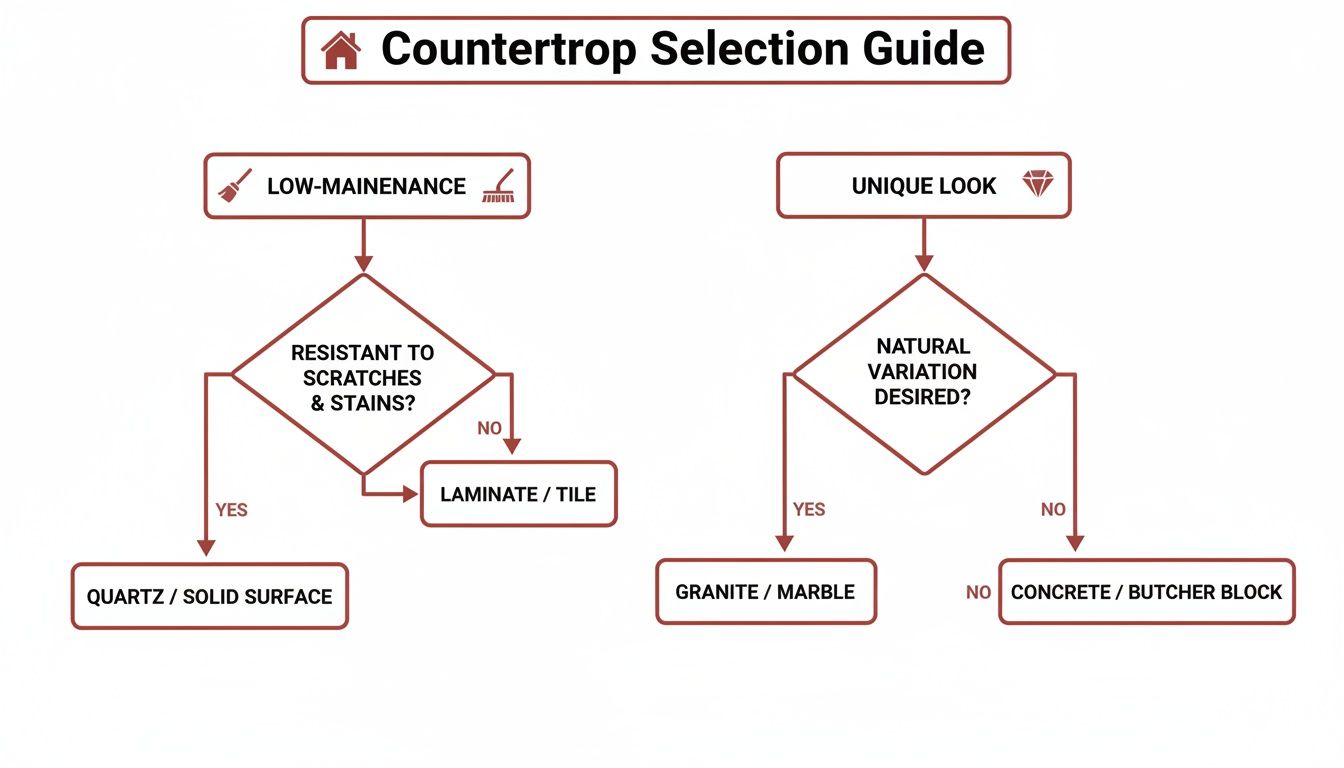
It really boils down to a simple question: are you after a one-of-a-kind natural look, or is easy, stress-free maintenance at the top of your list?
Before diving deep, here’s a quick overview of how these two heavyweights stack up.
Quartz vs Granite At a Glance
This table gives you a snapshot of the key differences, perfect for getting a feel for which material might be the right fit for your Southwest Michigan home.
| Feature | Quartz | Granite |
|---|---|---|
| Composition | Engineered (90-95% crushed quartz, resins) | 100% natural stone, quarried from the earth |
| Appearance | Consistent, uniform patterns and colors | Unique, one-of-a-kind veining and flecks |
| Durability | Extremely hard (Mohs hardness of 7), scratch-resistant | Very durable (Mohs hardness 6-7), strong |
| Heat Resistance | Moderate; can be damaged by direct high heat | Excellent; can handle hot pans directly on the surface |
| Stain Resistance | Non-porous and highly stain-resistant | Porous; requires sealing to prevent stains |
| Maintenance | No sealing required. Clean with soap and water. | Must be sealed on installation and resealed every 1-2 years |
| Cost Range | $60 – $150+ per sq. ft. | $50 – $200+ per sq. ft. |
Now that you've seen the highlights, let's explore these points in more detail.
Appearance and Aesthetic Consistency
How your countertop looks is probably the first thing you—and anyone who visits—will notice. This is where quartz and granite offer two completely different takes on beauty.
Granite’s Natural Artistry
Granite is pure, natural art. Every single slab tells a geological story, with its own unique veining, specks of minerals, and wild color patterns. No two pieces of granite are ever the same. That means your kitchen gets a centerpiece that is truly yours and yours alone.
But that uniqueness can also be a challenge. The sample you fall in love with at the showroom might not look exactly like the slab that arrives for installation. It’s absolutely critical to see and approve the exact slab for your project to make sure there are no surprises.
Quartz’s Engineered Precision
Quartz, on the other hand, is all about control and predictability. Because it’s manufactured, the colors and patterns are incredibly uniform across the entire slab. This is a huge plus for big kitchens, waterfall islands, or any spot where you need seams to be as invisible as possible.
Modern technology has also opened up a massive range of styles. You can find quartz that perfectly mimics marble or concrete, or you can go for a bold, solid color that just doesn't exist in nature. The only trade-off is that it won't have the raw, random beauty you get from natural stone.
Here’s an easy way to decide: Do you prefer a "perfectly imperfect" natural masterpiece or a "flawlessly consistent" modern design? Your gut reaction will probably point you in the right direction.
Durability and Daily Resilience
Both of these materials are famous for being tough, but they handle the chaos of a busy home in different ways.
The Hardness Factor
When it comes to pure hardness, quartz has a slight advantage. It scores a 7 on the Mohs scale of hardness, which makes it harder than many types of granite (which usually land between a 6 and 7). That engineered structure makes it incredibly resistant to scratches from knives, pots, and plates.
Chip and Crack Resistance
While both are strong, their internal structure makes a difference. Granite is a crystalline stone, so a sharp, hard hit—especially on an edge or corner—can sometimes cause a chip. A pro can repair it, but getting a perfect, invisible fix can be tough.
Quartz has a bit more give, thanks to the polymer resins holding it together. This makes it slightly less brittle and better at resisting chips from those everyday bumps and knocks. Plus, its uniform composition means there are no hidden fissures or weak spots like you might find in a natural granite slab.
Heat and Stain Tolerance
Your countertop is a workspace, and it needs to stand up to hot pans, spilled juice, and everything in between. In the great "quartz vs granite" debate, this is one area with some clear-cut differences.
Handling the Heat
Granite is the clear winner here. Forged by incredible heat and pressure deep in the earth, it can take a hot pot right off the stove without flinching. For cooks who are always on the move, this is a massive advantage.
Quartz isn’t quite as heat-proof. The resins that bind the stone particles can be damaged by extreme or sudden temperature changes, which can lead to discoloration or even cracking. You should always use trivets or hot pads for anything coming straight from the oven or stovetop.
Winning the War on Stains
This is where quartz truly excels. Its surface is non-porous, which is a fancy way of saying liquids can't seep in. Spills like red wine, coffee, or oil wipe away clean without a trace. This also makes it incredibly hygienic because there are no tiny pores for bacteria to settle into.
Granite, being a natural and porous stone, is a different story. If it isn't sealed correctly, it will soak up spills, leading to stains that can be a real headache to remove. And that leads us right into our next point: maintenance.
Long-Term Maintenance and Upkeep
How you care for your countertop will be part of your routine for years, so this is a big one. The needs of quartz and granite are completely different, and it's often the deciding factor for many homeowners.
-
Quartz Care Routine: It couldn't be simpler. Clean it with mild soap and water. That's it. Because it’s non-porous, it never needs to be sealed. This set-it-and-forget-it quality is a huge reason for its popularity, especially in busy family homes.
-
Granite Care Routine: Granite asks for a little more commitment. To keep it from staining, it has to be sealed when it’s installed and then resealed every so often—usually once every 1-2 years. The process isn't hard, but it's a chore on your to-do list that you can’t skip. For more on what it's like to live with it, check out this guide on understanding the pros and cons and true cost of granite countertops.
In the end, it’s all about what matters most to you. If you adore the wild, natural beauty of stone and don't mind a small annual task, granite is a fantastic choice. If you're looking for consistent style, superior stain resistance, and zero long-term maintenance, quartz is probably the perfect fit.
Unpacking the True Cost and Long-Term Value
When you're standing in a showroom comparing quartz and granite, the price tag on the slab only tells you half the story. To really understand the financial picture, you have to think like an investor and look at the total cost of ownership over the entire life of your kitchen.
The initial investment for both materials can look surprisingly similar at first. But a whole host of factors—like how rare a particular stone is, how tricky it is to cut, and the specifics of the installation—can make the final price swing wildly. Getting a handle on these variables is the first step to setting a realistic budget for your Southwest Michigan home.
The Upfront Investment: More Than Just the Material
At first glance, the price ranges for quartz and granite overlap so much it can be tough to draw a clear line. That’s because you’re not just buying a slab of stone; you’re paying for a complete service that takes it from the warehouse to your finished kitchen.
Here’s a general breakdown of what you can expect for a fully installed countertop:
- Granite Countertops: You’ll typically see prices from $40 to $100 per square foot. Common, readily available colors will be on the lower end, while rare, exotic slabs with incredible movement and veining can easily climb much higher.
- Quartz Countertops: The usual range is between $60 and $120 per square foot. The final cost is driven by the brand, the complexity of the pattern (think realistic marble veining), and the finish you choose.
These figures cover the stone itself, the precise digital templating, fabrication (cutting sink holes, shaping edges), and the final installation. It's worth noting that fabricating granite can sometimes lead to 10-15% more material waste due to natural fissures or weak spots in the slab, which can subtly bump up the project's total cost. On the other hand, the engineered consistency of quartz can sometimes reduce fabrication and installation time by up to 20%, potentially lowering labor costs.
Calculating the Cost Over Time
This is where the financial paths of quartz and granite really start to diverge. The maintenance needs of each material directly impact your wallet for years after the installation crew has gone home. The "cheaper" option today might not be the most cost-effective in ten years.
Granite’s biggest long-term cost is its upkeep. As a porous natural stone, it absolutely needs to be sealed regularly to fend off stains and keep bacteria from seeping in. This is a chore you’ll have to do yourself or pay a professional for every year or two.
The real cost of granite isn't just the purchase price; it's the ongoing commitment. Forgetting to seal your granite just once can lead to a permanent stain from a single spill of red wine or olive oil, potentially requiring costly professional restoration.
Quartz, however, is a different beast entirely. It’s engineered to be non-porous from the start, which means it has virtually zero long-term maintenance costs.
- No Sealing, Ever: You will never spend a dime or an afternoon sealing a quartz countertop.
- Simple Cleaning: A little soap and water is all you need. No special stone cleaners required.
- Built-in Stain Resistance: Its solid surface naturally repels common kitchen messes like coffee, juice, and oil, saving you from expensive stain removal treatments down the road.
Thinking about the long-term value of your countertop is a core principle in home building. If you're interested in how professionals maximize value in projects, the concept of value engineering in construction offers a great framework for making smart decisions.
Resale Value: A Smart Investment for Your Home
Finally, let’s talk about how your countertop choice impacts your home’s value when it’s time to sell. Both quartz and granite are seen as major upgrades over laminate, but the market is clearly shifting. Today’s buyers are drawn to durable, low-maintenance surfaces.
While quartz often has a higher initial cost, its maintenance-free nature can save $200-$500 every year on the sealing and potential repairs that granite might need. Over a 20-year lifespan, that adds up. Market data suggests that quartz often delivers a 15-20% higher return on investment in resale value, simply because modern homebuyers want beautiful homes that don't come with a long to-do list.
In the end, while a basic granite might have a lower entry price, quartz almost always proves to be the smarter long-term financial bet. It delivers lasting beauty without the recurring costs and hassle, making it a savvy choice for any homeowner looking to invest wisely.
Real-World Scenarios: Which Countertop Fits Your Life?
Choosing between quartz and granite isn’t just about specs on a fact sheet. It's about how the material fits into the actual rhythm of your life. To get past the technical details, let's drop these countertops into a few real-world situations you’d find right here in Southwest Michigan. When you see how each surface handles the specific pressures of your household, the right choice becomes much clearer.
We'll look at three common scenarios: the sometimes-chaotic hub of a busy family, the hardworking kitchen of a serious home cook, and the calm, style-forward bathroom vanity. Each of these environments will highlight different strengths and weaknesses, making the quartz vs. granite decision a whole lot easier.
The Busy Family Kitchen
Picture a typical weekday morning. Kids are grabbing their own breakfast, which means spilled juice and smeared jelly are practically guaranteed. In the evening, the counter is a landing zone for homework projects, complete with stray marker streaks, hurried meal prep with bowls sliding around, and maybe a tipped-over glass of red wine after everyone’s in bed. This kitchen isn't a showroom; it's the command center.
In this high-traffic, high-mess environment, stain resistance and effortless cleanup are non-negotiable.
- Spills Happen: The non-porous nature of quartz means that grape juice, coffee, and even that rogue permanent marker won't sink in. A simple wipe with soap and water is all it takes to make it look new again, which is priceless for peace of mind.
- Built for Daily Wear: From dragged ceramic bowls to dropped forks, the surface has to stand up to daily abuse. The engineered hardness of quartz gives it an edge here, shrugging off the kind of minor impacts that are just part of life in a busy family kitchen.
Granite can certainly work, but its natural porosity is a real liability in this setting. A missed spill on an imperfectly sealed counter could easily become a permanent stain. Plus, remembering to seal it every year is just one more thing on an already long to-do list.
Recommendation for the Busy Family: Quartz is the clear winner here. Its mix of fantastic stain resistance, durability, and zero-maintenance upkeep makes it the ideal, stress-free choice for a kitchen that sees constant action.
The Gourmet Cook’s Workspace
Now, let's imagine a kitchen that belongs to a passionate home chef. This isn't just a kitchen; it's a workshop. High heat is a constant, and sharp knives are always in play. Flour gets everywhere, olive oil splatters, and hot pans are moved quickly from the stove to the counter.
Here, the priorities pivot to heat tolerance and resilience under serious culinary pressure. This is a totally different battlefield in the quartz vs. granite showdown.
This is where granite truly shines. Forged deep within the earth, it's exceptionally resistant to heat. You can place a hot pan directly on its surface without a second thought—a massive convenience when you're juggling multiple steps in a complex recipe. And while you should never use it as a cutting board, its natural hardness is formidable against accidental nicks and scratches from prep work.
Quartz, on the other hand, has an Achilles' heel: high heat. The resins that bind the quartz particles together can be damaged by thermal shock. A hot pan placed directly on the surface can cause discoloration or even cracking. This means the home chef has to be disciplined about using trivets and hot pads every single time, without exception.
Recommendation for the Gourmet Cook: Granite takes the lead. Its incredible heat tolerance offers a level of freedom and functionality that serious cooks will appreciate every single day. The need for occasional sealing is a minor trade-off for the ability to handle the intense demands of a culinary workspace without worry.
The Elegant Bathroom Vanity
Finally, let's step into the bathroom. This space is all about creating a clean, serene, and visually pleasing retreat. The countertop here needs to tie the room’s design together while standing up to toothpaste, makeup, and constant moisture. The focus is on aesthetics, hygiene, and low-maintenance luxury.
For a bathroom vanity, especially a long one or a double-sink setup, a consistent appearance is often a top priority.
- Visual Uniformity: Quartz delivers predictable, uniform patterns. This makes it easy to achieve a seamless, sleek look that coordinates perfectly with your tile, fixtures, and cabinetry for a polished and intentional design.
- A More Hygienic Surface: The bathroom is a humid environment where you really don't want bacteria to thrive. Because quartz is non-porous, it prevents the growth of mold, mildew, and germs, making it an incredibly clean and safe choice for this space.
Granite can be beautiful in a bathroom, but its natural variations can sometimes feel a bit too busy or overwhelming in a smaller, more tranquil room. More importantly, its porous nature requires diligent sealing to keep water and bacteria from seeping in—a critical task in such a damp environment.
Recommendation for the Bathroom Vanity: Quartz is the superior choice. Its clean aesthetic, hygienic properties, and inherent resistance to moisture make it the perfect material for creating a beautiful, low-maintenance bathroom sanctuary.
Installation and Environmental Impact: From Quarry to Kitchen
When you're choosing between quartz and granite, it’s easy to get caught up in colors and patterns. But what about the journey that stone takes to get to your kitchen? The installation process and the environmental story behind each material are important pieces of the puzzle that can steer your decision.
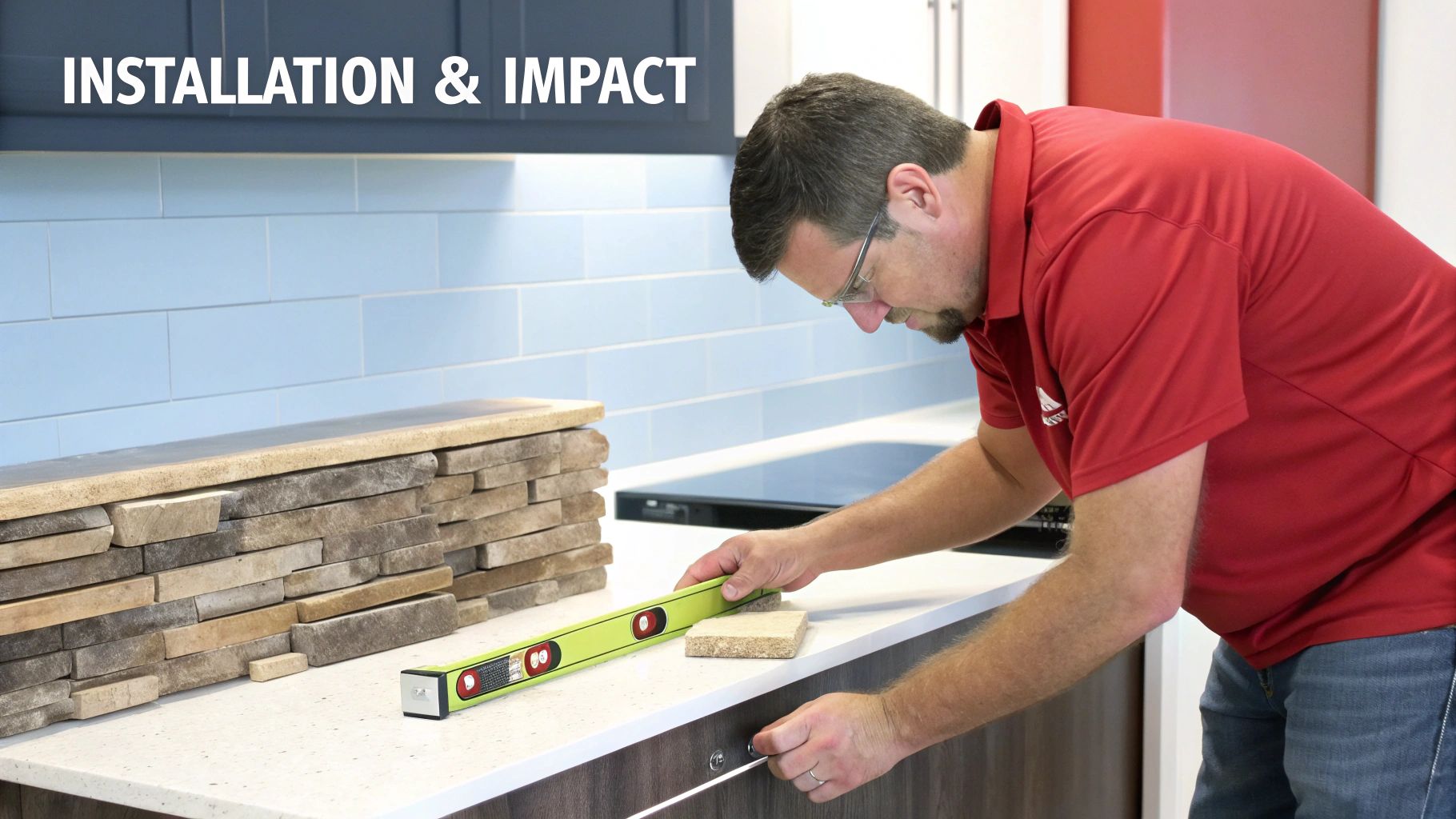
Both materials are heavy and unforgiving, making professional installation an absolute must. The process involves more than just heavy lifting; it's a craft that requires precision from start to finish. While the general steps are the same, the nature of each material introduces some subtle but important differences.
The Installation Journey: Templating to Turnover
Choosing granite or quartz means signing up for a professional installation that guarantees a flawless fit. This isn't a DIY weekend project; it's a multi-step, expert-led process.
- Templating: It starts with a technician creating an exact pattern of your cabinets. They'll mark out every detail, from the sink and cooktop cutouts to electrical outlets.
- Fabrication: This template heads to the workshop, where your chosen slab is cut to size using powerful water jets and saws. This is also when your desired edge profile is shaped.
- The Big Day: The finished countertop pieces are brought to your home. The crew levels them, secures them to your cabinets, and expertly joins any seams with a durable, color-matched epoxy.
This is where granite's unique character can add a layer of complexity. Because it's a natural stone with fissures and unpredictable patterns, installers have to be extra careful during handling. They also need a good eye to align the grain across seams for a fluid, natural look.
Quartz, on the other hand, is much more predictable. Its manufactured consistency makes the fabrication and seam-matching a more straightforward affair, which can sometimes result in a quicker, smoother installation day.
The consistency of quartz is a huge asset for tricky designs, especially long stretches of countertop or dramatic waterfall islands. Getting a virtually seamless look is far easier when the pattern is uniform—a small detail that makes a big difference in a high-end kitchen.
What About Sustainability?
For homeowners in Southwest Michigan who are thinking green, the countertop's origin story is a big deal. Both quartz and granite come with their own set of environmental pros and cons.
Granite: The All-Natural Option
On the surface, granite seems like the obvious eco-friendly choice. It’s a 100% natural material, after all. But its path from deep within the earth to your home leaves a footprint.
- Quarrying: Carving huge blocks of stone out of a mountain is a massive, energy-heavy operation.
- Transportation: Many of the most beautiful and popular granite slabs are shipped halfway across the world from places like Brazil, India, or Italy. That long-distance travel adds up to a significant carbon footprint.
Quartz: The Engineered Alternative
As a man-made product, quartz is typically composed of 90-95% crushed natural quartz held together with polymer resins. This process creates some interesting environmental angles.
- Recycled Content: Many top quartz brands are now making slabs with recycled materials like crushed glass, mirrors, and leftover stone, which helps divert waste from landfills.
- Shorter Journeys: While quartz is manufactured, the raw mineral is abundant globally. Some companies make a point of sourcing materials closer to their factories, cutting down on those long-haul transportation emissions.
The bottom line is that neither material is perfect. Granite's impact is tied to the energy of quarrying and shipping, while quartz's is linked to its manufacturing process. However, for those focused on sustainability, the option to choose a quartz countertop with recycled content is a really compelling advantage.
Alright, let's wrap this up. How do you actually make the final call between quartz and granite? It really boils down to what you value most. There’s no universal "best" choice here—only what’s best for your kitchen, your family, and your lifestyle.
Think about it this way. All the details are in front of you, but the decision comes down to three straightforward questions:
- Maintenance: Honestly, how much time do you want to spend on upkeep? Are you a "seal it and forget it" person, or does routine care not bother you?
- Aesthetics: Do you want a one-of-a-kind, natural masterpiece with unpredictable veining, or do you prefer a consistent, uniform look you can count on?
- Budget: Is the primary goal to keep initial costs down, or are you thinking more about long-term, worry-free value?
Your gut answers to these questions will almost always point you to the right countertop for your home.
So, What's Next?
Once you have a good idea of which way you're leaning, it’s time to get out of the research phase and into the real world. Here’s how to turn your decision into a reality for your Southwest Michigan home.
- Grab Some Samples: Don't just look at pictures online. Bring physical samples of both quartz and granite into your kitchen. See how they look next to your cabinets and in your home's unique lighting at different times of the day.
- Get a Real Quote: Ballpark figures are helpful, but you need a precise, installed quote based on your kitchen's actual measurements and the specific slab or design you love.
- Talk to a Pro: Have a conversation with a local remodeling expert. They've seen it all and can offer advice tailored specifically to your space, your project, and the realities of our local market.
Taking these practical steps is the best way to move forward with confidence. You're not just picking a slab of stone or engineered material; you're choosing the surface that will be the backdrop for countless family meals and memories for years.
Making that final decision on quartz vs granite countertops is a huge step. Now you're ready to take that vision and create a kitchen that’s both beautiful and built for your life.
Frequently Asked Questions About Countertops
Even with all the details laid out, you probably still have a few specific questions bouncing around in your head. That's completely normal. Here are some straight-up answers to the questions we hear most from homeowners around Southwest Michigan as they weigh their granite and quartz options.
Can You Cut Directly on Quartz or Granite Surfaces?
Technically, you could, but you absolutely shouldn't. Think of it this way: your countertop is the stage, not the tool.
Granite is a beast—it's usually harder than your knife's steel. So while you probably won't scratch the stone, you will instantly dull your expensive chef's knife. It's a quick way to ruin a sharp edge.
Quartz is also incredibly scratch-resistant, but it's not invincible. A determined slip with a serrated knife could potentially leave a mark. The bottom line for both? Always use a cutting board. It protects your investment and your cutlery.
What Is the Best Way to Clean Each Countertop?
Cleaning is straightforward for both, but the "don'ts" are where they differ.
-
Quartz: Simple is best. A soft cloth, warm water, and a drop of mild dish soap will handle everyday messes. Since it’s non-porous, you never need to reach for harsh chemicals or abrasive pads—in fact, those can dull its beautiful finish over time.
-
Granite: The same soap and water combination works perfectly for properly sealed granite. The big rule here is to avoid anything acidic. Cleaners with vinegar, lemon juice, or other acids can eat away at the sealer, leaving your stone vulnerable to stains and etching.
Are There Different Quality Grades?
Absolutely, and it's a major factor in the final price.
With granite, "quality" is all about Mother Nature. The grade is based on the slab's rarity, color purity, thickness, and unique features. You'll see them grouped into tiers, from common, entry-level patterns to high-end exotic slabs with breathtaking, one-of-a-kind veining.
For quartz, quality is tied to the manufacturer. Top-tier brands invest heavily in creating hyper-realistic marble patterns, ensuring crystal-clear resin (no cloudiness), and backing their product with solid warranties. The complexity of the design and the brand's reputation play a huge role.
Which Material Better Increases Home Resale Value?
Both quartz and granite are a huge step up from laminate and will definitely boost your home's appeal. Right now, though, quartz seems to have a slight advantage in the market.
Today's buyers are often looking for two things: modern style and convenience. Quartz hits both of those notes perfectly. Its clean look and zero-maintenance durability give it a slight edge in resale value because it’s exactly what busy families are looking for in a move-in ready home.
Ready to see how these materials would look in your own home? The team at Trademaster Construction can guide you through every step, from selecting the perfect slab to a flawless installation. Explore our Inspiration Gallery to get started.

