
Alright, let's get straight to it. What exactly is rectified tile?
In the simplest terms, rectified tile is ceramic or porcelain tile that gets an extra haircut after it comes out of the kiln. This process grinds the edges down to be perfectly straight and uniform. Think of it like a chef meticulously trimming the crusts off a sandwich to get those perfect, sharp lines. The result is a tile that’s incredibly precise in its dimensions.
What Rectified Tile Really Means
Let's use an analogy. Imagine you're baking a batch of drop cookies. They spread out on the baking sheet, and while they're all delicious, no two are exactly the same shape or size. That's a lot like traditional, non-rectified tile. Its edges are slightly rounded and irregular right out of the kiln, which is why it needs wider grout lines to hide those little differences.
Rectified tile, on the other hand, is more like brownies baked in a pan and then cut with a precision knife. Every single piece is identical. That extra step of grinding the edges after firing is what gives rectified tile its signature sharp, 90-degree corners and consistent size.
This diagram does a great job of showing the basic split between the two.
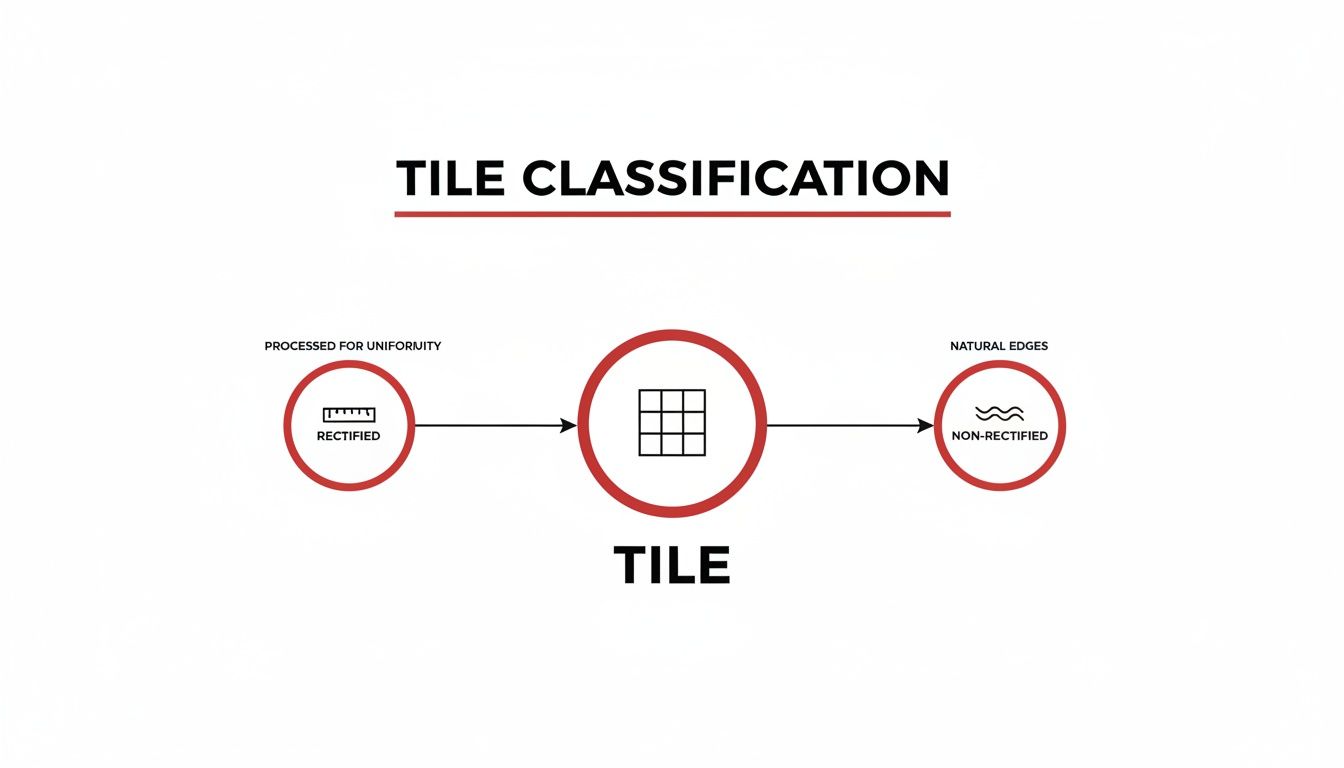
You can see how one path leads to that perfectly uniform, rectified edge, while the other maintains the more natural, "pressed" edge of a traditional tile.
Why This Precision Matters
So, why go through all that extra trouble? Because that precision unlocks a whole different look. The ability to lay tiles so close together—with grout lines as thin as 1/16th of an inch—is what gives rectified tile its high-end, contemporary feel.
This is a big reason why homeowners in Southwest Michigan love it for modern kitchen backsplashes and sleek bathroom floors. It creates an almost seamless surface that makes spaces feel bigger and cleaner.
Quick Look: Rectified vs Non-Rectified Tile
To make things even clearer, here’s a quick side-by-side comparison. It’s a handy way to see the key differences at a glance.
| Feature | Rectified Tile | Non-Rectified (Pressed) Tile |
|---|---|---|
| Edge Finish | Sharp, precise 90-degree angles | Slightly rounded, natural edges |
| Size Consistency | Highly uniform, exact dimensions | Minor variations between tiles |
| Grout Joints | Very thin (1/16" to 1/8") | Wider (3/16" or more) |
| Look & Feel | Modern, seamless, monolithic | Traditional, rustic, or classic |
| Installation | Requires a very flat subfloor | More forgiving of subfloor imperfections |
| Cost | Generally more expensive | More budget-friendly |
Ultimately, choosing between rectified and non-rectified tile comes down to the style you're trying to achieve and your project's specific needs.
The Big Benefits of Going Rectified
For many people, the advantages are well worth the investment. Here’s what you gain:
- A Clean, Modern Aesthetic: Those super-thin grout lines create a continuous look. It’s a game-changer for minimalist designs.
- Easier Cleaning: Let's be honest, nobody likes scrubbing grout. Less grout means less work and a cleaner-looking surface for longer.
- Design Freedom: The uniformity of rectified tiles allows for creative patterns and layouts that just wouldn't work with less consistent tiles.
A quick heads-up on installation: Because these tiles are so precise, there's no room for error. The subfloor has to be perfectly level to avoid "lippage," which is when one tile edge sits higher than its neighbor. This demand for precision often means installation takes longer and can be more expensive. It's always a good idea to get familiar with how much flooring installation costs in general when budgeting for a project like this.
How Precision-Cut Tiles Get Their Sharp Edges
Every tile, whether it ends up rectified or not, starts its life the same way. A specific blend of clay and other natural ingredients is mixed, pressed into a tile shape, and then fired in an intensely hot kiln. This firing process is what makes the tile hard and durable.
But once it comes out of the kiln, the journey for a rectified tile takes a critical turn. This is where the real precision work begins.
The Final Cut: The Rectification Process
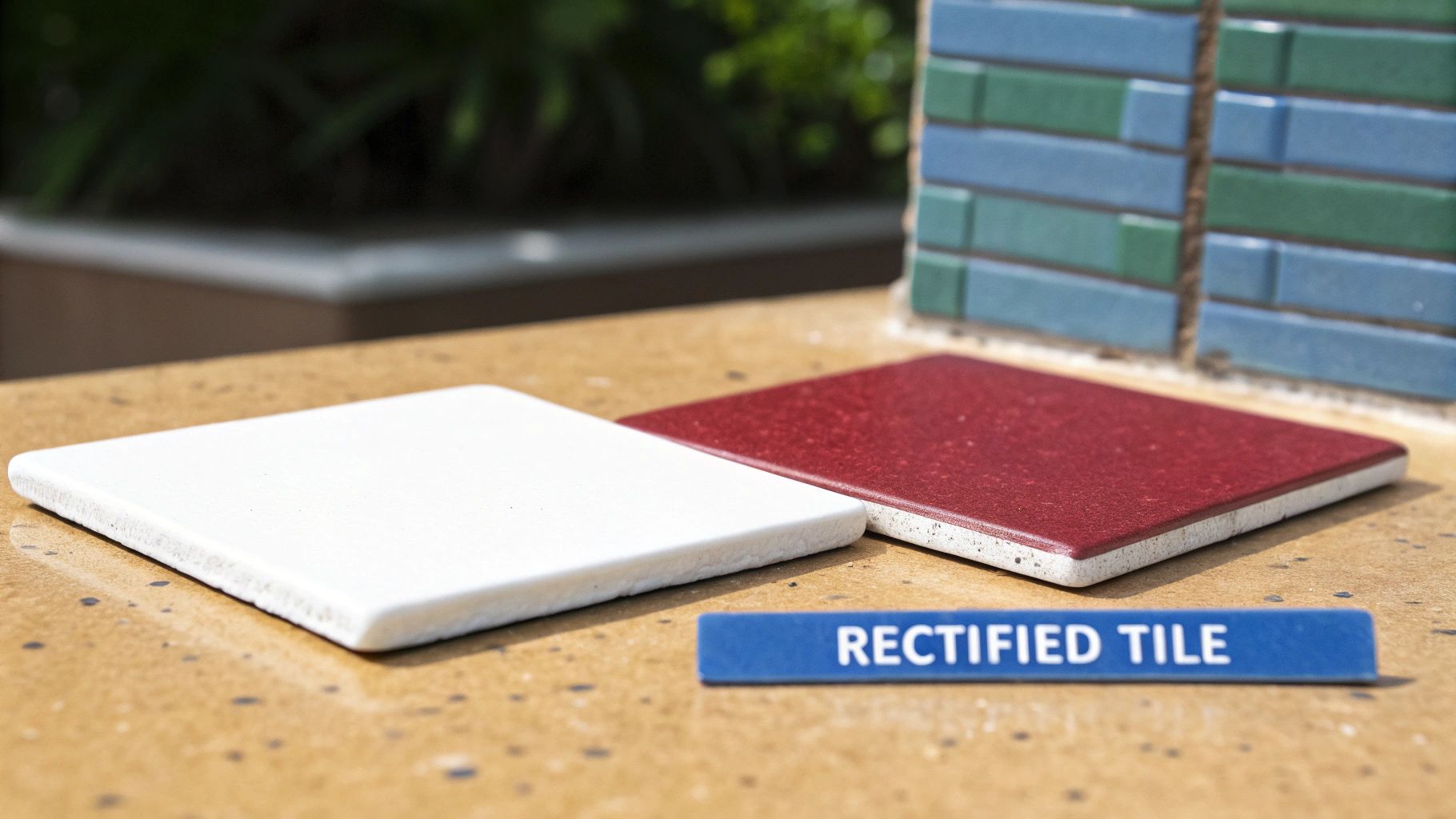
Instead of heading straight to the boxing line, these tiles are moved to a special machine for one last touch. Imagine a master woodworker trimming the edge of a board on a high-end table saw to get a perfectly straight line—it’s the same concept, just with tile.
The machine uses a diamond blade or a grinding wheel to precisely trim down all four edges of the tile. This process is incredibly accurate, creating a sharp and perfect 90-degree angle on every corner.
This mechanical finishing is the one and only thing that makes a tile "rectified." It’s not about the material itself; you can have rectified porcelain or rectified ceramic tiles. The term rectified purely describes this edge-cutting process that gives the tile its dimensional stability and uniformity.
This extra step shaves off the slightly rounded, pillow-like edges you see on standard tiles. What you're left with is a tile with incredibly crisp lines and exact dimensions, making it virtually identical to every other tile in the box.
Why This Manufacturing Step Matters
This level of precision is more than just a technicality; it's a detail that has completely reshaped modern interior design. For context, since 2010, the use of rectified tile in European markets like Italy and Spain jumped by 25% because designers wanted that exact, modular look.
That trend has made its way to the U.S., where it's estimated that 60% of high-end remodels now call for rectified tiles specifically to achieve grout lines as thin as 1mm. If you're curious about market trends, you can dive deeper with the latest industry analysis.
Knowing how these tiles are made makes it clear why they are the key to achieving that seamless, monolithic look so popular today. The manufacturing process ensures every single tile is a near-perfect clone of the next, and that consistency is the secret sauce for those barely-there grout lines that define contemporary style.
Weighing the Pros and Cons of Rectified Tile
Choosing the right tile goes way beyond just picking a color you like. When you're considering rectified tile, you're looking at a specific set of pros and cons that will directly affect your project's final look, your budget, and even how it gets installed. Getting a handle on this trade-off is the key to making a smart decision.
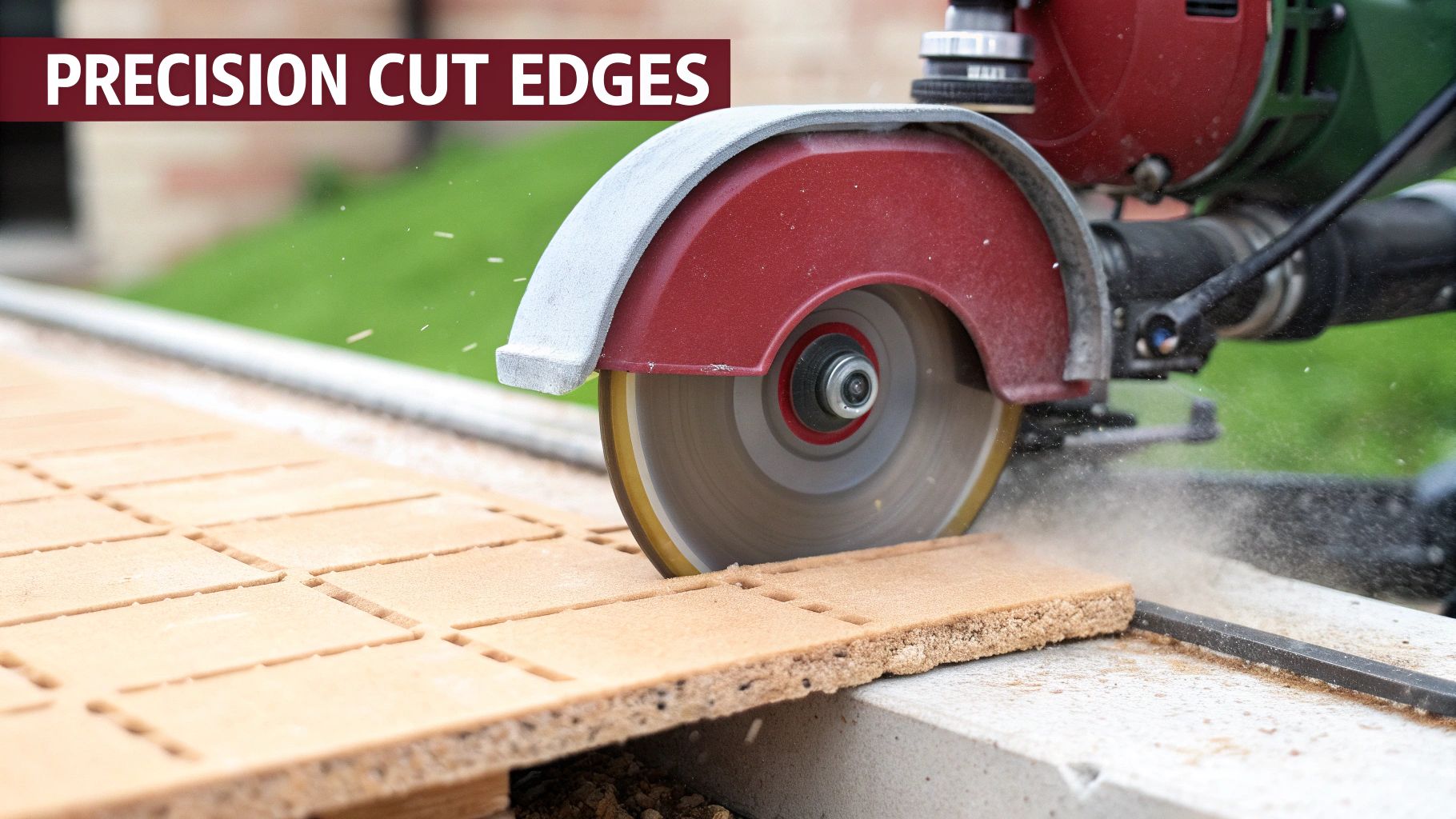
Let's be honest: the main reason people fall in love with rectified tile is that clean, almost futuristic look. Those perfectly machined edges allow for incredibly tight grout lines—we're talking as thin as 1/16th of an inch. The result is a stunning, nearly seamless surface that makes any room feel bigger and more unified.
The Upside: A Sleek and Seamless Finish
The perks of rectified tile aren't just about looks, though. The benefits are genuinely practical and help create that high-end feeling in any space.
- Minimalist Aesthetic: The super-thin grout lines are the main event here. They create a smooth, continuous surface that’s perfect for a spa-like bathroom or a sleek, modern kitchen where the tile itself is the star.
- Easier Cleaning and Maintenance: It's simple math: less grout means fewer places for dirt, grime, and mildew to hide. This makes cleaning so much easier and keeps your floors and walls looking fresh.
- The Illusion of Space: Large-format rectified tiles are fantastic at making a smaller room feel more expansive. With fewer grout lines breaking up the view, the uninterrupted surface fools the eye and creates a wonderful sense of openness.
This uniform and sleek appearance is precisely why so many modern designs rely on what is rectified tile. It delivers a high-impact visual that traditional tiles simply cannot match, establishing a clean backdrop for other design elements.
In a perfect world, this precision can also speed things up. When you're working with a perfectly level subfloor, industry data shows that rectified tiles can actually reduce installation time by as much as 30% compared to standard tiles. If you want to dive deeper, you can discover more insights about ceramic tile market trends and see how these materials are shaping the industry.
The Downside: Precision Demands Perfection
Of course, the perfection of rectified tile comes with some pretty strict requirements and a few potential headaches. The very thing that makes it so attractive—its precision—is also what creates its biggest challenges.
First up is the cost. Both the tiles themselves and the installation are almost always more expensive than their non-rectified cousins. That extra step in the factory adds to the price tag, and the painstaking installation process demands more time, skill, and specialized tools from your tile setter.
Those sharp, perfect edges also mean there is zero wiggle room for mistakes. Even the slightest dip or bump in your subfloor will create lippage—that frustrating and sometimes trip-hazardous issue where one tile's edge is higher than its neighbor. This is why a perfectly flat subfloor isn't just a friendly suggestion; it's an absolute must.
Why Expert Installation Is Non-Negotiable
The sleek, almost seamless look of a rectified tile floor is a real showstopper. But getting that flawless finish? That’s where the pros come in. The very things that make rectified tile so beautiful—its sharp, perfect edges and exact dimensions—also make it incredibly tricky to install. There's just no room for error.
A lot of people think you can lay rectified tiles right next to each other with no grout at all. That’s a common myth, and it's a recipe for disaster. Your house isn't static; it breathes, expanding and contracting with every shift in temperature and humidity.
That tiny grout line, even one as slim as 1/16th of an inch, is non-negotiable. It's a tiny expansion joint that gives each tile the breathing room it needs. Without it, tiles will push against each other, leading to chipping, cracking, or even buckling.
Think of it as the secret to making sure your beautiful new floor lasts.
The Subfloor: Your Unforgiving Foundation
If there's one make-or-break factor in a rectified tile job, it's the subfloor. With traditional tiles, a little unevenness in the floor can be hidden with a bit more mortar or a wider grout line. You can fudge it. But with rectified tile, every single imperfection in the foundation will show.
The subfloor has to be perfectly flat and level. Any little dip or hump will telegraph straight through to the surface, creating what we call lippage. That's when the edge of one tile sits higher than its neighbor. You'll feel it when you walk on it, and you'll see it the moment light hits the floor from an angle. It completely ruins that smooth, monolithic look you paid for.
Tools and Techniques of the Trade
This is why professional installers have a whole different set of tools and techniques for rectified tile. They don't just wing it; they engineer a perfect surface from the ground up.
Here’s what a proper installation looks like:
- Subfloor Prep: This is priority number one. A pro will grind down high spots and use self-leveling compounds to pour a perfectly flat, glass-smooth surface before laying a single tile. They don't guess; they use long levels and straightedges to check their work.
- Tile Leveling Systems: Those little plastic clips and wedges you see installers using are absolutely essential for rectified tile. As the mortar sets, they physically lock the tiles together, holding them perfectly flush and preventing any lippage from forming.
- Full Mortar Coverage: Professionals use the right trowel and a specific back-buttering technique to get 100% mortar coverage on the back of every tile. This eliminates hollow spots that could cause a tile to crack under pressure later on, which is especially important with today's popular large-format tiles.
This commitment to precision is what makes rectified tile a hallmark of high-end construction. Its ability to create a nearly seamless, easy-to-clean surface is a huge reason why we use it in accessible, zero-barrier shower remodels for aging-in-place homeowners here in Portage. When the subfloor is prepped correctly, the result is both beautiful and incredibly durable. You can see how material trends lean toward durability to understand why this matters.
At the end of the day, trying to save money on installation is the quickest way to waste your investment in a premium tile. To get the stunning, high-end look that rectified tile promises, you really need to trust a team with the skill and experience to do it right.
Where Can You Use Rectified Tile in Your Home?
So, we've talked about what rectified tile is, but where does it actually make sense to use it? This is where the fun begins. Seeing how these precision-cut tiles can completely transform a space is what gets homeowners really excited. Their unique look is a perfect match for areas where you want a clean, modern vibe that's also practical.
The secret is in those sharp edges and super-thin grout lines. It's not just a small detail; it’s a choice that creates a cohesive, high-end feel, making a room feel more intentional and surprisingly spacious.
The Modern Kitchen Backsplash
A rectified tile backsplash can be a total game-changer in the kitchen. Just picture a surface behind your stove that looks like one continuous, seamless slab of polished stone. You get that stunning high-end look, but with all the durability and stain-fighting power of top-notch porcelain.
Because the grout lines can be as thin as 1/16th of an inch, the surface is nearly uninterrupted. This isn't just for looks; it's incredibly practical. Thinner, fewer grout lines mean way fewer places for tomato sauce splatters and grime to get stuck, which makes cleanup so much easier. Using large-format rectified tiles here is especially effective for cutting down on visual clutter and creating a sophisticated backdrop.
Luxurious, Spa-Like Bathrooms
If there's one place rectified tile was born to be, it's the bathroom. It's the key ingredient for creating those sleek, spa-like retreats you see pinned all over design boards. The clean lines and monolithic look can turn an ordinary bathroom into a personal, serene getaway.
It’s an especially great choice for designing accessible and modern showers.
- Curbless Showers: The uniform edges of rectified tiles are ideal for building curbless, walk-in showers. Creating that unbroken flow from the main bathroom floor right into the shower enhances the minimalist design while also improving safety and accessibility.
- Wet Rooms: When designing a full wet room, using large-format rectified tiles on both the walls and floor creates a grand, waterproof envelope that feels expansive and is a breeze to maintain.
- Feature Walls: You can also use them to design a dramatic feature wall behind a freestanding tub or vanity. The nearly seamless look draws the eye and adds an undeniable touch of elegance.
The low water absorption rate of porcelain, combined with the minimal grout of a rectified installation, makes for an ideal high-moisture solution. It's a perfect blend of style and function for any Southwest Michigan bathroom remodel.
Open and Bright Basements
Basements often feel a bit dark and cramped, but rectified tile can be a powerful antidote. Laying large tiles—we're talking 24×24 inches or even bigger—across a basement floor can instantly make the whole space feel more open and bright.
With so few visual interruptions from grout lines, you trick the eye into perceiving a larger, more continuous area. The sleek surface also reflects light far better than many other flooring types, helping to brighten up a room that doesn't get a lot of natural sun. For homeowners around Kalamazoo looking to turn a basement into a polished, functional living area, rectified tile offers a solution that’s durable, moisture-resistant, and visually stunning.
Bringing Your Vision to Life with an Expert Touch
You can see by now that rectified tile offers a truly spectacular, high-end look. But there's a catch: that sleek, seamless finish is only as good as the installation itself. For homeowners here in Portage, Kalamazoo, and throughout Southwest Michigan, getting that flawless result means bringing in a team that lives and breathes precision.
This is where the demanding nature of rectified tile really shows. It's not a job for a standard installer. It requires an almost obsessive focus on the details, from meticulous subfloor prep to the final, perfect grout line. At Trademaster Construction, that’s exactly the kind of challenging work we excel at.
Protect Your Investment
You wouldn't put economy tires on a luxury car, and the same logic applies here. Don't risk a premium material like rectified tile on a rushed or inexperienced installation. Our craftsmen have the expertise to translate your vision for a clean, modern space into a reality that’s built to last.
Your investment in beautiful tile deserves to be protected long after the installation is complete. Small, everyday habits make a big difference, like knowing how to protect your floors from furniture to prevent scratches and scuffs.
Our goal is simple: to make sure your new tile project is not just a showstopper on day one, but also a durable, valuable addition to your home for years to come.
If you’re ready to get it done right, let's talk. Reach out today to discuss your project, and let's create a beautiful, durable, and perfectly finished space together.
Answering Your Questions About Rectified Tile
When homeowners start looking at rectified tile, a few key questions always pop up. Let's clear the air so you can decide if this clean, modern look is the right fit for your home.
Can You Install Rectified Tile Without Grout Lines?
This is probably the biggest myth out there, and the answer is a hard no. You absolutely cannot install any tile without grout, including rectified tile.
While those sharp edges let you get an incredibly thin grout line—as narrow as 1/16th of an inch—that joint is non-negotiable. It’s a tiny expansion gap that gives your floor room to breathe with temperature and humidity shifts. Skipping the grout is just asking for cracked or buckled tiles down the road.
Is Rectified Tile More Expensive?
Yes, you can expect to invest a bit more in both the tile and the installation. The tiles themselves cost more because of that extra step in the manufacturing process where they are precisely ground to size.
Installation costs also run higher, and for good reason. The subfloor has to be flawlessly flat. This often means your installer will spend extra time and materials on leveling before a single tile goes down. This isn't just a suggestion; it's a requirement for getting that perfect finish.
Is Rectified Tile Harder To Install?
It absolutely is. Those perfect, unforgiving edges are what make it tricky. With a standard tile, a wider grout line can do a great job of hiding tiny imperfections in the subfloor or slight variations in tile placement.
You don't get that buffer with rectified tile. Every little flaw will stick out. That’s why hiring an experienced pro is so important. They'll use special tools like tile leveling systems to prevent lippage—where one tile edge sits higher than its neighbor—and achieve that smooth, single-slab appearance. It’s a craft that demands serious patience and skill.
Is Rectified Tile Slippery?
A tile's slipperiness has everything to do with its surface finish, not its edges. The key factor is a measurement called the Coefficient of Friction (COF).
A rectified tile with a glossy, polished face will be slick, while one with a matte or textured finish will offer more grip. If you're thinking about using it for a bathroom or entryway floor, always check the tile's COF rating to make sure it’s safe for areas that might get wet.
Ready to bring the clean, modern look of rectified tile to your Southwest Michigan home? The experts at Trademaster Construction have the precision and skill to deliver a flawless installation. Let’s discuss your project today

