A midrange bathroom remodel adds about $20,915 in resale value after a $26,138 project cost, which is roughly 80 cents back per dollar. That national result is a planning benchmark, not a refund of the contractor's invoice.
Southwest Michigan readers should not treat 80 cents as a local promise. East North Central recovery, the band that includes Michigan, sits nearer 70 cents on the dollar. If you're asking how much value does a bathroom remodel add, the useful metric is recovered cents per dollar, checked against closed sales on your own street, before you lock in stone, fixtures, or a bigger footprint.
How Much Value a Bathroom Remodel Adds
The cleanest national answer comes from the 2025 Cost vs. Value Report. A standardized midrange bathroom remodel averaged $26,138 in construction cost and was estimated to add $20,915 at resale, an 80% cost recovery, or about 80 cents per dollar invested. That added figure is market value inferred from comparable sales. It is not a guarantee that one Portage or Kalamazoo house will appraise higher by the full invoice.
Scope moves the percentage harder than a prettier faucet package. The same report put a universal-design bathroom at an average cost of $42,183, with $25,812 in resale value, or 61% of cost. Those projects, including curbless or wheelchair-friendly showers, can still be the right build for daily use even when the resale share is weaker than a conventional midrange job. The report compares standardized projects across 119 U.S. markets, so treat every row as a planning benchmark, not an appraisal of your house.
| Project | Typical cost | Value added | Cost recovered |
|---|---|---|---|
| 2025 midrange bathroom | $26,138 | $20,915 | 80% |
| 2025 upscale bathroom | $81,612 | about $34,000 | about 42% |
| 2025 universal-design bathroom | $42,183 | $25,812 | 61% |
| 2024 midrange bathroom | $25,251 | about $18,686 | 74% |
Midrange is the efficiency benchmark: the highest share of cost back among these rows. An upscale bathroom around $81,612 is estimated to return roughly $34,000, about 42%, so it can add more dollars while giving back a smaller slice of what you spent. Universal design lands in the middle on percentage, with real aging-in-place utility that the resale column only partly captures. The 2024 midrange point, about $25,251 with professionals expecting 74% back, shows the band moves year to year, as HGTV's report of Remodeling Magazine's Cost vs. Value numbers recorded. Seventy-four percent of that cost is about $18,686 in expected value added.
Pick the row before the finishes
A pre-listing renovation guide such as the Royal LePage Brookside Realty renovation guide is useful here because it separates updates buyers can already see in nearby sales from personal upgrades that mostly please the owner. Local resale prices, neighborhood standards, workmanship, materials, and whether the existing bath is outdated will move your result off the national row.
Practical rule: Choose the cost-recovery row first, then specify tile and fixtures inside that budget. A more expensive fixture package rarely repairs a scope that already recovers a weak share of its cost.
Workmanship and a tired starting bath matter as much as the national average. An outdated room has more deferred maintenance to correct, so the same midrange scope can look like a bigger jump to buyers than the identical spend in a bath that was already updated.
Why the Invoice Is Not the Appraisal
Value, in an appraisal, is a move into a condition buyers already pay for. It is not a line-by-line refund of construction cost. Replacing a dated tub, a worn floor, poor light, and failing ventilation can lift the bath toward the level of nearby closed sales. Once the room matches that level, extra luxury is mostly scenery.
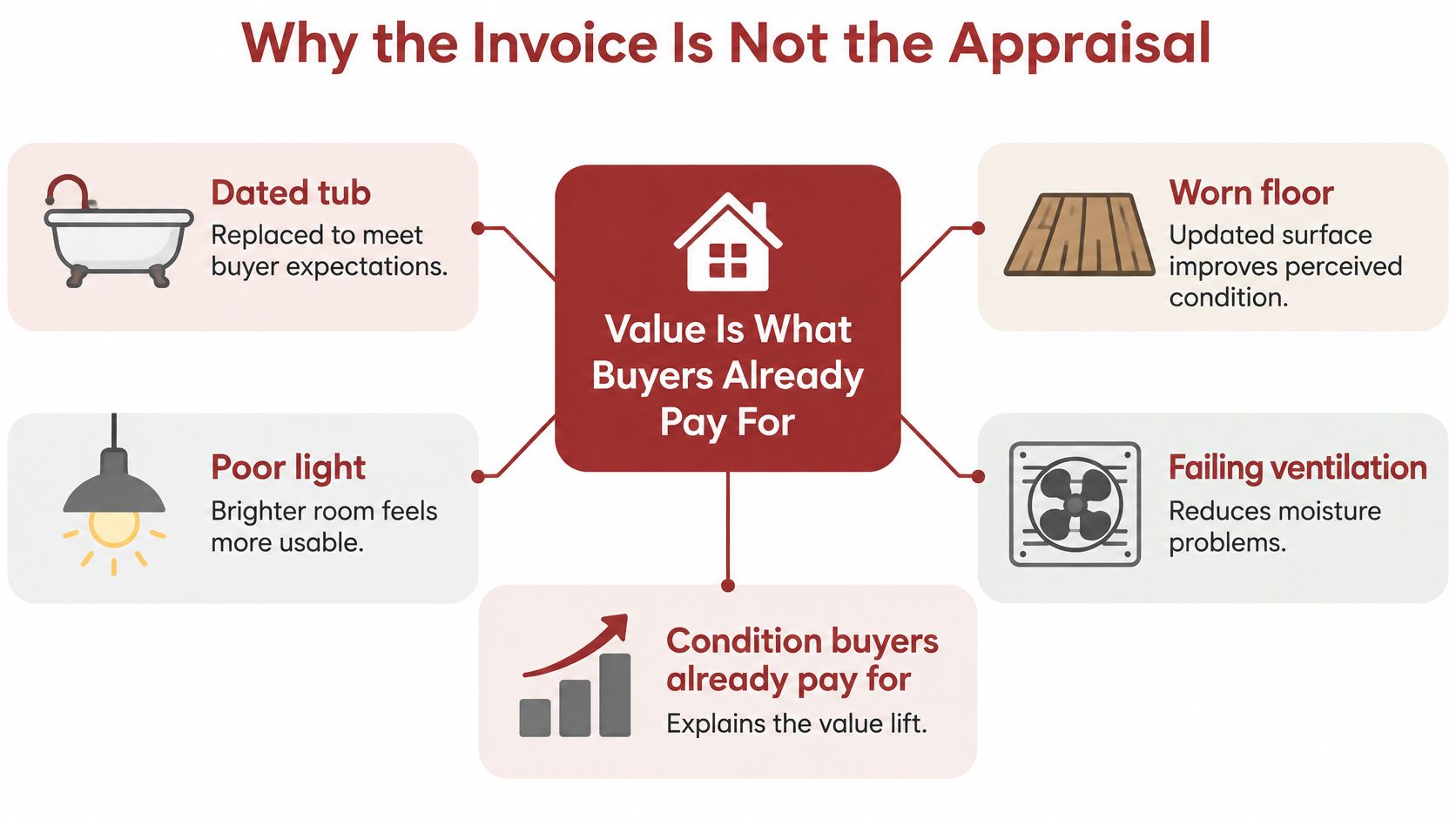
Think of the remodel as a bridge from an outdated room to the neighborhood's normal bathroom. Buyers pay to get across. They don't pay extra, dollar for dollar, for gold railings on a bridge everyone else already crossed with ordinary materials.
Two value channels, not one
Market value is what a buyer might pay, inferred from comparable transactions. Personal value is comfort, safety, and daily use. The 2025 Remodeling Impact Report from the National Association of REALTORS® and the National Association of the Remodeling Industry estimated that a bathroom renovation recovered about 50% of its cost at resale, while the project scored a 9.8-out-of-10 Joy Score. A job can be worth doing for the people who live there even when resale math is modest. For a curbless or wheelchair-compatible shower, the financial return can understate the practical benefit.
Appraisers generally don't reimburse spending automatically. They compare:
- Condition: How the bath stacks up against recent closed sales nearby.
- Quality: Materials and workmanship a typical buyer in that price tier would expect.
- Functional utility: A shower that works, ventilation that controls moisture, and enough clear floor space.
- Bathroom count: Don't trade away a usable bath to enlarge one showpiece.
- Permits: Documented, permitted work is easier to defend than an unrecorded gut job.
Sale price and marketability are not the same thing. A clean, code-sensible bath can cut buyer objections and help a listing compete without returning every construction dollar. Technical choices support both channels: a properly sloped waterproof shower, slip-resistant flooring, blocking for grab bars, and a preserved bath count.
A moderate update aligned with the rest of the house usually defends value better than a showpiece that outruns the kitchen and the neighborhood.
What Local Markets Do to the Percentage
A national return estimate can hide substantial regional differences. For planning, the reported midrange figures put the Pacific and New England regions near 91%, while East North Central, including Michigan, sits near 70%.
| Market | Midrange cost recovered | How to use it |
|---|---|---|
| United States | about 80% | National planning benchmark |
| Pacific | about 91% | High end of reported regions |
| New England | about 90.5% | High end of reported regions |
| East North Central including Michigan | about 69.4% to 70.9% | Closer guide for Southwest Michigan |
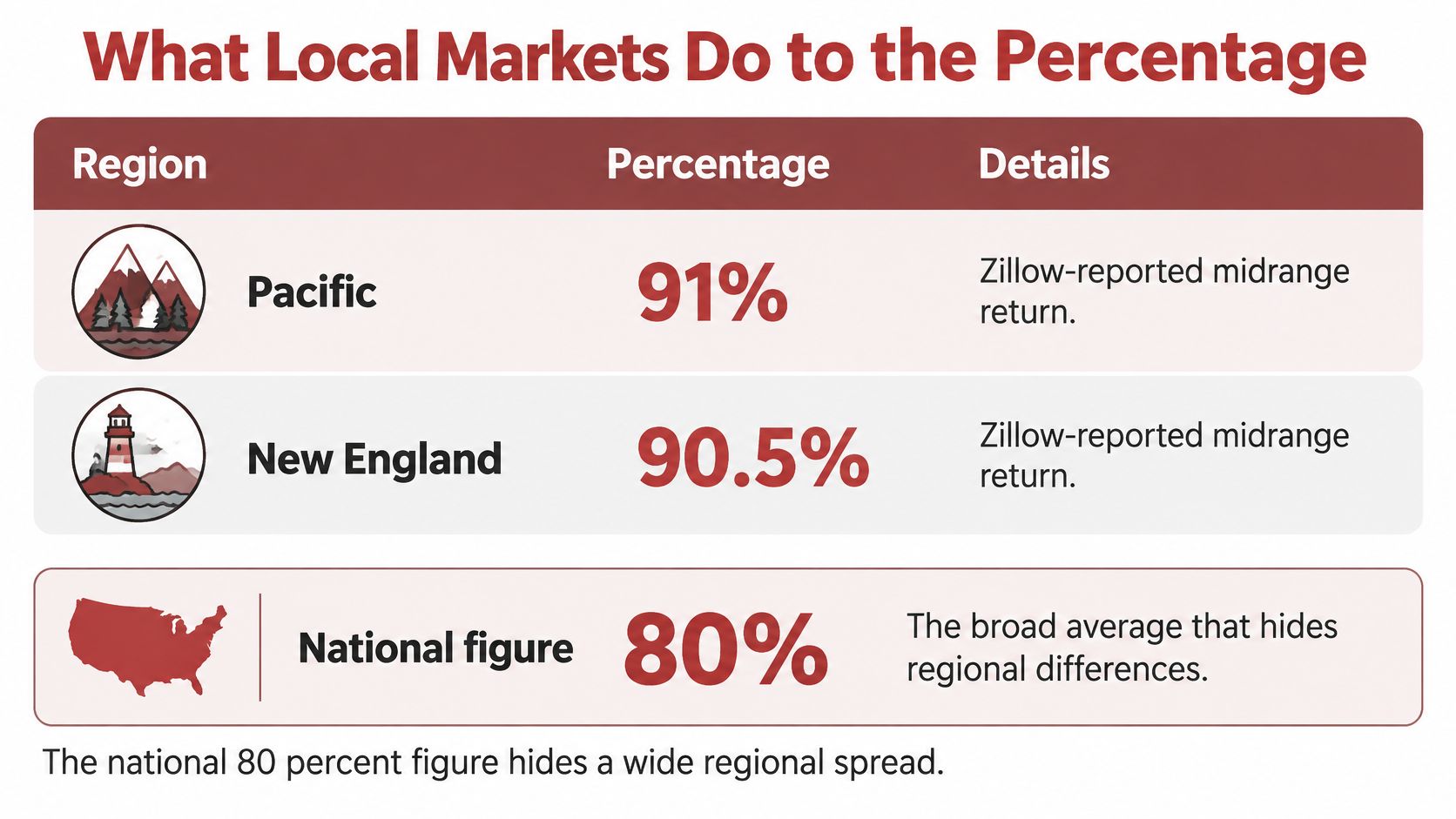
Zillow's regional estimates for home improvements put midrange returns at about 91% in the Pacific region and 90.5% in New England. East North Central estimates are roughly 70%. Michigan is part of that region, so Southwest Michigan homeowners can use about 70 cents recovered per dollar spent as a starting point, then compare it with nearby closed sales. A Destin real estate market is not a useful substitute for those local comparisons.
What moves one house off its regional row
Scope. A targeted $15,000 update may recover a higher share of its cost than a $50,000 luxury expansion, even if the expansion adds more dollars in total. The useful comparison is recovered cents per dollar, not the largest possible resale gain.
Quality and permits. Poor waterproofing or unpermitted work can weaken the value buyers and appraisers assign to a renovation. A tile shower that fails becomes a condition problem rather than a selling point.
Match to the house. Finishes should fit the home's price tier and the condition of nearby rooms. A spa-style primary bath beside a builder-grade kitchen may look out of step instead of supporting a higher value.
Starting point. An already updated bathroom has less deferred maintenance to correct, so repeating that work may add less than improving a dated room.
Neighborhood standard. Spending beyond what nearby sales support can reduce the share of the invoice recovered. In Kalamazoo and Portage, the regional figure is a starting benchmark, not a prediction for every street.
Recovered cents per dollar, checked against local sales, is a better guide to finish choices than a national headline.
Check Your Street Against Closed Sales
Run this before you pick finishes. The goal is a ratio: estimated value added divided by the project cost you priced.
- Pull recent closings. Gather the last 12 months of closed sales within a half-mile, or inside the same subdivision, for homes of similar size and price tier.
- Sort the baths. Label each sale as updated, fully remodeled, or dated. Ignore model-home photos and look at what sold.
- Compare condition gaps, not price per square foot. Buyers pay for condition. A higher price per foot can come from a larger lot or a newer roof, not from the bath.
- Ask about time and price. A local agent can tell you how long dated and updated bathrooms sat on those streets and how far apart their prices landed.
- Confirm permit history. Appraisers rely on documented improvements. Ask whether recent bath work was permitted and closed out.
- Estimate the gap, then divide. Value added is the gap between your current bath and the updated comps. Divide that gap by the project cost. A 1970s Kalamazoo bath on a street where updated sales show a clear premium may justify a complete midrange update. The same bath on a street where sales are already updated may not.
- Scale back if the ratio is weak. If recovered cents land well below the East North Central band, cut finishes before you sign.
Adjusting comps is its own skill. A walk-through of reconciling adjusted sale prices shows why you adjust for condition rather than treating two nearby sales as identical just because the lot sizes match.
When Safety Features Beat the Resale Percentage
Safety features do not automatically reduce resale appeal. In its 2025 U.S. Houzz Bathroom Trends Study, Houzz found that 68% of homeowners undertaking bathroom projects considered special needs, up four percentage points year over year. Among those homeowners, 61% considered grab bars, 55% nonslip flooring, 52% low-curb showers, and 28% curbless showers. These figures describe project choices, not how common the features are in homes buyers see.
A phased upgrade is a different bet than a full rebuild
A full accessible remodel can recover a smaller share of its cost than a conventional midrange update, while targeted safety improvements require less work. The $1,885 average for smaller home modifications is reported by AARP's Home and Community Preferences survey. Adding wall blocking, safer flooring, or a lower curb can address specific needs without rebuilding every wall.
Resale percentages leave out practical benefits:
- Fewer falls for older adults on wet floors.
- More independence for wheelchair users who can enter without a step.
- Greater comfort for guests who want a steady, usable bathroom.
- Potentially one renovation instead of two if safety features are installed during the current remodel.
Built in, not bolted on later
During an ordinary remodel, incorporate safety features into the work. Add wall blocking for current or future grab bars, install slip-resistant floor tile, and slope and waterproof the shower pan correctly. A low-curb or curbless entry and clear floor space can support access without making the room look clinical. Keep the home's bathroom count and use a broadly appealing midrange palette.
In Portage or Kalamazoo, compare the recovered cents per dollar with the daily use the changes provide. If you plan to sell within a year, discreet safety details within a broadly appealing update may make more financial sense than a full accessible rebuild aimed at a narrower group of buyers.
Three Budgets and What Each One Returns
Three budgets produce three different bets. The finish level and the age of the bath change the cents you get back.
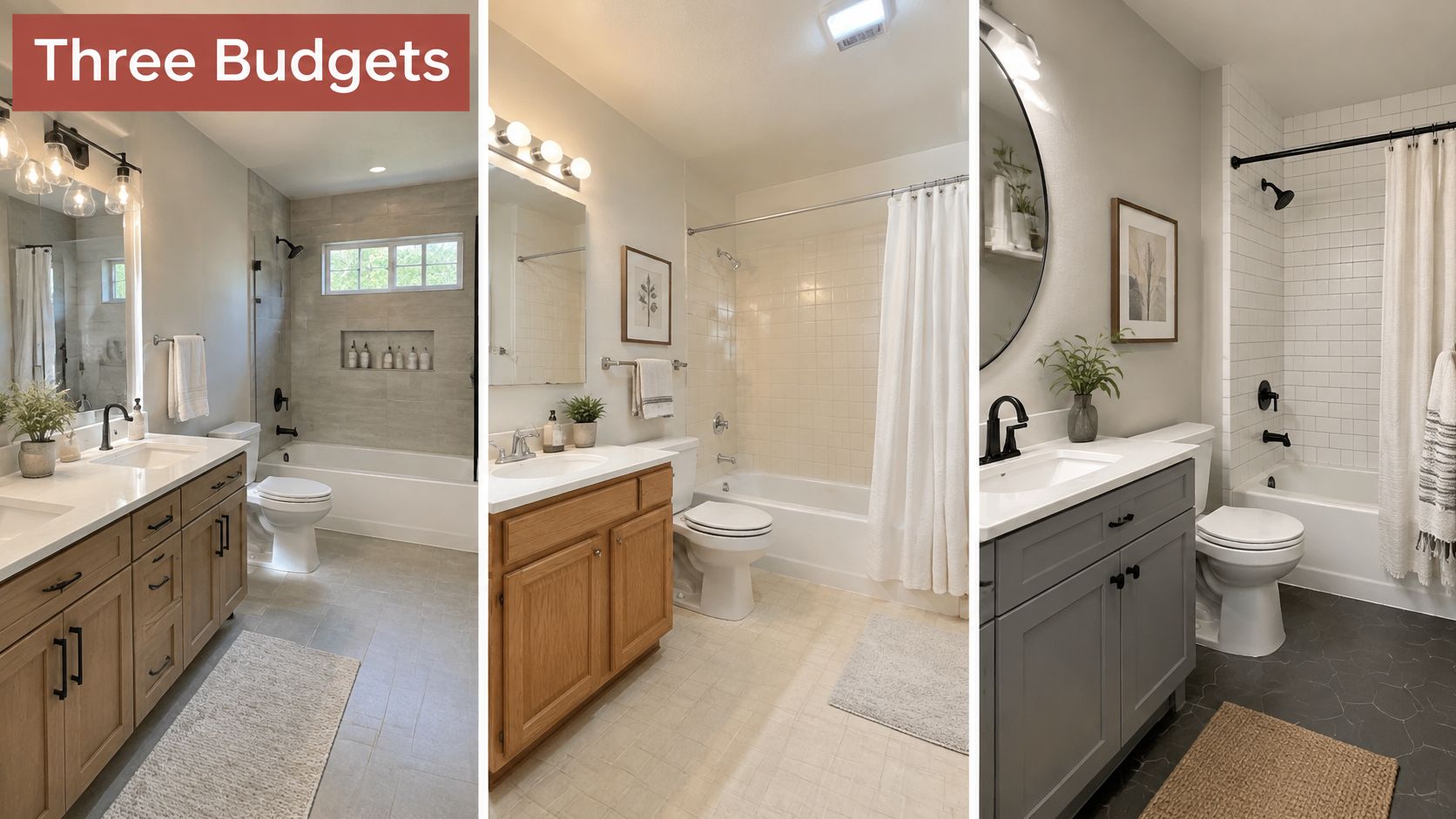
A tired bath, functional reset
Say the bathroom is at least 25 years old. The work is a functional midrange reset: new toilet, tub, and lights, a double sink, a tiled floor, and a simple wall finish. Zillow reported in 2019 that this kind of renovation could produce approximately $1.71 in added home value for every $1 spent. Treat that multiple as historical evidence, not a 2026 promise. Pair it with today's milder national picture, where a midrange remodel recovers 80%. The direction is the same. Buyers reward correction of deferred maintenance more reliably than personalized luxury. This case fits an owner whose bath is obviously dated and whose goal is a clean, usable room that also helps a sale.
The standardized midrange job
The 2025 midrange project, near $26,000 in cost, adds about $21,000. Buyers are paying for a reliable shower, ventilation that moves moisture, updated fixtures, and a neutral look that photographs well and doesn't fight the rest of a Southwest Michigan house. This is the case for someone listing in the next year or two who wants the efficiency row, not a custom statement.
Upscale finishes, slower recovery
An upscale path with a full-body shower wall, a bidet, and premium finishes tells a different story. In that 2019 contrast, the upscale remodel produced only about $0.87 in added value per dollar spent. The 2025 upscale project near $81,612 returned roughly $34,000, about 42%. Resale value grows more slowly than installation cost at the high end. The luxury bath can still be the right room if you'll live with it for years. It is a weak pure-resale bet if the kitchen and the neighborhood are ordinary.
A short walk-through of how scope changes the room is worth watching before you pick a path.
Match the case to the horizon. Sell soon, and the functional or standardized midrange job is the rational spend. Stay and use it, and daily comfort can justify more finish. Age in place, and a curbless or low-curb shower belongs in the plan even when the resale share is lower.
Choose the Scope and Decide Before You Sell
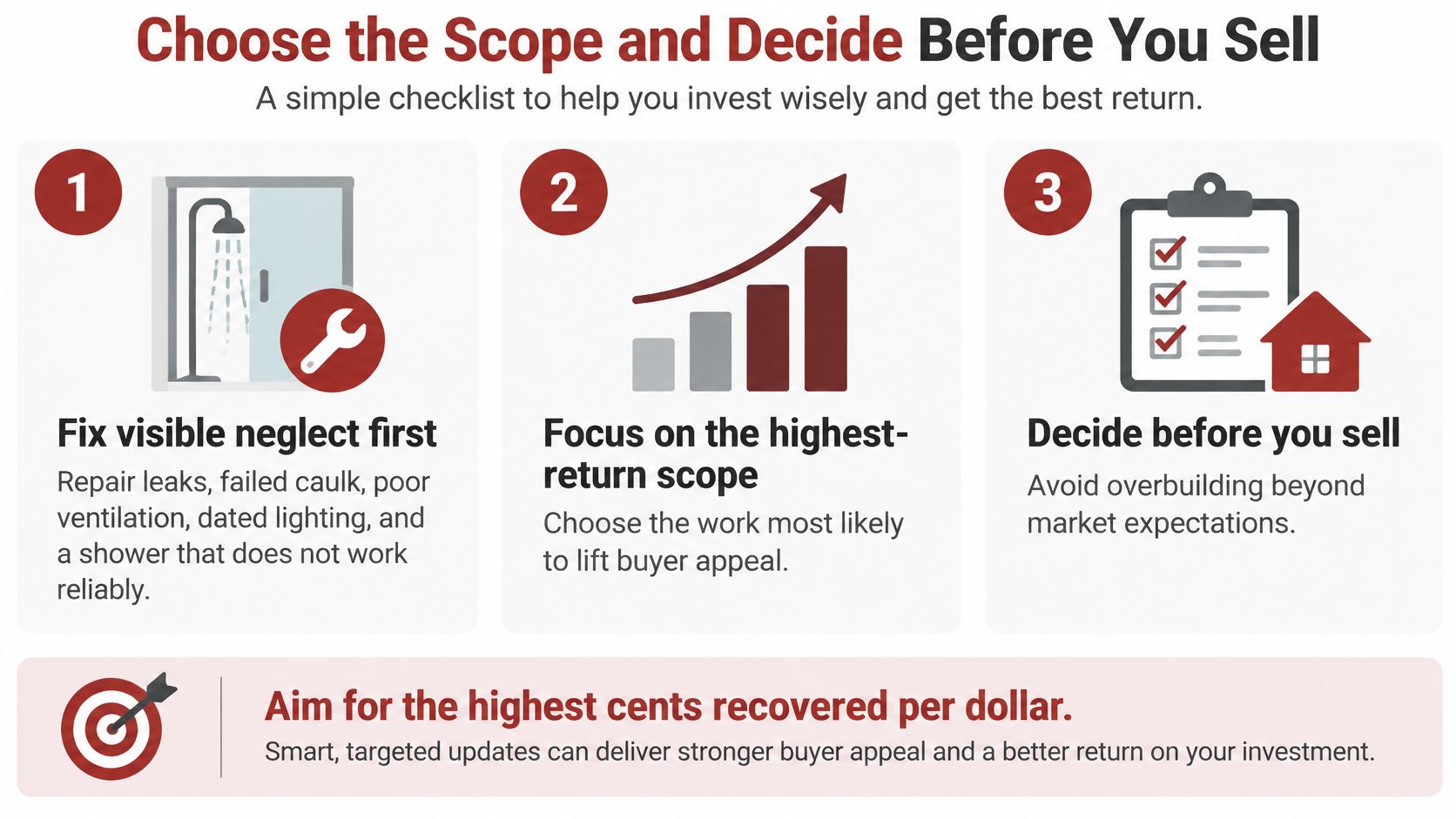
Spend for cents recovered per dollar, not for the largest possible bath.
- Fix visible neglect first. Stop leaks, replace failed caulk, repair poor ventilation, swap dated lighting, and make the shower work reliably. Buyers discount a pretty room that still looks damp.
- Spend on durable, widely liked assemblies. A waterproof tile shower, slip-resistant flooring, quality but not exotic fixtures, and a neutral palette that towels and accessories can personalize later will outlast a trend color.
- Keep the bathroom count. Don't take a closet or hallway the rest of the house needs just to widen one shower.
- Skip highly personal luxury when the sale is soon. A bidet-centered plan or rare stone is a weak resale bet within a few years if the rest of the house is ordinary.
- Price the scope before you choose finishes. Regional figures place Michigan in the East North Central region with Wisconsin, Illinois, Indiana, and Ohio, where midrange bathroom-remodel cost recovery is reported at approximately 69.4% to 70.9%, below the 80% national average, according to Zillow's bathroom remodel ROI breakdown. Those figures are benchmarks, not a guaranteed appraisal for Kalamazoo or Portage. Outcomes still depend on neighborhood comparables, existing condition, permits, workmanship, and whether the renovation matches local buyer expectations. Use Trademaster Construction's instant pricing tool to get a ballpark, then compare that estimate with the recovery row that matches your scope.
Three verdicts
Listing in one to two years, and the bath is dated. Favor a complete midrange update. Plan on recovering nearer 70% in East North Central than the national 80% headline. Put the money into function and a neutral finish, not into rare materials.
Staying for years. Spend for daily use, including a curbless or low-curb shower when mobility matters, and treat resale as a partial offset. The joy of a safer, easier room is a real return even when the appraisal doesn't match the invoice.
The bath already matches neighborhood sales. Pause. More finishes are unlikely to return their cost. A luxury primary bath beside an untouched kitchen, in a modest price tier, is the classic way to overspend the house.
A bathroom remodel adds real value most reliably when it brings an outdated room up to the local standard, and rarely when it tries to outspend the house. Estimate the scope with the instant pricing tool, then talk with a local remodeler who works in Portage, Kalamazoo, and nearby communities on kitchens, baths, tile, and accessible showers.
Trademaster Construction remodels kitchens, bathrooms, basements, and custom tile for homeowners in Portage, Kalamazoo, and nearby Southwest Michigan communities, including curbless and wheelchair-friendly showers. If you're weighing cents recovered against the bath you live with, start with a ballpark and a scope that fits your street. Visit Trademaster Construction to see project styles, browse planning resources, and line up a conversation before you commit to finishes.