Saturday morning usually makes the problem obvious. One person is rinsing berries, another is trying to fill a stockpot, and the faucet that looked fine in the listing photos suddenly feels too short, awkwardly placed, or out of step with the rest of the kitchen. In Southwest Michigan remodels, I see that a lot, especially in homes where an older sink base, newer counters, and mixed metal finishes all meet in one tight work zone.
A kitchen faucet sets more than water flow. It affects reach, splash, clearance, cleaning speed, and the way the whole sink wall reads in photos and in person. The right pick has to match the sink, the mounting setup, and the finish palette already in the room.
That is why this guide focuses on real remodel decisions, not showroom labels.
Each faucet style below is paired with finish recommendations, common mounting types, and realistic cost ranges, so you can compare what works in a modern bungalow in Kalamazoo, a lake house near South Haven, or a full kitchen update in St. Joseph. If you want numbers for your own project, Trademaster's instant pricing tool for Southwest Michigan projects can help you budget the faucet portion alongside the broader remodel.
1. Modern Single-Handle Pull-Down Faucets
In Southwest Michigan remodels, this is the faucet I install most often because it solves the most common sink-area problems without complicating the cabinet or countertop work. One handle is faster to use with messy hands, and the pull-down head gives you the reach to rinse corners, wash produce, and clean the bowl without fighting the faucet.
It also fits the mounting setup in a lot of existing kitchens. If the sink or counter is already drilled for a standard deck mount, a modern single-handle pull-down usually drops in with fewer surprises than wider, more decorative faucet bodies. That matters in older homes around Kalamazoo, Portage, and St. Joseph, where a simple faucet swap can turn into patching stone or covering unused holes if the style change is too aggressive.
Best fit and finish pairing
This style looks right in kitchens that want clean lines and a lighter visual footprint. I usually pair it with brushed nickel for broad resale appeal, matte black for high-contrast kitchens with matching hardware, or a softer brass when the room has warmer floors, cream cabinetry, or mixed-metal lighting that already leans warm.
Models from Kohler Simplice, Delta, and Moen's cleaner-profile pull-down lines tend to photograph well and hold up visually once the rest of the kitchen is finished. They pair especially well with undermount sinks, quartz counters, and simple shaker or flat-panel cabinets.
Practical rule: Match the faucet finish to the cabinet hardware first, then check the light fixtures. The sink wall reads more cohesive in person and in listing photos when those metals are working together.
What works and what doesn't
This style performs best with a reasonably deep primary sink and enough clearance behind the faucet for the handle to move freely. It is also a strong choice for cooks who use the sink hard every day. The spray head earns its keep.
The common mistake is choosing height before checking splash and reach. A practical buying guide from Rise notes that 1.5 to 1.8 GPM flow rates and mid-to-high arc spouts tend to suit standard kitchen setups, while unusual sink depth can change coverage and splash behavior. I see that in older local kitchens where the basin is shallower, narrower, or set farther back than current faucet photos assume.
Cost is usually straightforward here. Expect roughly $200 to $600 for a solid midrange faucet, with premium finishes and touch features pushing the number higher. Installation is often simpler than with bridge or wall-mounted options, but hole spacing, sink depth, and backsplash clearance still need a quick check before ordering. If you want a fast budget number for your own Southwest Michigan remodel, Trademaster's instant pricing tool is a practical place to start.
2. Farmhouse (Apron Front) Faucets
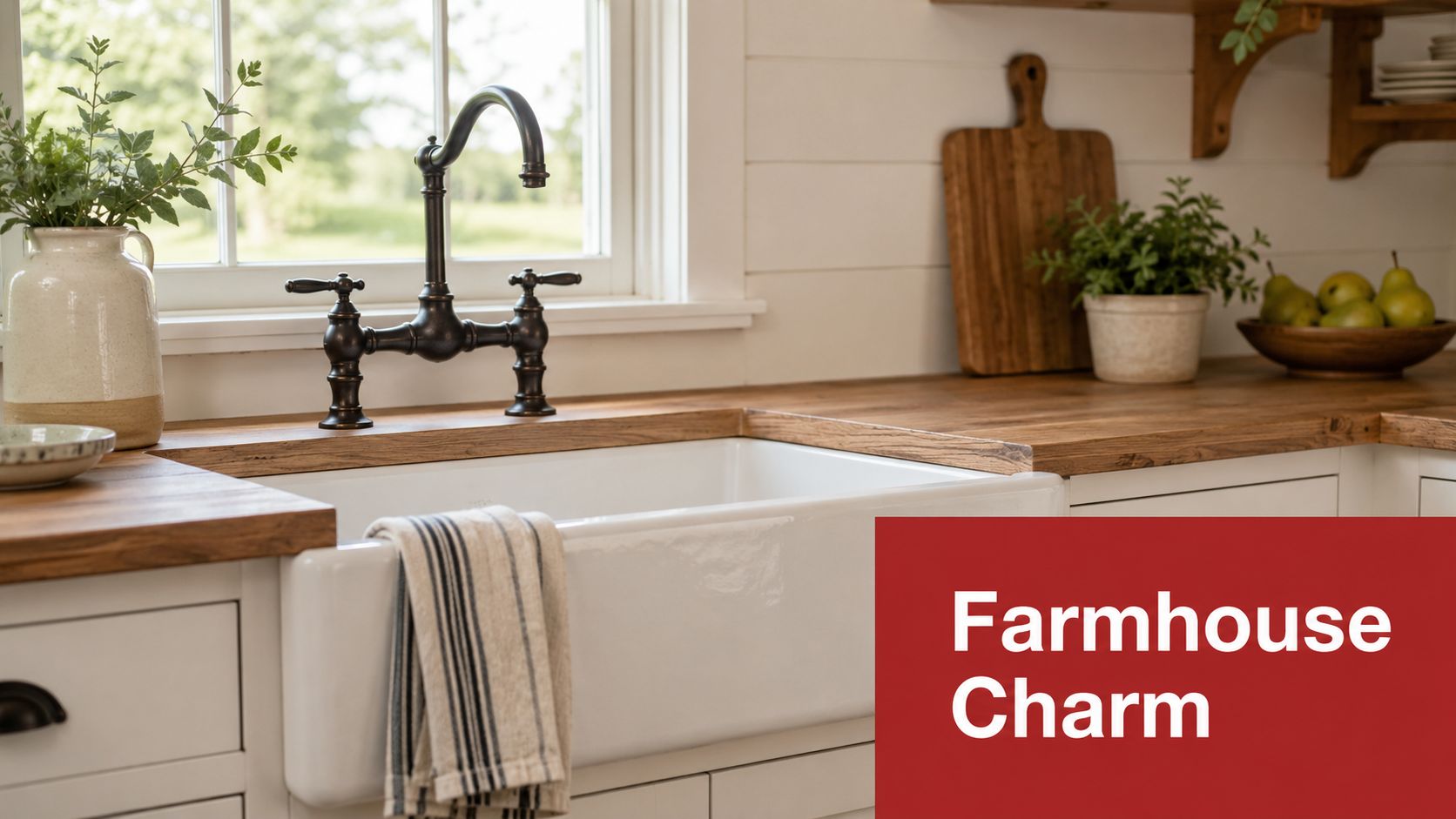
Farmhouse faucets bring personality fast. If your kitchen has an apron-front sink, warmer wood tones, inset details, or a collected look instead of a sharply modern one, this style can make the whole room feel settled.
The classic image involves a bridge-style body with a curved spout, exposed connections, and handles that look a little more architectural. This image is indeed representative. These faucets aren't trying to disappear. They're there to add presence.
Finish choices that actually suit the style
Oil-rubbed bronze, aged brass, and muted unlacquered-looking finishes usually suit farmhouse kitchens better than bright chrome. The style wants softness and depth. If you pair a vintage-leaning faucet with cold shiny hardware everywhere else, it can feel forced.
Examples worth looking at include Kohler Artifacts, Waterworks Henry, and vintage-inspired Restoration Hardware pieces. Pair them with apron sinks, natural stone looks, or painted cabinetry that has a little warmth to it.
The real installation catch
This style trips people up because the visual is romantic, but the mounting requirements are not. Widespread kitchen faucets need 8 to 16 inches between hot and cold handles, so not every existing sink or countertop layout can take one cleanly.
That's where projects in older homes get interesting. If the spacing is wrong, you're not just making a style choice anymore. You're changing the install approach, adding a plate, or reworking the deck surface, and that can dilute the look that made you choose the faucet in the first place.
3. Touchless and Sensor-Activated Faucets
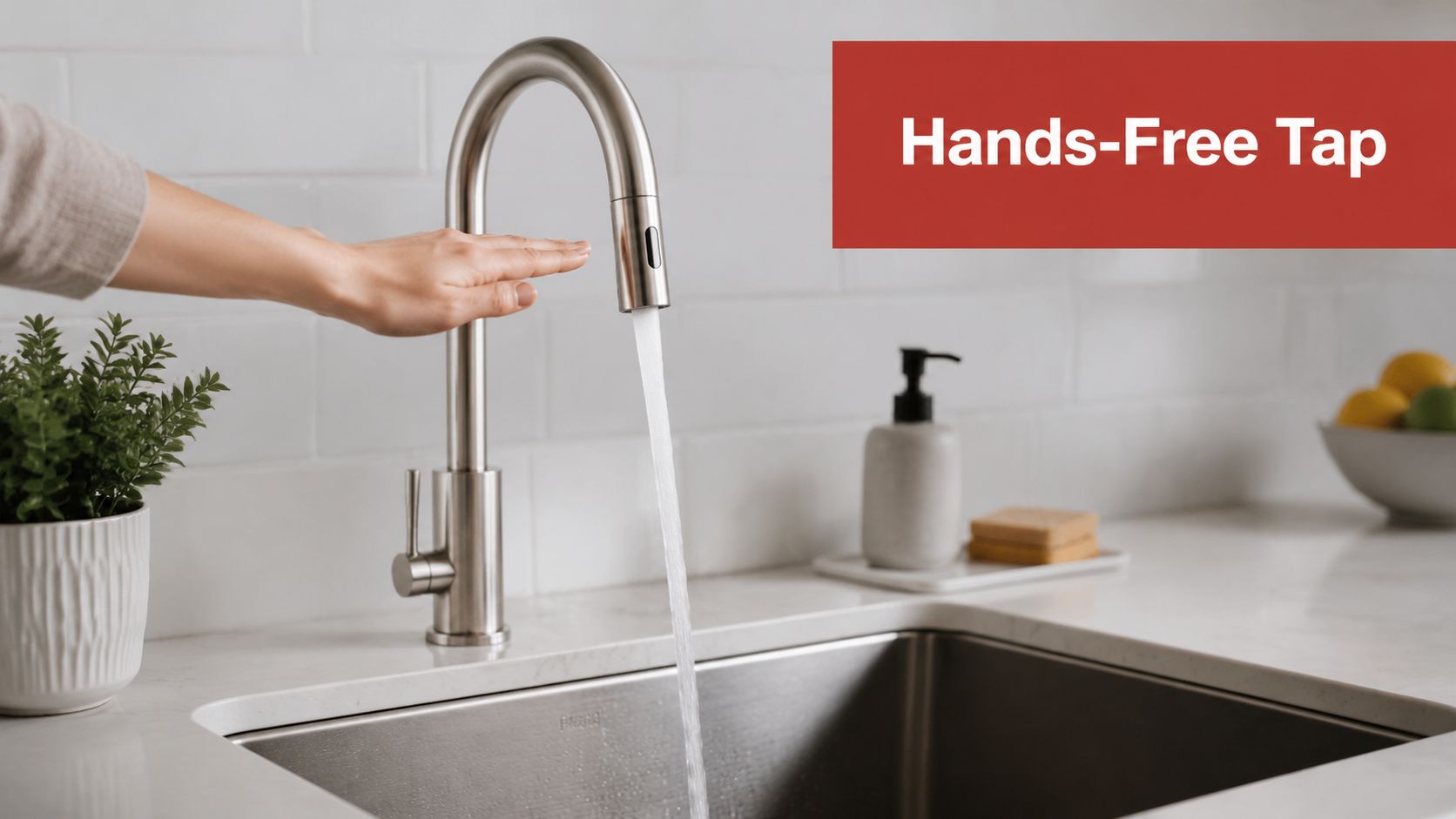
Touchless faucets stopped being a novelty a while ago. In busy family kitchens, they solve a real problem. Raw chicken on your hands, dough on your fingers, a pan in one hand. You don't want to grab a handle every time.
That's one reason this category has grown so quickly. Touchless and sensor-activated kitchen faucets increased from 18.2% market share in 2022 to 28.5% in 2026, with a reported 30% reduction in water consumption compared to conventional models. If you want one upgrade that feels modern every single day, this is high on the list.
Where they earn their keep
Homes with kids, serious cooks, and households that use the kitchen constantly tend to love touchless models. The best versions also allow manual use, which matters because no one wants a smart faucet that becomes awkward the moment batteries need service or a sensor gets fussy.
Look at Moen MotionSense, Kohler touchless models, and Delta Motion Activate options if you want a mainstream starting point. Choose a version with clear battery or power access, plus a manual override.
A touchless faucet is only convenient if the sensor placement matches how people actually move around the sink.
Finish and style notes
Touchless doesn't have to look futuristic. Many of the better models now come in shapes that read like standard modern pull-downs, so you can get the convenience without making the faucet look like a gadget.
Brushed nickel and stainless-toned finishes usually hide day-to-day handling best. Matte black can look excellent too, but in a kitchen with a lot of natural light, make sure it coordinates with the cabinet pulls and lighting metal so it doesn't become an isolated dark object.
4. Professional Restaurant-Style Faucets
A homeowner loves this faucet style in a showroom, then gets it home and realizes the coil sits in front of a window or overpowers a small sink. That is the trade-off with professional restaurant-style faucets. They work best when the kitchen has enough room, enough sink capacity, and enough visual weight to support them.
These are the tall spring-neck or semi-commercial models with an exposed coil, larger spray head, and more reach than a standard pull-down. In daily use, they shine for stock pots, sheet pans, and heavy prep. They also become the first thing your eye lands on, so the style has to fit the rest of the remodel.

Where this style makes sense
I like this category most in larger Southwest Michigan kitchen remodels with a wide single-bowl sink, a deeper sink base, and open space above the deck. An island sink is often a better home for it than a perimeter sink under shorter wall cabinets. If the room already has a bigger range, substantial hood, and bolder hardware, this faucet usually looks intentional instead of oversized.
Mounting matters here. Most professional-style faucets are deck-mounted, and many need a stable one-hole or reinforced deck setup because the spring assembly adds height and movement. Before choosing one, check window clearance, upper cabinet swing, and sightlines across the room. A faucet can perform well and still feel wrong if it blocks a focal point.
Finish, fit, and cost
Stainless, brushed nickel, and other soft silver finishes usually look best on this style because they match the commercial profile and hide water spotting better than polished surfaces. Matte black can work in a modern kitchen, but only when the lighting, cabinet pulls, and appliance finishes support it. In a traditional kitchen, this faucet often looks out of place unless the rest of the space has a more utilitarian edge.
Expect a wider price spread than with standard pull-downs. Entry-level semi-commercial models can be fairly approachable, while premium options from brands like Kohler, Kallista, Waterworks, and other design-forward lines can climb fast. I usually tell homeowners to budget not just for the faucet, but for the sink scale and installation conditions that let it look right.
For a quick visual breakdown of the professional style, this video helps:
The biggest mistake is forcing this look into a compact kitchen with low uppers, a shallow sink, or a quiet traditional design. In the right setting, it feels capable and striking. In the wrong one, it reads like commercial equipment dropped into a room that never asked for it.
5. Two-Handle Centerset Faucets
Two-handle centerset faucets are the steady, familiar option. They're less fashion-forward than a sleek pull-down, but in the right kitchen they feel appropriate, practical, and honest.
This style usually makes sense when the kitchen already leans traditional or when the sink deck has an existing multi-hole setup you don't want to fight. It's also a sensible choice for a secondary kitchen, basement bar sink, or a lower-drama update where reliability matters more than making a design statement.
Why some kitchens still need them
A lot of homeowners assume every remodel should move to a single-handle faucet. Not always. If the surrounding kitchen has classic cabinet details, paneled doors, and more traditional lighting, a centerset faucet can match the room better than a highly contemporary fixture.
Models like Delta Classic, Kohler Standard, Moen M-Dura, Pfister, and American Standard all live in this lane. Finish-wise, brushed nickel and polished chrome still fit this category well, especially when the rest of the room already uses familiar, neutral hardware.
Match the faucet to the hole pattern
Mounting decides whether this style is convenient or frustrating. The most common kitchen faucet hole patterns are one, three, or four holes, with three holes used for a spout and two separate handles, and extra features requiring additional holes. That means a faucet can be perfectly attractive and still be the wrong choice for your sink deck.
Best advice: Count holes before you shop finishes. Homeowners often do that in reverse and waste time.
If your sink already has the right pattern, centerset can be a clean, budget-friendly solution. If it doesn't, the conversion pieces can make the result look more patched together than planned.
6. Vessel Sink and Specialty Design Faucets
This is the outlier category. Most kitchens don't need vessel-style or highly sculptural specialty faucets, but some projects absolutely do. Think beverage station, prep area, pantry sink, or a kitchen that leans boutique rather than standard builder logic.
These faucets are more about visual intent than broad utility. They're often taller, more decorative, and selected the way you'd select a statement pendant. They need the right setting or they can look self-conscious.
Where specialty faucets make sense
If the sink itself is unusual, handmade, prominent, or part of a custom feature area, a standard faucet may look underdressed. Waterworks sculptural pieces, Kallista design collections, and specialty fixtures from high-end tile and bath studios can work well in these niche applications.
The finish should usually echo another strong material in the room. If the backsplash has handmade tile variation, a warmer brass tone often feels intentional. If the room is cooler and more gallery-like, brushed nickel or black may fit better.
The trade-off
You give up some everyday versatility when you chase a sculptural look. That's fine at a bar sink or a secondary station. It's usually not the smartest move at the main family sink unless the faucet has been chosen with real use in mind.
Specialty faucets are best when the whole composition supports them. On their own, they can read more like showroom styling than practical remodeling.
7. Wall-Mounted Faucets
Wall-mounted faucets are clean, sharp, and visually calm. They free up the counter or sink deck, make wipe-down easier, and bring a more refined design language to the kitchen.
They also require commitment. This isn't the faucet to choose on a whim. Once it's roughed into the wall, placement becomes much less forgiving than a deck-mounted install.
Why designers love them
Wall-mount faucets look especially strong in European-leaning, minimalist, or Scandinavian-inspired kitchens. They keep the counter line uncluttered and can make a compact sink wall feel more custom.
Waterworks and Kallista both offer refined versions in this category, and several modern design brands have excellent restrained profiles. Matte black, brushed nickel, and softer stainless-toned finishes tend to work best because the faucet reads as an architectural element rather than just a plumbing fixture.
Where homeowners get into trouble
The biggest issue is reach. If the spout doesn't land where the sink needs water, the faucet will annoy you every day. Splashing, awkward hand position, and hard-to-clean corners usually come from poor planning, not from the style itself.
Also remember that most kitchens are still built around deck-mount assumptions. If you're choosing wall-mount, do it as part of a full remodel, not as a casual fixture swap, because the plumbing and finish work need to be coordinated from the start.
8. Bridge Faucets
A bridge faucet is one of the most architectural kitchen faucet styles you can buy. The exposed horizontal bridge between the hot and cold sides gives it structure and a sense of age, even when the rest of the kitchen is fairly new.
This style shines in transitional kitchens, old-house renovations, and spaces where a little period character helps the room feel rooted. It can also look excellent in a cleaner kitchen if the lines are restrained and the finish is right.
Finish first, then form
Bridge faucets look best in finishes that carry some depth. Aged brass, brushed brass, bronze, and softer nickel tones usually outperform bright polished chrome here because the form already has visual complexity.
Strong examples include Kohler Artifacts bridge models, Waterworks traditional bridge faucets, and custom brass-focused makers. Pair them with cabinet hardware that doesn't fight for attention. If the faucet has cross handles, don't also choose flashy pulls and ornate lighting in the same sightline.
One style, two common mistakes
The first mistake is choosing a bridge faucet for a kitchen that has no visual room for it. If the backsplash is busy, the sink wall is crowded, and the cabinets are already detailed, a bridge can push the area into clutter.
The second mistake is ignoring compatibility. Older or specialty bridge faucets may not align with the standard sink drilling patterns many newer faucets use, even though 35 mm, or 1-⅜ inches, is the standard kitchen faucet mounting hole diameter. Always check the actual spread and mounting requirements before falling in love with the shape.
9. Pull-Out Spray Faucets
Pull-out faucets are underrated. They don't get the same attention as pull-down models, but in the right kitchen they solve problems better. The wand pulls toward you instead of dropping down from a tall arc, which can make them more practical in tighter spaces.
This matters in kitchens with shorter visual lines, shallower sinks, or less room above the faucet. They also tend to feel quieter in the room, which is a plus when the cabinetry and surfaces are meant to do most of the talking.
The right layout for pull-out
If your kitchen has low visual clearance, a smaller sink area, or a divided-bowl setup, pull-out often makes more sense than a dramatic high-arc faucet. In use, the motion can also feel natural for tasks like rinsing produce, filling containers near the sink, or cleaning around the edges.
Models to consider include Moen Essie pull-out versions, Kohler pull-out options, Delta Leland, and value-focused options from Pfister or Kraus. Brushed nickel is especially forgiving here because the faucet tends to be more compact and utilitarian in shape.
Pull-out isn't the lesser style. It's the better fit when the sink area is compact and a tall arc would just get in the way.
Finish and function together
I like this style when the kitchen needs function without extra visual weight. It works well in transitional kitchens, smaller remodels, and homes where the sink wall sits under cabinetry or near a window detail that makes height awkward.
Check docking feel before buying if you can. A pull-out faucet that doesn't seat cleanly back into place gets old fast.
10. Industrial and Minimalist Modern Faucets
Industrial and minimalist modern faucets sit at opposite ends of the same spectrum. One shows structure. The other strips everything back. Both work when the room is disciplined enough to support them.
These are the faucets for urban-inspired kitchens, darker palettes, slab doors, concrete or stone looks, and cleaner geometry. They're less about ornament and more about line, proportion, and finish.
What makes this style work
A minimalist faucet like the Kohler Purist reads best when everything around it is similarly restrained. A more industrial fixture with exposed mechanical cues needs enough warmth nearby, usually wood, textured tile, or softer stone, so the room doesn't feel sterile.
Matte black, gunmetal, brushed stainless, and warm brushed metallics all have a place here. The finish should tie directly to cabinet hardware, lighting, or appliance details. If it doesn't, the faucet can look like it was selected from a different project.
The 2026 finish shift
Finish preferences have changed a lot. Industry reporting notes that while stainless steel led in earlier years, matte black, champagne bronze, and brushed gold have now moved ahead of polished chrome as the most-requested finishes in 2026, reflecting the move toward warmer and more matte surfaces rather than the old shiny default. That shift was highlighted in the same Pro Builder industry coverage noted earlier.
This category benefits from that change more than any other. Minimal forms look better in finishes with a little softness and depth, especially in real homes where fingerprints, hard water marks, and daily wear are part of the equation.
Top 10 Kitchen Faucet Styles Comparison
| Style | Implementation Complexity 🔄 | Resource & Cost ⚡ | Expected Outcomes ⭐ | Ideal Use Cases 💡 | Key Advantages 📊 |
|---|---|---|---|---|---|
| Modern Single-Handle Pull-Down Faucets | Moderate, standard deck install; retractable hose needs clearance | $200–$400; moderate plumbing; some models touchless | High ⭐⭐⭐⭐, versatile reach and functionality | Modern kitchens; filling large pots; everyday versatility | One-handed control, excellent reach, multiple spray patterns |
| Farmhouse (Apron Front) Faucets | Moderate–High, wide spread; requires 3 holes and space for bridge | Typically premium; may need custom sink/surface prep | High ⭐⭐⭐⭐, strong visual character and durability | Farmhouse or transitional kitchens; statement focal points | Adds warmth/character; solid construction; vintage styling |
| Touchless / Sensor-Activated Faucets | Moderate, sensor setup and power (battery/AC) required | Higher initial cost; ongoing battery or wiring needs | High ⭐⭐⭐⭐, improved hygiene and water savings | Busy households, hygiene-focused homes, families with kids | Hands-free operation, conserves water, convenient |
| Professional Restaurant-Style Faucets | Moderate–High, tall spout clearance and robust mounting | $300–$1000+; heavy-duty materials and space requirements | Very High ⭐⭐⭐⭐, commercial-level performance | Serious home chefs; high-volume kitchens; prep zones | Exceptional reach, powerful spray, durable commercial build |
| Two-Handle Centerset Faucets | Low, simple three-hole replaceable unit | $100–$150; minimal installation effort | Solid ⭐⭐⭐, reliable, economical performance | Budget renovations; replacing older three-hole faucets | Affordable, reliable, widely available finishes and parts |
| Vessel Sink & Specialty Faucets | Moderate–High, requires vessel sink compatibility and possible custom plumbing | Premium pricing; possible custom mounting/plumbing | High (visual) ⭐⭐⭐⭐, strong aesthetic impact, variable function | Boutique, spa-like baths/kitchens; design-forward projects | Dramatic focal point, accommodates above-counter sinks |
| Wall-Mounted Faucets | High, in-wall valve work and permanent placement | Expensive installation; requires wall access and planning | High ⭐⭐⭐⭐, clean minimalist look and more counter space | Contemporary/Scandinavian kitchens; small counters | Frees counter space, easy deck cleaning, sleek aesthetics |
| Bridge Faucets | Moderate, wide spread and three-hole requirement; heavier visual scale | Premium; often brass construction | High ⭐⭐⭐⭐, architectural, traditional appeal | Traditional, transitional, and farmhouse kitchens | Architectural focal point, durable materials, vintage charm |
| Pull-Out Spray Faucets | Low–Moderate, standard deck install; compact hose system | $200–$400 typical; economical overall | Good ⭐⭐⭐, compact versatility | Smaller kitchens; users wanting spray/function without bulk | Compact design, dual spray/stream, good for limited space |
| Industrial & Minimalist Modern Faucets | Moderate, standard installs but may need design coordination | Mid–high range; specialty finishes | High (design) ⭐⭐⭐⭐, bold contemporary statement | Industrial-chic, urban lofts, contemporary kitchens | Strong architectural lines, matte finishes hide spots, modern appeal |
Ready to Pick Your Perfect Faucet?
The best kitchen faucet styles don't just match a trend board. They match your sink, your cooking habits, your finish palette, and the way your kitchen is used on a Tuesday night. That's why the right answer in a Southwest Michigan remodel often comes down to details that photos won't show, like hole spacing, sink depth, wall clearance, and whether you want the faucet to blend in or carry part of the room visually.
If your kitchen is already fairly modern, a single-handle pull-down is still the safest all-around choice. It's popular because it earns that popularity. If you want warmth and character, a bridge or farmhouse faucet can do more for the room than almost any other fixture. If hygiene and convenience matter most, touchless models have become much more practical and much easier to integrate into good-looking kitchens.
Budget matters too, and not just the faucet price on the box. Mounting changes, sink compatibility, countertop drilling, and plumbing adjustments can all affect the total project cost. That's especially true in older homes around Kalamazoo, Portage, and nearby communities where existing conditions rarely match showroom assumptions.
Before you settle on a finish or brand, get a rough project number together. Trademaster's instant pricing tool for remodeling projects is a smart place to start if you want a clearer sense of cost before scheduling design conversations. It helps you frame the faucet decision in the bigger picture of cabinetry, counters, tile, and labor, instead of treating it like an isolated purchase.
One more practical tip. Bring your faucet choice into the project early, not at the very end. Faucet style affects sink selection, accessory holes, backsplash visual balance, and sometimes even cabinet planning. Late decisions create compromises. Early decisions create kitchens that look intentional.
If you're balancing aesthetics with kitchen performance, that same mindset applies elsewhere too. The right tools can improve function and reduce waste, whether you're choosing fixtures or exploring precise baking technology for savings in the rest of your kitchen setup.
If you're planning a kitchen remodel in Kalamazoo, Portage, or nearby Southwest Michigan communities, Trademaster Construction can help you turn style ideas into a practical project plan. Use the pricing tool, gather a realistic budget range, and take the next step with a team that understands how to balance layout, finish selection, craftsmanship, and everyday function.