A lot of homeowners in Southwest Michigan start in the same place. They want a kitchen that looks better, works better, and feels cleaner to live in, but once they start researching sustainable cabinets, the options get muddy fast. One showroom talks about bamboo. Another pushes painted MDF. A website says “green” without saying what that means. Then the practical questions show up. Will it hold up through Michigan humidity? Is it going to cost a fortune? Is it healthier, or is it just marketing?
That confusion is understandable. Cabinets sit at the center of the kitchen, so they affect almost everything at once. They shape the look of the room, the durability of the remodel, the air quality inside the house, and the amount of waste created during the project. Homeowners usually aren't trying to make a perfect environmental statement. They're trying to make a smart decision that fits real life.
Your Dream Kitchen Can Also Be a Healthy Kitchen
A kitchen remodel usually starts with hopeful ideas. Better storage. More light. A layout that finally makes cooking and cleanup easier. For many families around Kalamazoo and Portage, there's one more goal on the list now. They want materials that are safer in the home and less wasteful outside of it.
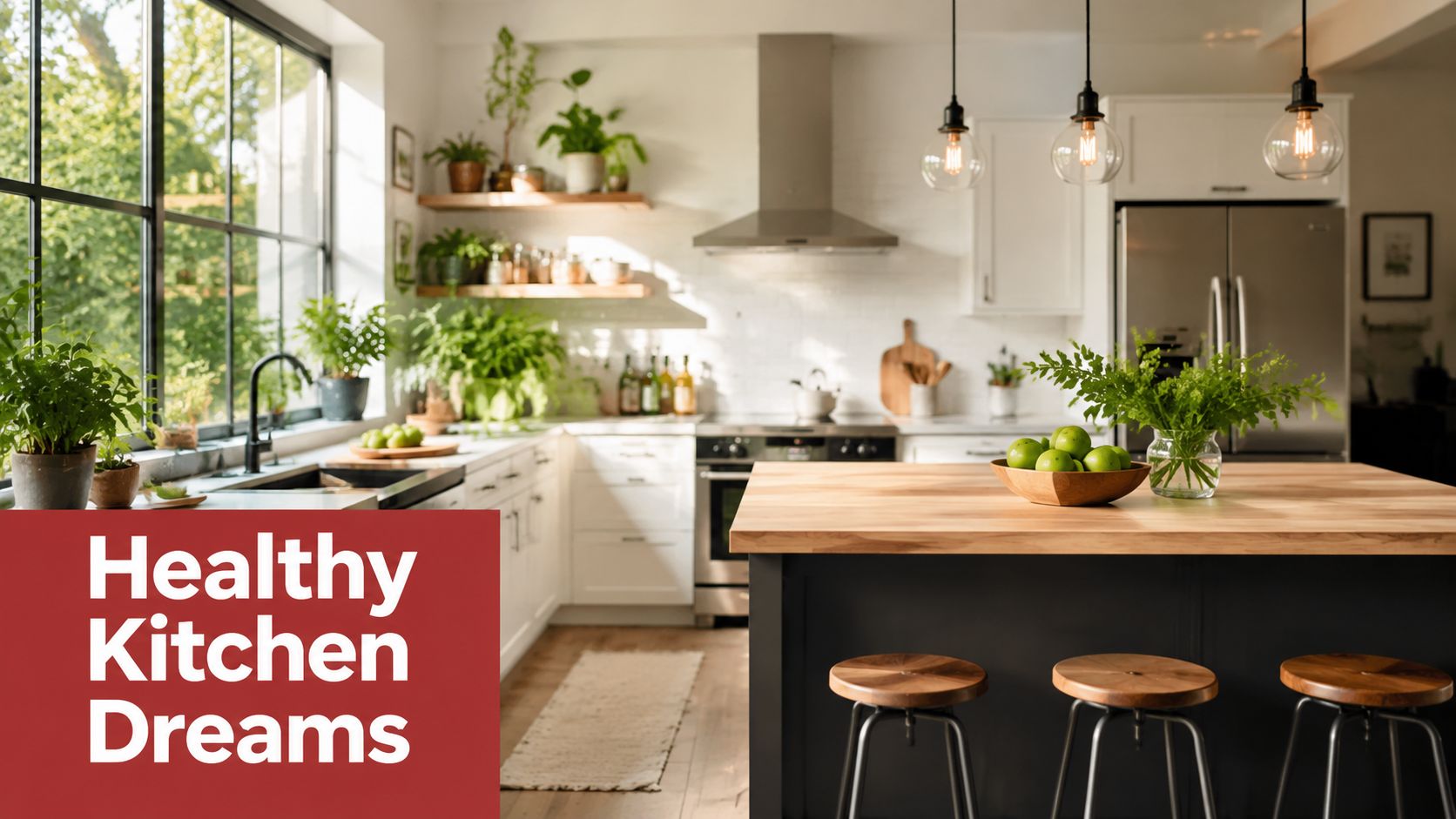
That doesn't mean every homeowner wants to rebuild the entire kitchen from scratch with specialty materials. Sometimes the smartest move is more modest. If the cabinet boxes are solid, refinishing or repainting can extend their life and keep good material out of the landfill. If you're exploring that route, this resource on how to transform your home with painted cabinets is a useful example of how appearance upgrades can work without defaulting to full replacement.
What most homeowners are really asking
The question usually isn't “What's the greenest cabinet on the market?”
It's closer to this:
- Will it last: Homeowners want to avoid paying for a remodel twice.
- Will it be safe indoors: Parents, pet owners, and anyone sensitive to chemical smells care about off-gassing.
- Will it still look good years from now: Sustainable doesn't help much if the finish chips early or the doors warp.
- Will the cost make sense: People can handle a smart premium. They don't want to overpay for a label.
A healthy kitchen isn't defined by a trendy door style. It's defined by what the cabinets are made from, what they release into the air, and how long they stay in service.
The good news is that environmentally friendly kitchen cabinets aren't a niche luxury anymore. There are practical options that balance durability, appearance, and indoor air quality. The harder part is separating meaningful standards from surface-level claims. That's where most of the decision should happen.
What Truly Makes a Cabinet Eco-Friendly
A cabinet isn't eco-friendly just because it has a wood look or recycled packaging. In practice, the best environmentally friendly kitchen cabinets meet three standards at the same time. They use responsible materials, they protect indoor air quality, and they avoid waste by lasting.
Start with what's inside the cabinet box
The most important detail is often the least visible. Box material matters more than the showroom finish sample because that's where many lower-cost products hide the chemicals that cause long-term off-gassing.
Environmentally friendly kitchen cabinets are technically defined by the complete absence of urea-formaldehyde in the box material, which eliminates volatile organic compound (VOC) off-gassing that degrades indoor air quality. For a standard $25,000 kitchen remodel using 15 panels of formaldehyde-free plywood, the incremental cost is only $100, according to Green Builder Media's overview of green kitchen cabinets.
In plain terms, that means the healthier choice often isn't a dramatic budget jump. It's usually a specification choice. You ask for a formaldehyde-free plywood or composite panel instead of a standard product built with urea-formaldehyde resin.
VOCs and formaldehyde without the jargon
VOCs are gases released from certain materials and finishes. In kitchens, that can come from cabinet boxes, doors, adhesives, stains, and clear coats. Formaldehyde is one of the chemicals homeowners should pay attention to because it can continue releasing over time from some engineered wood products.
A simple way to think about it:
| Cabinet feature | Better choice | Why it matters |
|---|---|---|
| Box panels | Formaldehyde-free plywood or compliant low-emission composite | Reduces off-gassing in the room |
| Adhesives | No added urea-formaldehyde options | Avoids a common source of emissions |
| Finish | Low-VOC or zero-VOC water-based coating | Cuts chemical odor and indoor residue |
The cabinet has to survive daily life
A cabinet that needs replacement too soon isn't a sustainable win. Real sustainability includes lifespan. If a cabinet box swells, delaminates, or loosens under normal kitchen use, the lower purchase price often turns into a higher lifetime cost.
That's why I tell homeowners to look past terms like “eco style” or “natural finish” and ask direct questions instead:
- What is the cabinet box made from
- Does it contain urea-formaldehyde
- What finish system is being used
- How does the product handle normal moisture and temperature swings
Practical rule: If a seller can't clearly explain the box material and finish chemistry, the eco claim isn't strong enough to rely on.
Exploring the Best Sustainable Cabinet Materials
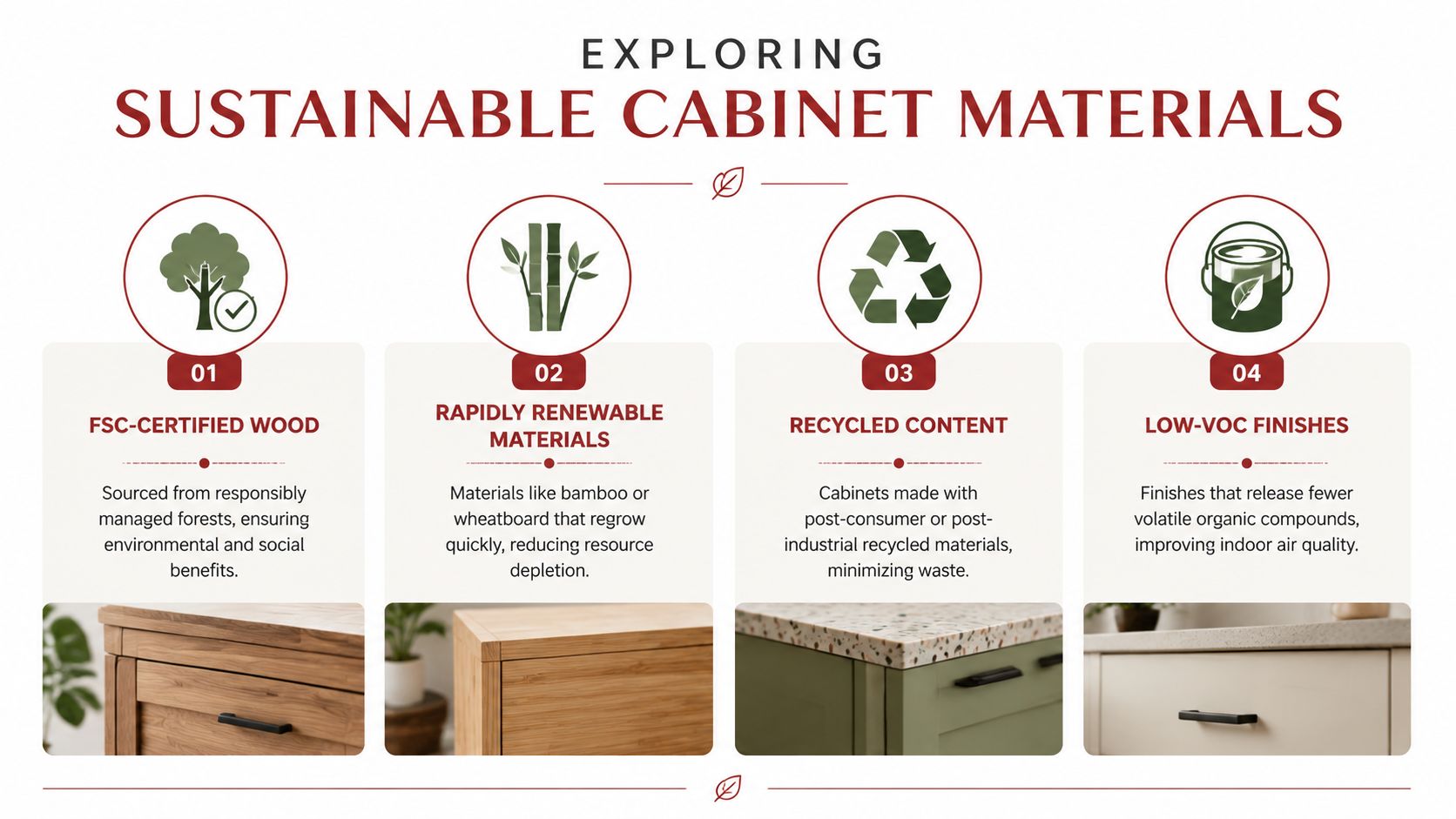
Not every sustainable cabinet material solves the same problem. Some are strongest on durability. Some reduce chemical exposure. Some make better use of forest resources. The right pick depends on whether your priority is lifespan, appearance, budget control, or reducing the environmental impact of a full replacement.
FSC-certified solid wood
If you want a premium material with a traditional feel, FSC-certified solid wood is hard to beat. It's durable, repairable, and usually ages better than lower-end manufactured products. It also carries a sourcing story that matters, because FSC certification is tied to responsible forest management and traceability.
One advantage that doesn't get enough attention is carbon storage. Wood-based kitchen cabinets serve as a significant carbon storage mechanism, with the domestic composite wood used by the North American Kitchen and Bath industry sequestering over 3,313,476 metric tons of naturally captured carbon in 2021 alone. Every kitchen constructed with wood-based cabinets stores hundreds of pounds of this captured carbon, according to the Kitchen Cabinet Manufacturers Association climate partnership infographic.
Best fit:
- Homeowners prioritizing longevity
- Kitchens where repairability matters
- Projects where natural grain is part of the design
Trade-off:
- Higher upfront cost
- Needs good finish protection in active kitchens
Bamboo and other rapidly renewable materials
Bamboo appeals to homeowners who want a modern sustainable story without giving up a clean furniture-grade appearance. It's fast-renewing, stable when well manufactured, and often works nicely in contemporary spaces.
The biggest caution is that bamboo quality varies. The material can perform well, but the adhesives and finish system still matter. A bamboo cabinet with questionable binders or coatings misses the point.
Reclaimed wood
Reclaimed wood has real character. It can reduce demand for newly harvested lumber and bring texture you can't fake. For accent areas, islands, floating shelves, or selected door styles, it's a strong design move.
That said, reclaimed wood isn't always the best choice for every full kitchen. It needs careful milling, consistent fabrication, and a design plan that keeps the room from feeling visually heavy.
Low-emission composite panels
For many kitchens, the most balanced option is a well-built composite cabinet using low-emission or no-added-formaldehyde panels paired with a durable low-VOC finish. This approach can offer cleaner lines, strong dimensional consistency, and better value than an all-solid-wood package.
The key is not to lump all engineered products together. There's a major difference between a cheap particleboard box and a better-grade low-emission composite built to current standards.
A side-by-side view
| Material | Strongest advantage | Watch for |
|---|---|---|
| FSC-certified solid wood | Durability and repairability | Price and movement if poorly finished |
| Bamboo | Renewable material story and modern look | Product quality varies by maker |
| Reclaimed wood | Character and reuse of existing material | Requires careful design and fabrication |
| Low-emission composite | Good value and stable construction | Must verify low-emission standards |
The best cabinet material isn't the one with the greenest label on the brochure. It's the one that fits the project, lasts, and avoids the weak points that lead to early replacement.
Decoding Eco-Labels and Certifications
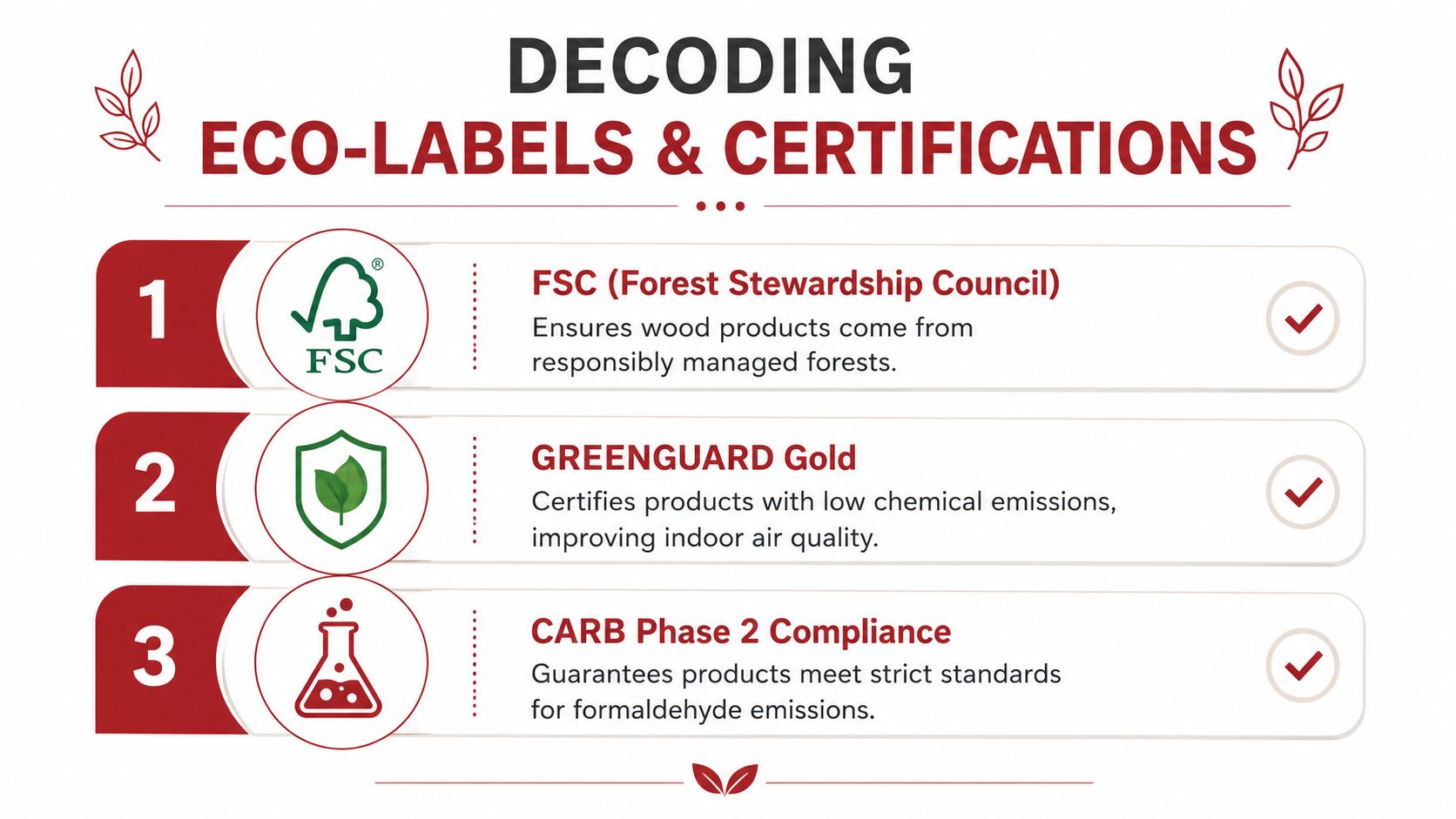
Labels can help, but only if you know what they verify. Homeowners see terms like FSC, GREENGUARD Gold, and CARB Phase 2 all the time, yet those marks cover different parts of the cabinet. One relates to sourcing. Another focuses on emissions. Another applies to formaldehyde limits in composite wood.
The labels that matter most
FSC matters when you want confidence that the wood supply chain is tracked responsibly. CARB Phase 2 matters when composite wood is involved and you want lower formaldehyde emissions. GREENGUARD Gold is most useful when you're evaluating finishes and emissions in lived-in spaces.
One technical detail is worth checking on the actual product. Eco-friendly kitchen cabinets must use composite wood panels certified by EPA-recognized third-party certifiers (TPC), with visible TPC numbers on product labels to verify low formaldehyde emissions. Only manufacturers holding valid FSC Chain of Custody certificates can legally use FSC marks, ensuring the wood is tracked from forest to finished product, as explained in this article on what makes kitchen cabinets eco-friendly.
What to ask before you buy
Don't settle for “yes, it's eco-friendly.” Ask for the exact paperwork or label detail.
- For composite panels: Ask where the TPC number appears on the label.
- For FSC products: Ask whether the manufacturer holds valid Chain of Custody certification.
- For finishes: Ask whether the finish is water-based and low-emission, and whether there's supporting product documentation.
- For the full cabinet: Ask which part is certified, because sometimes only one component qualifies.
Certifications work best when they answer a specific question. Responsible wood sourcing, low formaldehyde emissions, and cleaner finishes are not the same claim.
If you're trying to build a healthier kitchen as a whole, it also helps to think beyond cabinetry. Flooring choices affect the same indoor environment, and this guide to green flooring in Richmond, VA is a good example of how to evaluate other surface materials with the same skeptical mindset.
The Real Cost and Long-Term Value of Green Cabinets
Most cabinet discussions get stuck on the sticker price. That's understandable, because cabinets are one of the largest line items in a kitchen remodel. But if you only compare the initial proposal amount, you miss the bigger question. What will the kitchen cost over the years you live with it?
The smartest savings often come from keeping what still works
If existing cabinet boxes are structurally sound, replacing everything may not be the best move. Choosing to reface existing cabinets rather than replacing them entirely is the single most impactful sustainability decision, saving 8 to 12 mature trees and cutting 2.3 tons of CO₂ emissions. Financially, refacing costs 30–50% less than a full replacement, ranging from $4,000–$9,000 versus $12,000–$25,000+ for new FSC-certified cabinets, according to this breakdown of cabinet door sustainability metrics.
That's one of the few areas in remodeling where the greener choice can also be the obvious budget choice.
A lot of kitchens don't need a full tear-out. They need an honest assessment. If the boxes are solid, the layout still works, and the upgrade goal is mainly appearance, refacing or selective replacement can preserve value.
Upfront price versus cost per year
Environmentally friendly kitchen cabinets deserve a fairer conversation. A better-built cabinet can cost more at the start. But if it resists swelling, holds hardware properly, and keeps looking good through years of use, the yearly cost of ownership often compares much better than a bargain cabinet that ages out early.
Here's a practical way to think about budgeting:
| Decision path | Best when | Main advantage |
|---|---|---|
| Reface existing cabinets | Boxes are sound and layout works | Lower cost and less waste |
| Replace with low-emission composite cabinetry | You need a new layout but want value | Cleaner spec with controlled budget |
| Replace with FSC solid wood or bamboo | You want maximum lifespan and premium material | Strong long-term durability |
Don't ignore the hidden value
Some benefits don't show up neatly on a cabinet invoice. Cleaner indoor air matters if your family spends a lot of time in the kitchen. Better materials matter if you plan to stay in the home. And a cabinet system that doesn't need replacement early avoids another round of labor, disruption, and disposal.
To see how those choices might fit your own layout and budget, it helps to start with a rough planning number. You can get a preliminary estimate with the instant pricing tool for kitchen remodeling and compare whether refacing, selective replacement, or a full cabinet package makes the most sense before you go too far into design.
Evaluating Durability Maintenance and Lifecycle
The cabinet that looks good in a sample door display doesn't always perform well in a working kitchen. Southwest Michigan homes deal with seasonal humidity swings, dry winter air, summer moisture, and normal kitchen stress from steam, spills, and constant opening and closing. That local context matters.
Why better cabinets earn their keep
Data shows that quality sustainable cabinets last “two to three times longer” than cheap particleboard alternatives, making the long-term cost per year significantly lower despite the initial price jump, according to this review of eco-friendly cabinet materials for sustainable living. That difference matters more in places like Southwest Michigan, where humidity can expose weak construction quickly.
Cheap particleboard often fails in predictable ways. The edges swell after repeated moisture exposure. Fasteners loosen. Veneers peel. Once that process starts, repair options are limited.
What holds up better
Well-made sustainable cabinets tend to perform better because they start with better ingredients and construction choices. In day-to-day use, the strongest outcomes usually come from:
- Stable box materials: Better plywood or low-emission composite panels hold screws and hinges more reliably.
- Stronger doors and frames: Solid wood and quality bamboo generally tolerate long service better than bargain alternatives.
- Smarter finishes: Water-based low-VOC finishes can perform well when properly applied and cured.
In this climate, durability isn't just about hardness. It's about how a cabinet responds to repeated moisture changes without breaking down at the joints, edges, and hardware points.
Maintenance that actually helps
Most cabinet maintenance is simple. Wipe spills quickly. Use a mild cleaner instead of harsh degreasers. Keep the home's indoor moisture reasonably steady. Pay attention around sinks, dishwashers, and coffee stations where steam and drips collect first.
If you want cabinets to last, small habits matter more than specialty products. Homeowners don't need a complicated maintenance routine. They need consistency.
Choosing Your Sustainable Partner in Southwest Michigan
A sustainable kitchen project comes together when the design, material specs, and construction decisions all line up. That's why the contractor matters almost as much as the cabinet line. A good remodeler should be able to explain the difference between a low-emission panel and a generic one, tell you when refacing makes more sense than replacement, and steer you away from materials that won't hold up well in a Michigan kitchen.
Questions worth asking any remodeler
Bring these questions into your estimate meetings:
- What box material are you specifying
- Can you verify the panel and finish standards
- Do you recommend refacing, partial replacement, or full replacement for my kitchen
- How will this cabinet choice handle our local humidity
- What happens to removed materials during demolition
The best answers are direct and specific. If a contractor keeps things vague, that usually means the cabinet package hasn't been thought through carefully enough.
A good environmentally friendly kitchen cabinet plan doesn't have to be extreme. It has to be honest. Use healthier materials where they matter, preserve what still has life in it, and invest in construction that won't push you into another remodel too soon. For homeowners in Portage, Kalamazoo, and nearby communities, that's the combination that usually delivers the best long-term result.
If you're planning a kitchen remodel in Southwest Michigan and want practical guidance on durable, healthier cabinet options, Trademaster Construction is a strong local resource. Their team handles kitchen remodeling with a focus on design, craftsmanship, and realistic budgeting, and you can start by using their pricing tool to get a clearer sense of what your project may cost before scheduling the next step.