You've already got the cabinets picked out, the tile samples on the table, and a contractor promising the job will go smoothly. Then the paperwork conversation starts, and one question changes everything, is this contractor bonded, and what happens if the job goes sideways? That's where construction bond requirements stop being a technical detail and start becoming real protection for your budget, your schedule, and the people you've hired to do the work.
A bond is not just a form your contractor files and forgets. It's a financial backstop that can help keep a project moving when a contractor can't finish the work or pay the people behind the scenes. The federal model traces back to the Miller Act of 1935, which made bonded public construction the standard for federal work and later inspired state and local Little Miller Act rules across the country, including the public-project framework contractors run into today AZDOT's surety bond overview.
Homeowners in Michigan often hear the word “bond” and assume it means the same thing on every job. It doesn't. Public work, private remodels, contractor licensing, and owner-driven protections all work differently, which is why a Portage kitchen update and a municipal school renovation don't play by the same rulebook. If you've ever wondered why one contractor says a bond is mandatory while another says it's optional, the answer usually comes down to who owns the project, where the funding comes from, and what kind of risk is on the table.
For a plain-English comparison from another state, What are New Jersey construction bonds? is a useful companion read because it shows how the same core idea gets applied in a different market. The details change, but the purpose stays the same, protect the owner and make sure the work and the payments keep moving.
Introduction to Construction Bond Requirements
A homeowner usually hears about bond problems only after something has already gone wrong. A contractor walks off a job, a subcontractor sends a payment demand, or a lender asks for proof that the project is covered before releasing funds. That is when construction bond requirements stop being paperwork and start acting like a financial backup that can limit how messy the dispute becomes.
Why bonds exist at all
A bond is a promise backed by a surety. If the contractor does not perform or does not pay the people who helped build the project, the surety can step in under the bond terms and help address the loss. Federal procurement rules still require both performance bonds and payment bonds on qualifying public work over $150,000, unless a narrow waiver applies, and that rule comes from FAR Part 28.
The federal model traces back to the Miller Act of 1935, which established bonded construction as the standard for federal work and shaped state-level Little Miller Act rules, including Michigan's framework for public projects. For a homeowner, that history matters because it explains why bonded jobs are often treated as lower-risk by owners and lenders. A bond does not make a contractor perfect, but it does create a financial path for handling default, nonpayment, and unfinished work without leaving the owner to absorb every loss alone.
Practical rule: if a project is large, publicly funded, or tied to a lender, ask about bond language before you sign anything.
What a homeowner should look for
A bonded contractor should be able to show more than a verbal promise. Ask for the bond certificate, the surety name, and the bond type. For private work, the owner often sets the requirement, so the contractor may not volunteer those details unless you ask directly. Michigan homeowners who want to verify a contractor's status later should also expect to check with the Michigan Department of Licensing and Regulatory Affairs, or LARA, because bond questions and license questions often come up together.
On smaller remodels, homeowners often assume bonds are automatic. They are not. The requirement depends on the project type and the contract structure, not just the size of the kitchen or bathroom. Treat bond status the same way you would treat a permit or a warranty, ask for it early, review it carefully, and keep a copy with the contract.
If you are comparing contractors for a remodel, bond status should sit right beside price and timeline. A clean bid is good, but a bid backed by the right bond coverage gives you more room to handle trouble if the project runs into delays or payment disputes.
Types and Purpose of Construction Bonds
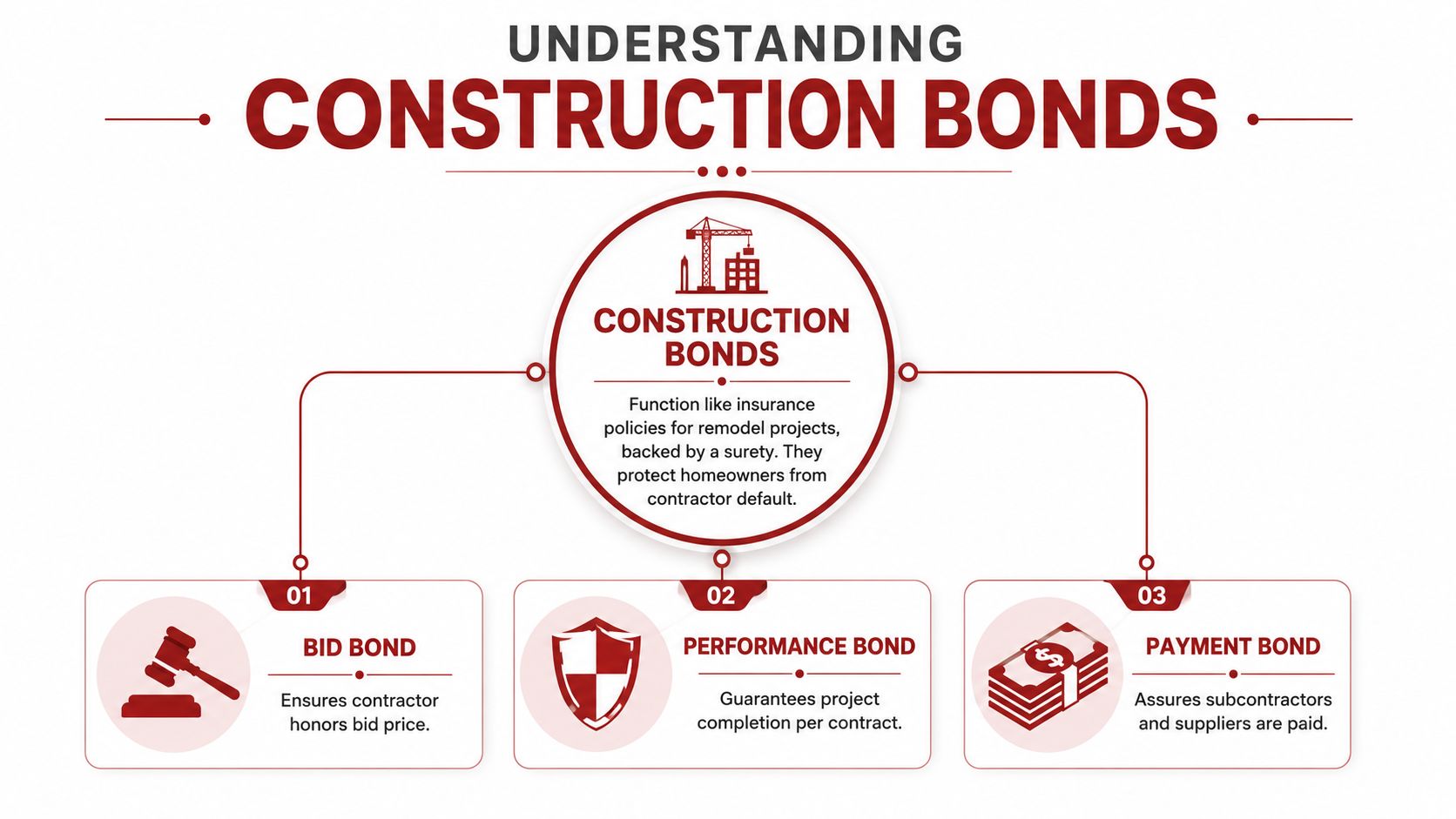
A construction bond works like a financial backstop. It does not make every project problem disappear, but it gives the owner a clear path if bidding, performance, or payment goes off track. In public work, the federal model built around the Miller Act separates performance protection and payment protection into the two core safeguards AZDOT's surety bond overview.
Bid bonds, performance bonds, and payment bonds
A bid bond shows the contractor stands behind the price in the proposal. If the contractor wins the job and then refuses to sign the contract or meet the bid terms, the bond gives the owner a financial remedy. It is best understood as a seriousness check at the bidding stage.
A performance bond covers finishing the work promised in the contract. If the contractor walks away, becomes unable to complete the job, or otherwise fails to perform, the surety has a financial duty tied to that failure. For public work, the usual standard is a 100% performance bond, which means the surety backs the full contract amount instead of only part of it general contractor bond requirements guide.
For a homeowner in Kalamazoo adding a large extension, that kind of bond matters because it helps keep the project from stopping halfway if the original contractor defaults.
A payment bond protects subcontractors, laborers, and suppliers. If the contractor does not pay them, the bond gives those parties a way to seek payment. That is one reason federal public projects require both bonds together, with the payment bond linked to the performance bond under federal law Miller Act bond summary.
A simple way to sort them out is this, a bid bond says the contractor will stand by the bid, a performance bond says the work will be finished, and a payment bond says the people who provided the labor and materials will have a route to recover what they are owed.
Why owners care even when they aren't required to
Homeowners may never need all three bonds on a kitchen remodel, but the idea still helps. A performance bond works like a completion safeguard if the contractor cannot deliver the project you paid for, because it creates a structured remedy instead of leaving the owner to absorb the loss alone. A payment bond helps keep the crew, suppliers, and specialty trades from getting stuck in the middle of unpaid bills.
That is also why bonded contractors often appear more credible on larger projects. Bonding means a surety has reviewed the contractor's financial standing and is willing to stand behind the work. It does not remove risk, but it does place that risk inside a system with rules, paperwork, and recourse. For owners comparing bids, that is a practical detail to check alongside the contract itself, and tools like LegesGPT's AI legal document generator can help organize contract paperwork while you review bond language.
Legal Requirements in Michigan Public and Private Projects
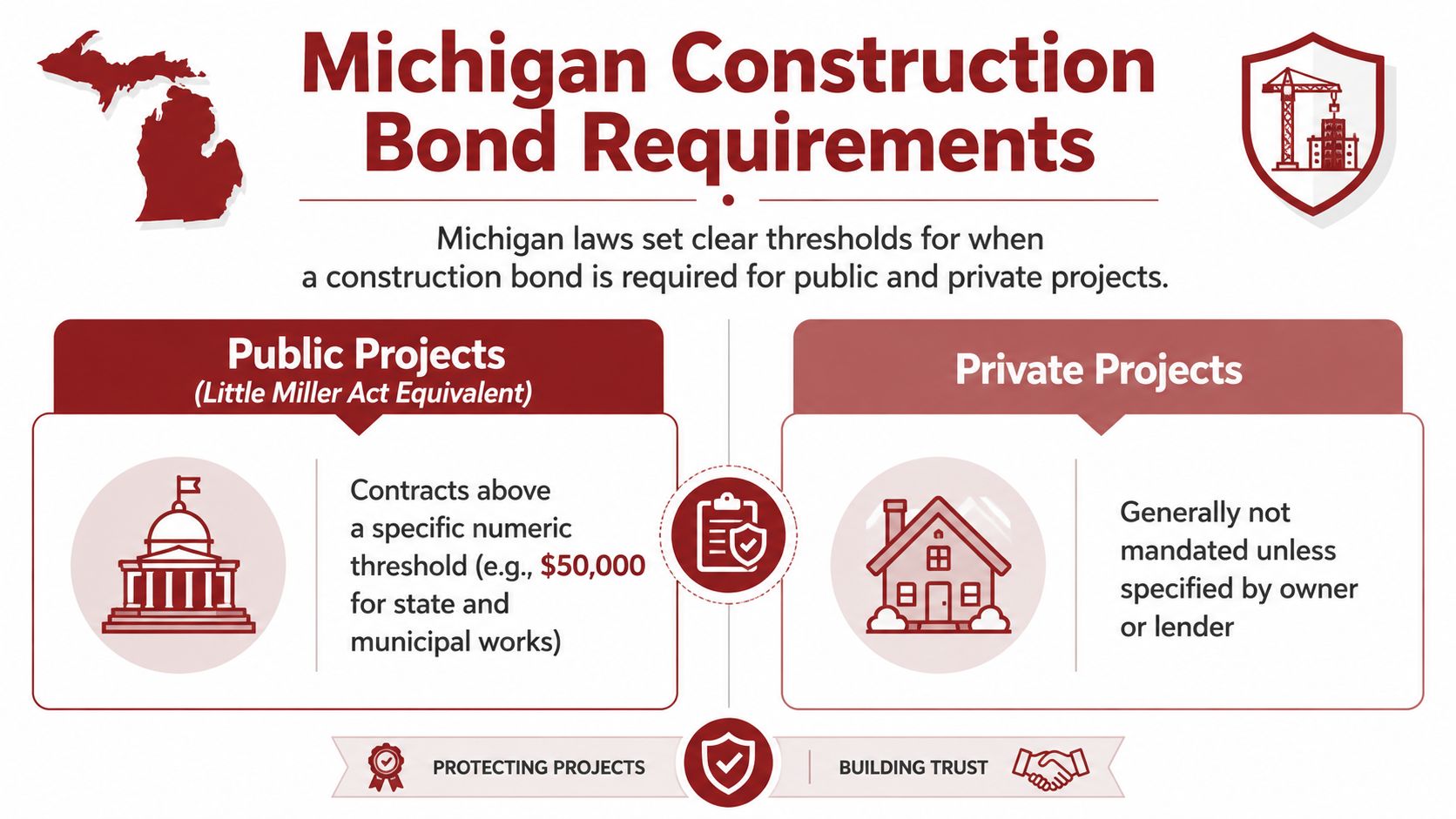
A Michigan homeowner can hear the word “bond” and still be left wondering whether it is a legal requirement or just a contract term. The answer depends on the type of project. Public work and private remodeling follow different rules, and that distinction matters more here than in many national guides.
Public projects follow stricter rules
Public construction usually comes with tighter bond requirements because public money and public oversight are involved. On many federally funded jobs, federal procurement rules and state Little Miller Act systems require performance and payment bonds for contracts over $150,000, unless an exception applies. The key point is the threshold. If the contractor cannot provide the required bond, the bid may never get past the front door. FAR Part 28
That is why school projects, city buildings, and other publicly funded jobs often ask for a more formal bond package. The owner is not just hiring a crew, they are also asking for a structured protection system if the contractor fails to finish the job or pay the people supplying labor and materials.
Private projects are owner-driven
Private remodels work differently. A homeowner can request a bond even when the law does not require one, and a lender can also make bonding part of the financing terms. A kitchen, bath, or basement project in Portage may not legally need a bond, yet the contract can still require one if the owner wants extra protection.
For private work, the best approach is to match the bond request to the size of the job and the payment schedule. If the contractor wants a large upfront payment or plans to use several subcontractors, a bond can serve as a practical risk-control tool rather than a paperwork formality. If you are drafting a private contract and want cleaner language, LegesGPT's AI legal document generator can help you understand how owners often organize project documents before a lawyer finalizes them.
Michigan-specific verification mindset
Michigan homeowners should keep three questions separate, is the work public or private, is the bond required by law or by contract, and who is responsible for enforcing it. That simple split prevents a lot of confusion. A school renovation, a city building job, and a bathroom upgrade can all involve construction bonds, but each one exists for a different reason.
Practical takeaway: if the project is public, expect close bond scrutiny. If it is private, treat the bond as a negotiated protection and make sure it is written into the contract.
How to Verify Your Contractor Bond

A contractor saying “we're bonded” is not enough. You want proof you can check, because the bond only helps if it's real, active, and tied to the correct job. For Michigan homeowners, the cleanest verification process starts with paperwork and ends with a direct check against the surety.
First, ask for the contractor's license number, the bond certificate, and the surety company name. Then compare the business name on the certificate to the name on the contract so you're not looking at a stale or unrelated bond. If the numbers or names don't line up, stop and ask for clarification before any deposit changes hands.
Second, use the Michigan Department of Insurance and the contractor's licensing records if the job involves a licensed contractor whose bond status should be visible through state compliance channels. You're looking for an active bond, not an expired one, and you want the coverage to match the entity that's doing the work. If anything looks off, call the surety directly and ask whether the bond is current.
Third, keep the bond certificate with the signed contract, permit paperwork, and payment schedule. That file matters if a dispute comes up later. For homeowners who want a broader legal context about contractor and job-site disputes, understanding New Jersey construction accident laws shows how quickly paperwork becomes important once a project turns contentious.
After you collect the documents, read them like a checklist, not a guess.
- Confirm the surety name: Make sure the issuer is a real surety company, not a generic insurance reference.
- Match the project party: The contractor name on the bond should match the entity signing your remodel agreement.
- Check dates: An active bond should cover the current project timeline, not last year's job.
- Save everything: Keep digital and paper copies in the same folder as your estimate, permit, and change orders.
If the bond can't be verified in writing, treat it as unconfirmed until the surety proves otherwise.
Costs and Alternatives to Construction Bonds
A bond can change the price of a remodel in ways homeowners do not always expect. It is not a fixed line item that looks the same on every job. The amount depends on the contract value and the contractor's risk profile, so two similar projects can still carry different prices because the contractor behind them is not the same bond premium guide.
What bond pricing usually looks like
Bond premiums commonly run about 0.5% to 5% of contract value, and a $1 million project often costs roughly $10,000 to $30,000 depending on the contractor's financial strength and underwriting profile bond premium guide. For a homeowner in Southwest Michigan, that kind of pricing can matter even on a mid-sized remodel. A $75,000 kitchen remodel in Portage, for example, could add anywhere from about $750 to $3,750 if a performance bond is required, depending on the contractor's history and the job's risk level. Those costs may show up inside the bid, get passed through in the contract, or be absorbed by the contractor.
For budgeting, it helps to compare bonds with other protections side by side. A bond is one piece of the financial picture, and each alternative solves a different problem.
| Bond Alternatives Comparison | Typical Cost | Pros | Cons |
|---|---|---|---|
| 100% performance and payment bonds | Often priced as a percentage of contract value | Strong project protection, clearer recourse if the contractor fails to finish or pay subcontractors | Adds cost, and the contractor must qualify for underwriting |
| Remodeler insurance policies | Varies by policy | Helps cover liability and property damage | Does not replace the contractor's bonding obligation or guarantee project completion |
| Project escrow accounts | Depends on the agreement | Gives the owner more control over payment timing and release | May not protect against mechanic's liens in Michigan if a contractor fails to pay subcontractors |
The comparison matters because homeowners sometimes ask for insurance when what they really need is a bond. Insurance and bonds solve different problems. Insurance addresses covered losses. A bond is about whether the contractor performs and pays according to the agreement.
When alternatives make sense
Some smaller private jobs work well with escrow or staged payments instead of a formal bond. That can keep a simple project moving without adding much paperwork, especially when the contractor has a strong local record and the scope is easy to define. Once the work gets larger, or several subcontractors are involved, a bond gives the homeowner a cleaner way to handle a default than a loose payment agreement.
If you are still sorting out the numbers, start with the total project cost before you sign. You can use our instant pricing tool to get a quick cost range and then compare that estimate with bond premiums, insurance riders, and your payment schedule. That makes the bond conversation easier to understand, because you can see how the protection cost fits into the full remodel budget.
Practical Checklist for Southwest Michigan Remodels
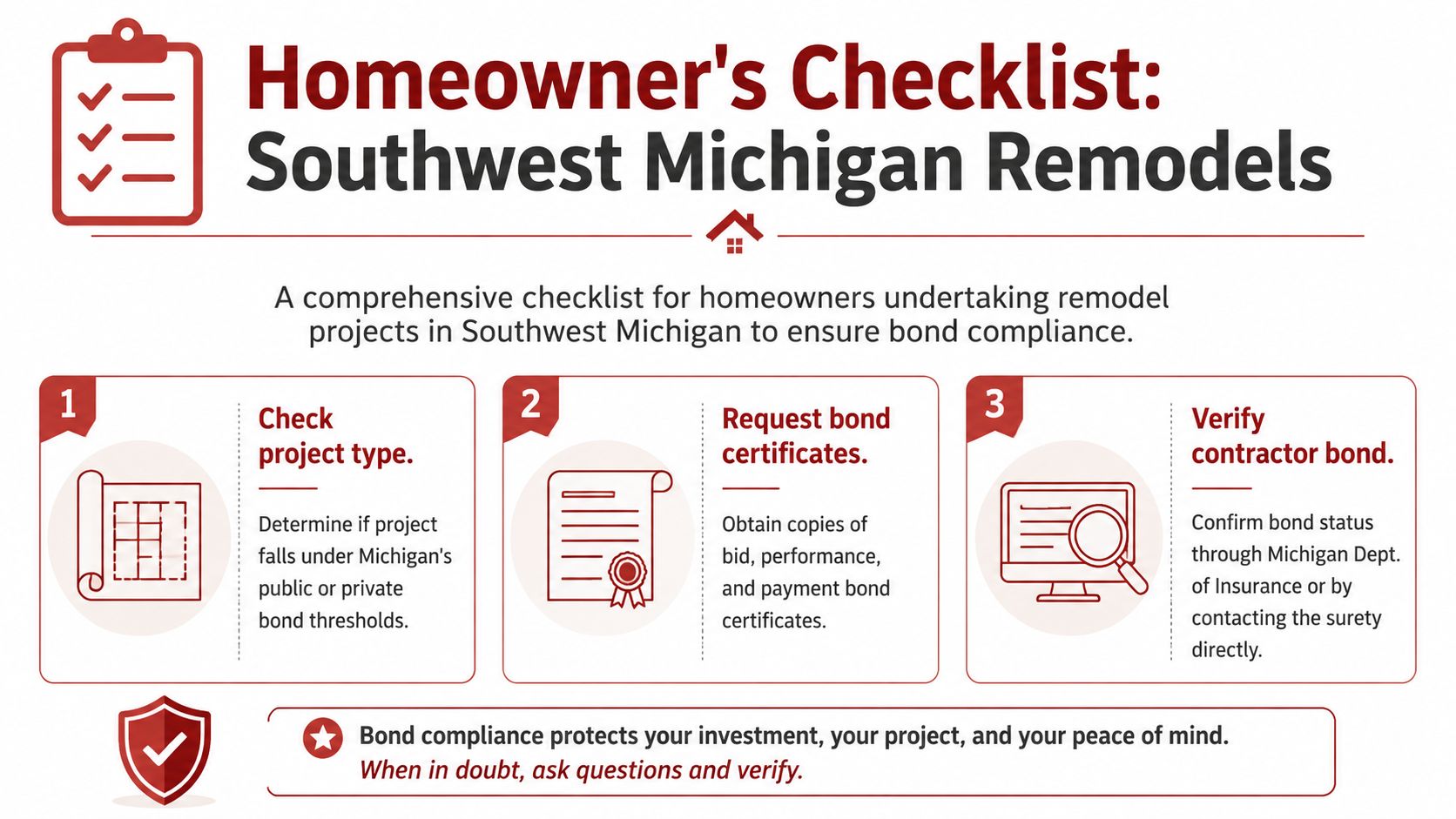
A remodel in Southwest Michigan can move quickly from a simple idea to a signed contract, and that is usually the point where bond questions start to matter. The easiest way to handle them is to check the project type first, then confirm the contractor's bond status, then review the money side. That order keeps you from focusing on price before you know whether the contractor has the coverage the job calls for.
Start with the project itself. A public job, a private remodel, and a lender-controlled project can each call for different proof, so the bond discussion should match the setup instead of using a one-size-fits-all assumption.
- Check project type: Decide whether your remodel is a public job, a private job, or a lender-controlled project.
- Request bond certificates: Ask for bid, performance, and payment bond documents before final signatures.
- Verify contractor bond: Confirm the bond through state records or by calling the surety directly.
- Match the names: Make sure the company on the bond matches the company on the contract.
- Review the dates: Confirm the bond is active for the full project window.
- Compare costs: Look at the bond premium alongside other project protections.
- Estimate the total budget: Use a pricing estimate before you commit, so the bond conversation sits inside the full remodel budget.
- File everything: Keep bond records with permits, contracts, and change orders in one place.
The strongest habit is to treat the bond like part of the contract file, not like an extra paper to handle later. That matters because a bond is there to back up performance and payment if the job slows down or the contractor's money runs tight. When homeowners in Southwest Michigan verify the bond early, they give themselves a cleaner path if a dispute ever surfaces.
Frequently Asked Questions
What happens if a contractor's bond claim is disputed? The surety usually reviews the contract, the bond language, the payment history, and the alleged default before making a decision. Homeowners should keep all written records so the dispute can be sorted out with facts instead of memory.
Can a private homeowner require a bond on a small renovation? Yes. Private owners can ask for bonding even when the law doesn't require it, though the contractor may price that risk into the bid. For small jobs, some owners prefer escrow or staged payments instead, especially when the scope is limited.
How soon must a bond be in place before work begins? For public work, the bond should be secured before the contractor starts performing under the contract. For private work, the safest rule is even stricter, don't let mobilization begin until the bond certificate is in your file and matches the signed agreement.
What documentation should be kept to enforce a bond claim? Keep the signed contract, the bond certificate, payment records, change orders, emails, photos, and any notice you sent about delays or nonpayment. The cleaner the paper trail, the easier it is to show what happened if the surety has to get involved.
If you're planning a remodel in Portage, Kalamazoo, or anywhere in Southwest Michigan, use our instant pricing tool to get a fast cost estimate before you sign anything, then compare that number against the bond and payment terms in your contract. That simple step can help you spot risk early and choose a contractor with the right mix of price, proof, and protection.