You're two weeks into a kitchen gut in Kalamazoo, standing in a Home Depot aisle with a cabinet sample in one hand and a phone full of Pinterest saves in the other. The big-box associate has one recommendation, a boutique showroom has sent a polished quote, and a local lumber yard has given you a completely different number. Meanwhile, your remodeler needs decisions before the next phase starts.
That confusion is normal. Home remodeling stores aren't interchangeable, and the cheapest shelf price can become the expensive choice once freight, missing parts, special orders, returns, and schedule delays enter the picture. The right buying channel depends on the room, the finish level, the amount of design help you need, and how closely the purchase must follow your contractor's timeline.
Staring Down the Aisle and Wondering Where to Start
A kitchen remodel rarely fails because someone couldn't find a faucet. It gets into trouble because the faucet, sink, countertop, cabinet, and plumbing rough-in don't agree with one another. A homeowner may visit three stores and receive three reasonable recommendations, yet still lack a coordinated plan.
For Southwest Michigan homeowners, the first useful question isn't “Which store is cheapest?” Ask, “Which store can help me make the right decision for this phase of the work?”
Practical rule: Buy ordinary, readily replaceable materials wherever convenience makes sense. Buy schedule-sensitive, fit-sensitive, or highly visible materials where accountability matters most.
Big-box retailers such as Home Depot and Menards are useful when you need common materials, tools, commodity tile, or an item today. Specialty showrooms are stronger when cabinetry, countertops, plumbing fixtures, lighting, and finishes need to work together visually. Independent suppliers, including lumber yards, plumbing wholesalers, and stone fabricators, often bring trade knowledge that a general retail counter can't match.
The market is large and established. The U.S. home improvement retail market was estimated at about $298.4 billion in 2026, with 5,090 businesses operating in the sector, which expanded at a 6.5% CAGR from 2021 to 2026 (market data on the home improvement retail industry). That scale gives homeowners plenty of choice, but it also makes comparison harder.
This guide follows the practical path I recommend: compare the three channels, test each store before committing, create a room-by-room checklist, set a budget by finish grade, and coordinate every delivery with the remodeler's schedule. That approach works whether you're updating a Portage bathroom, finishing a Kalamazoo basement, or replacing a kitchen in a nearby Southwest Michigan community.
Big-Box Stores, Specialty Showrooms, and Local Suppliers Compared
Big-box stores win on reach and convenience. Home Depot and Menards are useful for standard lumber, drywall, fasteners, basic flooring, tools, commodity tile, and common plumbing parts. They can also make sense for off-the-shelf cabinets when the layout is straightforward and you're comfortable managing measurements, assembly, and missing-part follow-up yourself.
Specialty showrooms take a different approach. A good showroom can coordinate cabinet door styles, countertop edges, sinks, faucets, hardware, tile, lighting, and installation details in one design conversation. You'll usually see deeper selections and better access to finish samples, but special-order products can carry stricter return rules and longer waiting periods.
Independent suppliers are the trade-oriented option. A Kalamazoo-area lumber yard may know which framing products are available, while a plumbing wholesaler can help match valves, trim, and rough-in components. A stone fabricator can explain templating, seam placement, support requirements, and the consequences of changing a cabinet dimension late in the job.
| Channel | Best For | Watch Out For |
|---|---|---|
| Big-box retailer | Stock materials, tools, standard tile, commodity products, and one-stop purchasing | Design help may be limited, product depth can vary by location, and special-order support may pass between departments |
| Specialty showroom | Coordinated kitchens, bathrooms, finish-heavy selections, cabinetry, plumbing, countertops, and lighting | Higher design or product costs, stricter returns, and lead times that must be confirmed in writing |
| Local supplier | Trade expertise, custom work, lumber, plumbing components, stone, and job-specific problem solving | Smaller public-facing selection, account requirements, and fewer casual browsing options |
For exterior work or decking decisions, a homeowner can also learn from a dedicated showroom model such as visit a decking showroom, where product systems and installation considerations are presented together. The lesson applies indoors too: seeing coordinated components in person often exposes compatibility issues that online browsing hides.
The category's concentration explains why homeowners encounter the same large retailers repeatedly. During the first half of 2024, Home Depot held 17.1% of dollar share, Lowe's held 15.2%, contractor channels held 10.3%, Amazon held 6.4%, and Walmart held 4.9% (home improvement channel share data). The same source's 2023 snapshot listed 2,314 Home Depot stores and 1,974 Lowe's stores. Scale is useful, but it isn't the same thing as project coordination.
How to Evaluate a Home Remodeling Store Before You Buy
Give each store the same test. Bring a rough floor plan, room photos, and the actual questions your remodeler has raised. A store that looks impressive online should still earn your order at the counter.
Start with availability, not appearance
Ask for the exact cabinet line, tile series, finish, model number, and quantity you need. Don't accept “we can get it” as a lead-time answer. Ask whether the material is physically on hand, how many complete units are available, whether matching lots are available, and what happens if part of the order is backordered.
Tile deserves special attention because color and shade can vary between production runs. Natural stone needs an even closer look at slab availability, movement, thickness, edge treatment, and fabrication timing. If you're comparing surface materials, a technical reference such as this practical guide to Katni marble can help you prepare better questions before you visit a supplier.
Test the design help
Hand over your plan and ask for a layout, take-off, and itemized quote. A capable kitchen or bath representative should ask about appliance clearances, plumbing locations, door swings, electrical needs, storage goals, and installation responsibility.
For a basement, ask who is accounting for ceiling height, posts, ductwork, egress, moisture concerns, stairs, and mechanical access. If the representative only points to product displays, you're shopping, not planning.
Read the terms line by line
Before paying, confirm:
- Returns: Ask about unopened goods, opened cartons, custom products, restocking fees, and damaged materials.
- Freight: Find out whether delivery is included, who unloads, and who pays if the truck can't access the property.
- Warranty: Ask who handles defects, replacements, and color or finish discrepancies.
- Accountability: Identify the person who will remain responsible after the order is placed.
Get lead times and exclusions in writing. A verbal promise at the register won't protect your schedule when a cabinet, valve, or replacement tile is missing.
The Practical Shopping Checklist Every Remodeler Needs
A useful checklist starts before you walk into a store. Begin with the room's physical facts, then move toward product decisions, then lock those decisions to the construction calendar.
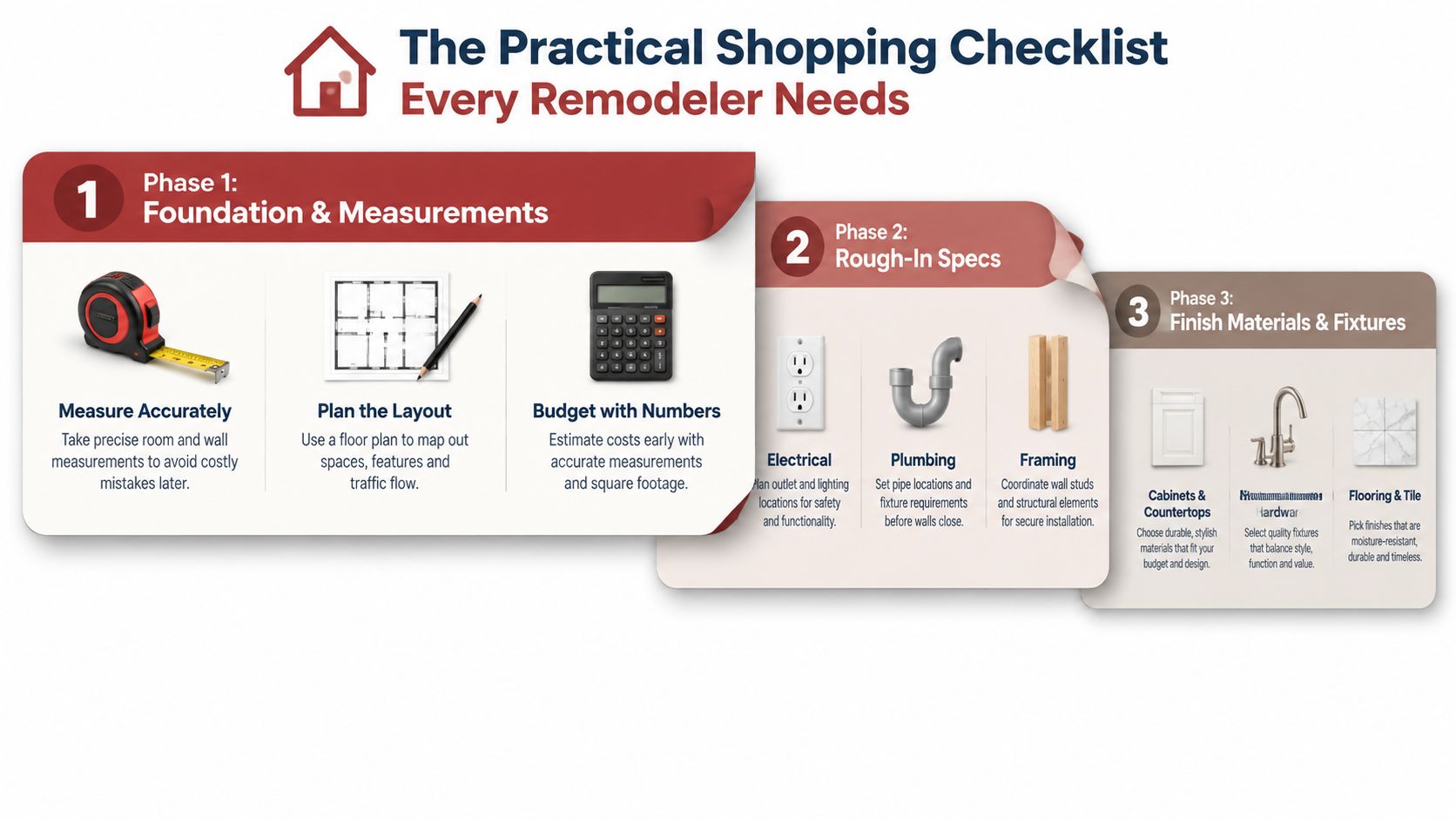
Phase one starts with the room
Record rough length, width, ceiling height, door openings, window locations, stair conditions, and any fixed obstructions. In a kitchen, note appliance dimensions and the locations of water, waste, gas, and electrical connections. In a bathroom, record the toilet centerline, drain location, valve position, fan location, and available wall space.
Don't measure only the visible finish. A cabinet quote based on an inaccurate wall length can affect fillers, panels, countertop sizing, and appliance clearances.
Phase two captures the rough-in
Write down the electrical circuit needs, outlet locations, plumbing rough-ins, framing clearances, vent paths, blocking requirements, and access panels. Accessible bathrooms need especially careful coordination. The U.S. Access Board standard requires grab bars, fasteners, and backing to withstand 250 pounds of force, with 1.5 inches of wall clearance, and specifies a toilet seat height of 17 to 19 inches (accessible bathroom technical guidance).
A curbless shower has a near-zero entry threshold, with accessibility guidance commonly limiting the threshold to 1/2 inch, or 13 mm (curbless shower definition and guidance). Plan the framing, slope, waterproofing, drain, backing, controls, and grab bars before ordering the visible fixtures.
Phase three identifies finishes and timing
List the exact SKU, model number, finish, color, size, quantity, and approved substitute for every major item. Then add the promised in-stock date and delivery window beside it. Your final quote meeting should include:
- Measurements and plans: Bring marked-up drawings and rough-in notes.
- Photos: Include walls, floors, ceilings, utilities, access routes, and problem areas.
- Inspiration images: Use them to communicate style, not as a substitute for dimensions.
- Rules: Bring HOA requirements if you live in a condo or governed community.
- Scope summary: Keep the project description to one page, including what is included and excluded.
Budgeting Smart Across Store Channels and Finish Grades
Budgeting by room alone is too vague. Set a target for each category before a salesperson shows you upgrades, then decide where flexibility exists. Cabinets, countertops, plumbing fixtures, flooring, lighting, tile, labor, freight, and installation accessories all compete for the same budget.
Kitchen scope changes the financial picture sharply. A minor kitchen remodel is listed at about $27,492 and can recoup roughly 96% nationally, while major midrange and upscale remodels recoup about 38% and 35%, respectively (kitchen remodel return-on-investment data). Those figures aren't a promise of resale value for your house, but they do show why a carefully controlled refresh can behave differently from a full luxury redesign.
Match the finish grade to the project
Builder-grade materials can be sensible for a rental, basement utility area, or short-term improvement. Mid-grade products usually offer a stronger balance of durability, appearance, and replacement availability. Premium finishes make sense when the room's design, daily use, and long-term ownership justify the added cost.
| Category | Builder Grade | Mid Grade | Premium Grade |
|---|---|---|---|
| Cabinets | Standard sizes, simpler finishes, limited customization | Better construction options, broader storage accessories, coordinated finishes | Custom dimensions, specialty storage, upgraded doors, and detailed interior fittings |
| Countertops | Practical laminate or basic solid surface options | Durable surfaces with broader color and edge choices | High-end stone, distinctive slabs, complex edges, and more fabrication decisions |
| Plumbing fixtures | Common finishes and basic functions | Better finish selection, stronger feature sets, and coordinated collections | Designer collections, specialized functions, and higher replacement cost |
| Flooring and tile | Readily available, straightforward patterns | More texture, format, and design flexibility | Specialty materials, intricate layouts, custom mosaics, and more demanding installation |
Big-box stores often serve builder and mid-grade needs efficiently. Showrooms become more valuable as the finish plan gets more coordinated or customized. Local suppliers can reduce uncertainty for structural materials, specialty fabrication, and trade-specific components, but they may not offer the same casual return flexibility as a general retailer.
Keep a separate line for delivery, freight, restocking, design services, replacement parts, and installation accessories. A low product price doesn't remain low if the order arrives incomplete or the contractor must stop work while you source a missing component.
Coordinating Purchases and Deliveries With Your Contractor
Your remodeler's schedule should control deliveries, not the other way around. A truck arriving early can block the work area, damage fragile materials, or force you to store products in a damp or unsecured space.
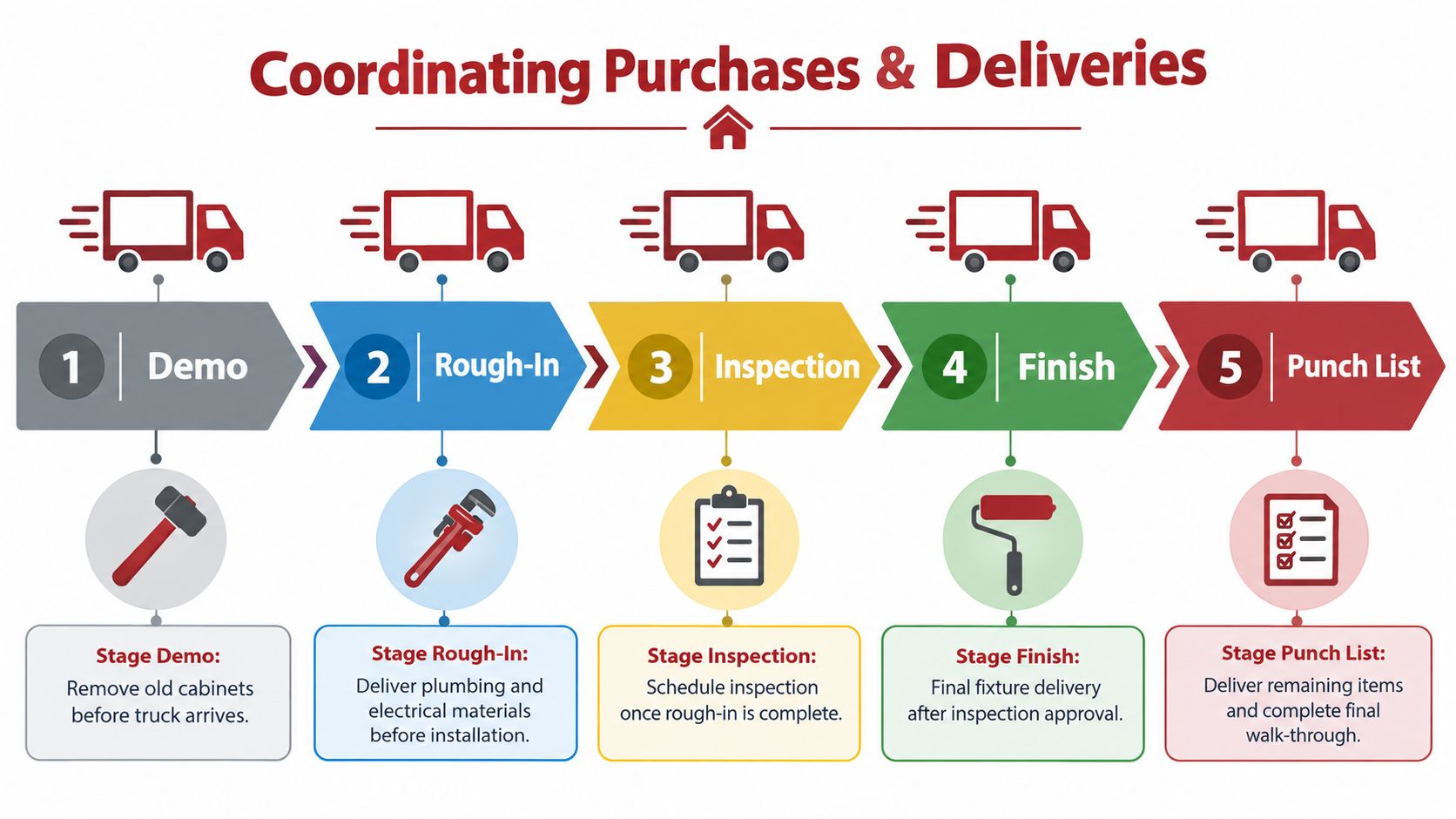
Use the construction phases as your delivery map
Demo: Remove old cabinets, fixtures, flooring, and damaged finishes before new materials arrive. Confirm that the access path is clear and decide where deliveries will be staged.
Rough-in: Bring plumbing, electrical, framing, blocking, and mechanical components when the crew is ready to install them. Don't store finish fixtures in a rough construction zone.
Inspection: Hold back finish-sensitive materials until rough work has been reviewed and approved. This is especially important for shower systems, wall tile, cabinets, and countertop templates.
Finish: Schedule cabinets, tile, flooring, plumbing trim, lighting, and appliances according to installation order. A tile delivery before substrate preparation creates clutter, not progress.
Punch list: Reserve replacement pieces, touch-up materials, hardware, and final accessories for the closeout phase. Confirm that all backordered parts have a documented delivery date.
The homeowner and contractor should agree in advance about who verifies quantities and signs for each delivery. On arrival, inspect cartons, finishes, model numbers, visible damage, and the number of boxes or pieces. Photograph damage before accepting the shipment, write exceptions on the delivery record, and notify the store immediately.
Delivery rule: Never let a store's available date overrule the contractor's ready date.
For practical communication habits and accountability questions, review this bathroom remodel contractor advice before work begins. Keep one shared list showing the item, supplier, ordered date, promised date, actual arrival, inspection result, and person responsible for follow-up.
A short visual walkthrough can also help homeowners understand how deliveries fit into active work:
Local Resources and Your Next Step in Southwest Michigan
Southwest Michigan homeowners don't need to force every purchase through one retailer. Use the channel that fits the material and the phase. A Kalamazoo or Portage showroom can make sense for kitchen cabinets and coordinated bathroom selections. A specialty vendor in Grand Rapids may offer deeper tile or finish options. An independent yard in or near St. Joseph may be the practical choice for framing lumber and jobsite materials.
That split-channel approach reflects how people shop. HIRI reports that big-box retailers remain the dominant purchasing channel, while specialty suppliers are used for about one-third of projects involving interior finishes and mechanical systems (home improvement spending and channel guidance). The same source reports that about 45% of consumers blend online research with in-store purchases, 77% of DIYers use retailer websites for product comparisons, and retailers are expanding digital tools and AI guidance.
Use those tools for research, then bring confirmed selections to your remodeler. For cost planning, Trademaster Construction's instant pricing tool can help turn a kitchen, bathroom, basement, or tile concept into a working estimate before you commit to a coordinated shopping list. Treat the result as a planning number, then verify site conditions, product selections, labor, delivery, and scope during a walkthrough.
Trademaster Construction serves Portage, Kalamazoo, and nearby Southwest Michigan communities with kitchen remodeling, bathroom renovations, custom tilework, and basement finishing. The practical next step is simple: use the estimate to stress-test your finish grade, request a second opinion on an existing plan, or schedule a walkthrough before placing special orders. For follow-up questions, warranty support, and referrals to local trades, review the company's project gallery and contact options.
Trademaster Construction can help coordinate kitchen, bathroom, basement, and custom tile decisions with the shopping and delivery schedule your project requires. Visit Trademaster Construction to review project examples, start an estimate, and request a conversation about your Southwest Michigan remodel.