
So, you're thinking about a tile project? Great choice. Whether it's a new kitchen backsplash or a full bathroom floor, tile adds timeless style and value. But the big question is always the same: what's this going to cost me?
Nationally, a standard tile installation project usually lands somewhere between $1,500 and $4,500. That number covers the basics—materials, labor, and supplies—and gives you a solid starting point for your budget. Of course, the final bill can swing quite a bit depending on the tile you fall in love with and how complex the job is.
Your Guide to Tile Installation Costs
Jumping into a tile project can feel a little overwhelming with all the prices and options out there. This guide is here to cut through the noise and give you clear, straightforward answers. We want you to feel confident building a realistic budget for your project, from start to finish.
Let's break it down into two main buckets: the cost of the tile itself (materials) and the cost to have a pro install it (labor). The price tag you see on a box of tile is just one piece of the puzzle.
Tile Installation Cost At a Glance
To get a quick snapshot, it helps to look at costs on a per-square-foot basis. This makes it much easier to estimate what you might spend, whether you're tackling a tiny powder room or a sprawling living area.
Here’s a simple breakdown of what you can expect to pay for each part of the job.
| Cost Component | Average Cost Range (per sq. ft.) |
|---|---|
| Basic Materials (Ceramic/Porcelain) | $2 – $10 |
| Premium Materials (Stone/Glass) | $10 – $50+ |
| Professional Labor | $5 – $20 |
| Supplies (Adhesive, Grout, Sealer) | $1 – $3 |
| Total Estimated Cost | $8 – $83+ |
As you can see, the range is huge. A project using classic, budget-friendly ceramic tile will keep you at the low end of that spectrum. But if you've got your heart set on luxurious marble or intricate glass mosaics, expect to be at the higher end.
Your project's final cost is a direct reflection of your design choices. While labor rates are relatively consistent, the material you choose—from economical ceramic to high-end natural stone—is the single biggest variable that will shape your budget.
Getting a handle on this financial landscape is the first step toward a successful renovation. It’s no secret that costs for both materials and labor have been climbing. In 2025, the national average for a complete tile flooring project often falls between $2,700 and $5,780. That's a noticeable jump from the $1,000 to $3,000 range we saw just a decade ago. It's worth a moment to explore more about these evolving tile costs and what they mean for homeowners planning a project.
Don't worry, we'll walk you through every factor so you can move forward feeling prepared and in control.
Understanding the Two Main Costs: Labor and Materials
Every tile project's price tag is really a tale of two parts: the materials you see and the skilled labor you don't. It's a lot like a restaurant bill—you have the cost of the ingredients (the materials) and the cost of the chef who turns them into a great meal (the labor). Getting a handle on how these two pieces fit together is the first step to building a smart budget.
The final cost of any tile installation always comes down to this fundamental split. While the beautiful tiles you picked out are the star of the show, the expertise needed to lay them perfectly is just as crucial. You can't have a long-lasting, professional result without both.
Deconstructing Labor Costs
Professional tile setters have a few different ways of pricing their work, and it usually depends on the job's size and what's common in your area.
- Per Square Foot: This is the method you'll see most often. Installers charge a set rate for each square foot they tile, typically falling somewhere between $5 and $20 per square foot.
- Per Hour: For smaller jobs, tricky repairs, or highly detailed work, an hourly rate just makes more sense. For a skilled pro, you can expect to pay anywhere from $60 to $150 per hour.
- Day Rate: Some contractors prefer to charge a flat rate for a full day's work. This can be a good way to go for projects that will clearly span several days.
The complexity of the job is a huge factor here. Laying large, simple tiles on a flat, open floor is one thing. But installing a complex herringbone pattern in a tiny bathroom with dozens of cuts around a toilet and vanity? That takes way more time and precision, which naturally drives up the labor cost.
Remember, you're not just paying for someone to stick tiles to a wall. You're investing in their experience, their specialized tools, and their knowledge of how to prep the surface so your tile job still looks fantastic years from now.
Your geographic location also plays a big part. Labor costs in major cities are almost always higher than in rural towns, thanks to differences in the cost of living and running a business. For instance, tiling costs can vary dramatically by region even in other countries. In the United Kingdom, the average cost of tile installation is about £110 per square meter, but prices in a major hub like London can be 20% higher. You can dive deeper into these international cost breakdowns on hyperiontiles.co.uk.
Accounting for Material and Supply Costs
Beyond the tiles themselves, a proper installation depends on a whole host of other supplies. These are the unsung heroes of your project, and they absolutely need a line item in your budget. Think of them as the foundation and framework of a house—you don't see them, but they're critical for stability and a good finish.
These behind-the-scenes materials usually add $1 to $3 per square foot to your total, but can climb higher for specialized jobs like a full shower waterproofing system.
Essential Tiling Supplies Breakdown:
- Adhesive or Mortar: This is the "glue" that bonds the tiles to the surface. The right kind depends on your tile and where it's being installed.
- Grout: This is what fills the gaps between tiles, locking everything together and keeping dirt and moisture out.
- Backer Board: For wet areas like bathrooms and showers, a cement-based backer board goes down first. It creates a stable, water-resistant base that won't warp or rot.
- Sealer: Porous tiles like natural stone—and even the grout itself—need a sealer to protect them from stains and water damage.
When you get a quote from a contractor, these items should be clearly listed. A detailed estimate that breaks down both labor and all the necessary materials is the sign of a true professional and gives you a complete financial picture, so there are no surprises later.
How Your Choice of Tile Shapes the Final Price
When you're mapping out a tile project, the tile itself is the headline act. Think of it like buying a car—choosing a basic sedan versus a luxury SUV will set a completely different budget from the very start. The material you pick is the single biggest factor that sways the final cost, not just because of its price tag but because it dictates the entire installation process.
Some tiles are cooperative and easy to work with, while others demand a true artisan's touch and specialized gear. That difference is where a straightforward job can quickly turn into a more complex, and expensive, one.
This infographic gives a great visual of how the budget for a typical tile project breaks down. It's often a close split between the materials you see and the skilled labor you don't.
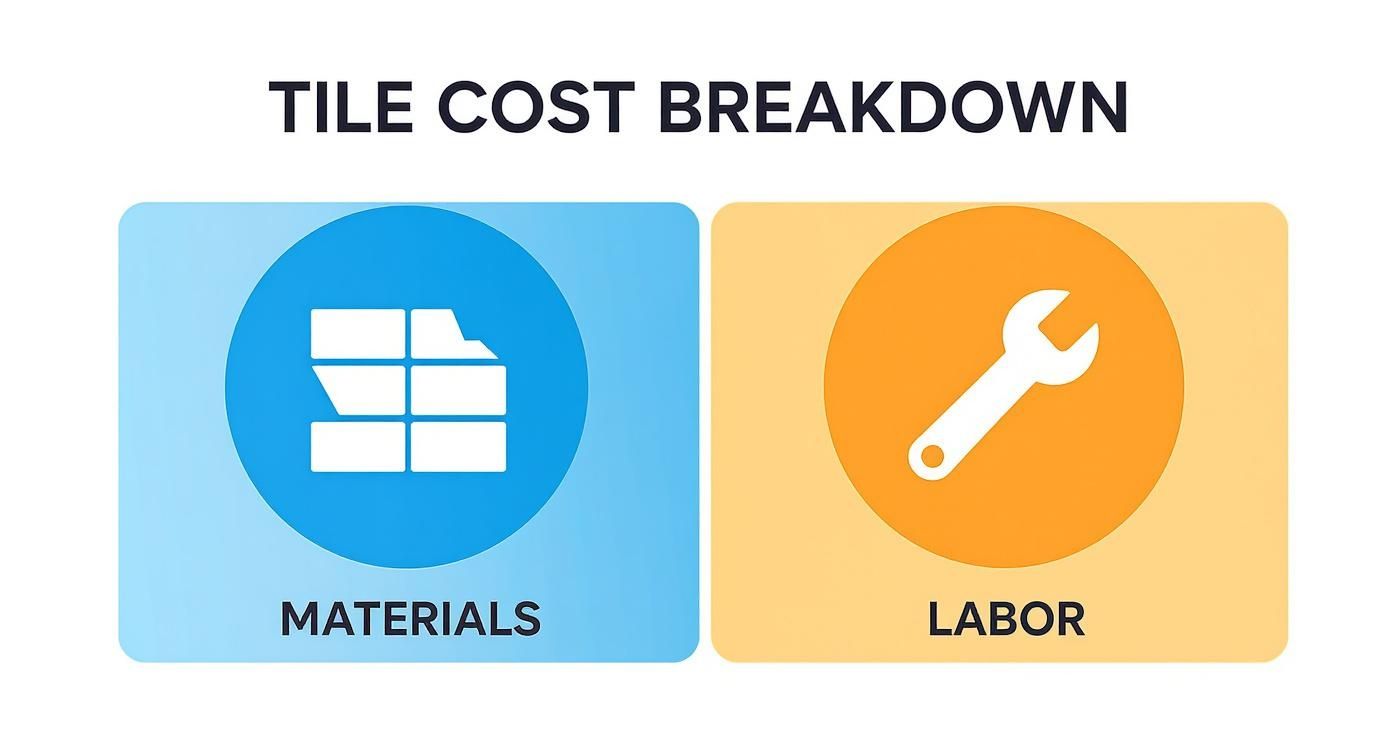
As you can see, labor isn't an afterthought; it's a huge piece of the puzzle. The time and expertise of your installer are just as critical to the budget as the tile itself.
Comparing Tile Material Costs and Installation Difficulty
To get a better handle on how different materials stack up, it helps to see them side-by-side. The table below breaks down the usual suspects by their material cost and how tricky they are for a pro to install—which, of course, affects the labor price.
| Tile Type | Average Material Cost (per sq. ft.) | Installation Difficulty / Labor Cost | Best For |
|---|---|---|---|
| Ceramic | $1 – $5 | Low: Softer, easier to cut, and forgiving. The most straightforward and affordable to install. | High-traffic floors, backsplashes, and budget-conscious projects. |
| Porcelain | $3 – $10 | Moderate: Extremely dense and hard. Requires a powerful wet saw and more time for precise cuts. | Bathrooms, showers, outdoor areas, and anywhere needing maximum durability and water resistance. |
| Natural Stone | $8 – $30+ | High: Heavy, porous, and requires sealing. Each piece is unique, demanding careful layout and handling. | Luxury floors, shower walls, and statement entryways where a one-of-a-kind look is desired. |
| Glass & Mosaic | $15 – $50+ | Very High: Fragile and prone to chipping. Mosaics require meticulous attention to keep lines straight. | Kitchen backsplashes, accent walls, and decorative borders where visual impact is the top priority. |
This comparison really highlights the trade-offs. While a material might be affordable on the shelf, its installation demands can easily push the total project cost much higher.
Why Some Tiles Cost More to Install
The price on the box is only half the story. A tile's physical properties—how hard, heavy, or delicate it is—directly translate into the time and effort a pro has to put in. More effort always means higher labor costs.
It’s like the difference between a carpenter working with soft pine versus dense hardwood. Pine is easy to cut and shape, but a hardwood like ebony requires more powerful tools, more patience, and a much higher level of skill. Tiling works the exact same way.
H3 Key Factors Driving Up Labor Costs
- Hardness and Density: A standard ceramic tile is relatively soft. But ultra-dense porcelain fights back. Installers need a heavy-duty wet saw with a diamond blade to get clean cuts, which takes more time and wears down expensive equipment.
- Weight and Size: Setting massive, heavy slabs of slate or large-format porcelain is a workout. It’s often a two-person job and demands a perfectly flat surface to prevent cracking. This adds muscle and man-hours to the bill.
- Fragility: Glass tile looks incredible, but it can be a nightmare to cut without chipping. Pros have to work slowly and methodically, and they’ll factor in a higher waste percentage for inevitable breakage. All that extra care costs money.
- Porosity: Natural stone is like a sponge. Materials like travertine and marble have to be sealed before grouting (and sometimes even before setting) to prevent stains. This adds an entire extra step to the installation process.
In the end, choosing your tile is a balancing act between the look you want, the performance you need, and the budget you have. Sometimes, a simple ceramic gets the job done beautifully. Other times, the unique character of a hard-to-install natural stone is well worth the investment in both materials and masterful labor.
Looking Beyond the Quote: What Really Goes into Your Tiling Cost
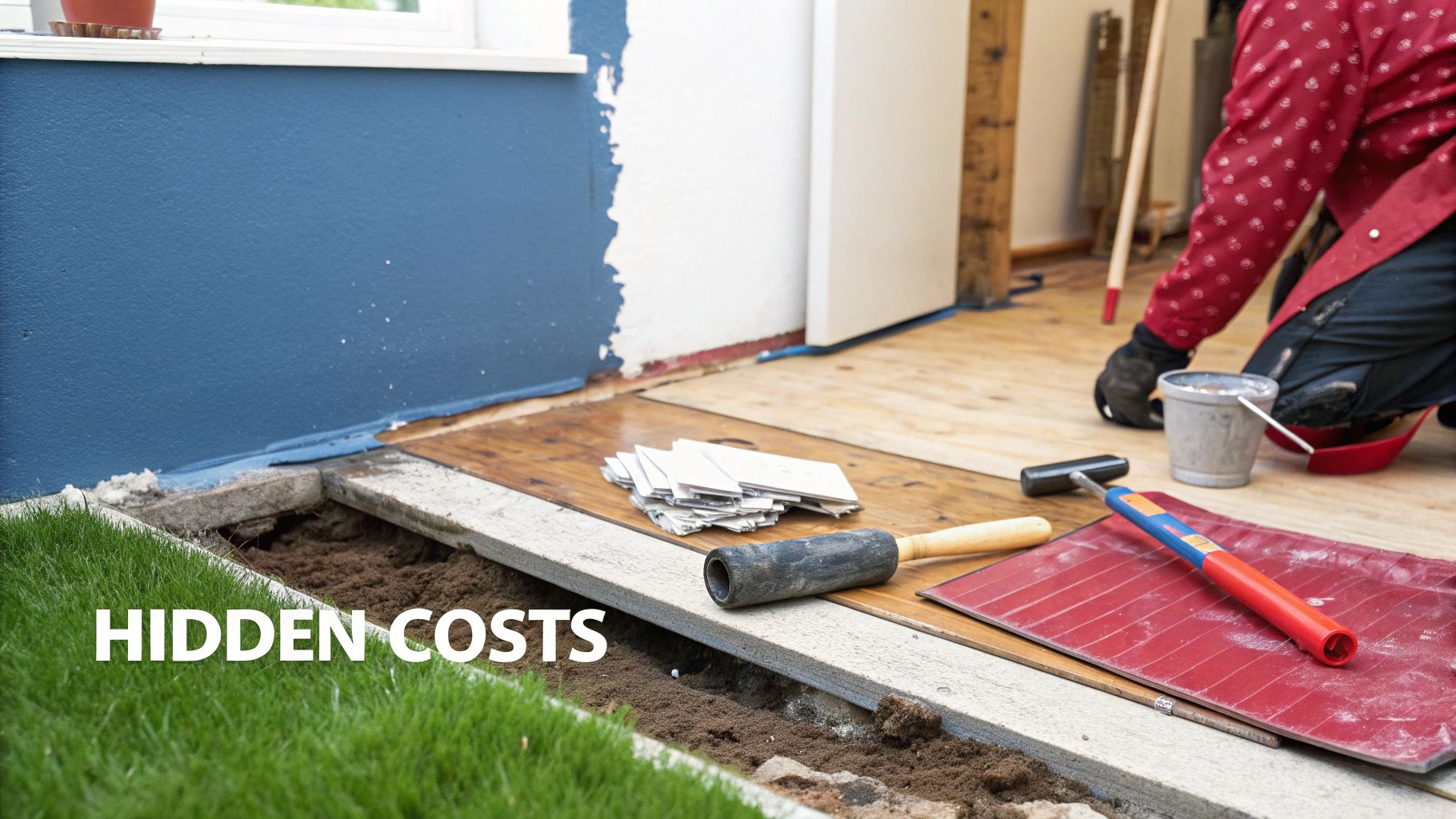
When you get a quote for a tiling job, the numbers for labor and the tiles themselves are just the starting point. The real story of a lasting, professional installation is told in the work that happens before a single tile is set. It’s these essential prep steps that can add to your budget if you aren't ready for them.
Think of it this way: painting a car is about more than just the paint. The real skill—and a chunk of the cost—is in sanding down the old finish, fixing dings, and laying down the perfect primer. Tiling is exactly the same. The prep work is everything, and understanding these potential add-ons helps you get a complete, all-in estimate from the start.
The Groundwork: Demolition and Prep
You can't build a great new floor on a faulty foundation. Before the beautiful new tile goes in, the old stuff has to come out, and the surface beneath has to be made perfect.
First up is demolition. Tearing out old flooring or wall tile is a messy, back-breaking job that contractors will price as a separate line item. You should expect to budget between $2 to $7 per square foot for a pro to remove and haul away old tile. The exact cost really depends on what kind of tile it is and how stubbornly it's stuck to the subfloor.
Once the old surface is gone, all eyes turn to the subfloor or wall structure. A rock-solid, completely flat, and clean surface is the only way to guarantee your new tile won't crack or fail down the road.
Common Surface Prep Costs:
- Subfloor Repair: If the plywood or concrete underneath is water-damaged, warped, or cracked, it has to be fixed. This might be a simple patch or could mean replacing whole sections, a fix that can range from a few hundred to several thousand dollars depending on how bad the damage is.
- Leveling: An uneven subfloor is a tile job’s worst enemy, leading directly to cracked tiles and grout. Installers often pour a self-leveling compound to create a glassy-smooth surface, which adds both material and labor costs.
- Backer Board: In wet zones like bathrooms and showers, drywall and plywood are a no-go. A pro will install a cement backer board, a water-resistant substrate that creates a stable, moisture-proof foundation for the tile and prevents water from ever reaching the wood framing.
Special Touches and Wet Area Essentials
A simple kitchen backsplash is a world away from a master bathroom shower. The more complex the job, the more steps—and costs—are involved.
Waterproofing is the perfect example. For a shower, it’s not just a good idea; it’s absolutely critical. This involves painstakingly applying a liquid or sheet membrane over every inch of the backer board, creating a seamless, bathtub-like enclosure behind the tile. This is what stops water from getting into your walls and causing thousands in mold and rot damage.
It's a common misconception, but tile and grout are only water-resistant, not waterproof. The real hero is the hidden waterproofing system underneath the tile. It’s a crucial step no pro would ever skip in a shower or wet room.
Your design choices can also move the price needle quite a bit. The pattern you select has a direct impact on the average cost of tile installation.
- Complex Patterns: Laying tile in a herringbone, diagonal, or mosaic pattern takes much more time, precision, and cutting than a standard grid. This extra labor can easily increase the installation cost by 20% to 40%.
- More Material Waste: All those intricate cuts also mean more wasted tile. For complex patterns, you'll need to order 15% to 20% extra material, up from the standard 10% overage for a basic layout.
- Sealing Porous Tile: If you've chosen a beautiful natural stone like marble or travertine, it needs protection. These materials are porous and will soak up stains. Your installer will need to apply a special sealer before and after grouting, adding another task and cost to the project.
Putting It All Together: What Tiling Projects Actually Cost
Square-foot pricing is a good starting point, but let’s be honest—it’s hard to picture what that means for your actual kitchen or bathroom. To make these numbers more concrete, let's walk through some real-world budget examples for the most popular tiling jobs we see.
Think of these as ballpark figures. We'll look at a budget-friendly option and a more high-end scenario for each project to show you how much the final price can swing based on the materials you choose and the complexity of the job.
Tiling a Kitchen Backsplash
A new backsplash is one of the most satisfying home updates. It’s a relatively small area that can completely change the feel of your kitchen, making it a perfect entry point into the world of tile.
-
Low-End Scenario (Approx. 30 sq. ft.): Going with a classic ceramic subway tile at around $3/sq. ft. is a wallet-friendly and timeless choice. For a straightforward job on a prepped wall, you’re likely looking at a total cost of $700 to $1,200 including all labor and basic materials.
-
High-End Scenario (Approx. 30 sq. ft.): If you've fallen in love with a stunning glass mosaic tile that costs $40/sq. ft., the budget looks quite different. Setting tiny mosaic sheets is painstaking work, which drives up the labor bill. For a premium backsplash like this, the final invoice could easily be between $2,500 and $4,000.
Tiling a Small Bathroom Floor
Tackling a small bathroom floor in a powder room or guest bath is another common project. The space might be small, but the work is often surprisingly detailed, with lots of tricky cuts around toilets and vanities.
-
Low-End Scenario (Approx. 50 sq. ft.): A durable porcelain tile at $4/sq. ft. is an excellent, hard-wearing choice for any bathroom. Once you factor in tearing out the old floor, the labor for those detailed cuts, and all the setting materials, a realistic budget is $1,300 to $2,500.
-
High-End Scenario (Approx. 50 sq. ft.): For a touch of spa-like luxury, maybe you want a $25/sq. ft. marble or natural stone tile. The price here reflects not just the premium material but also the more delicate installation process and the crucial step of sealing the stone. Your total investment would probably land in the $3,500 to $6,000 range.
Tiling a Master Bathroom Shower
A walk-in shower is one of the most labor-intensive tiling jobs out there. A huge chunk of the cost is for something you'll never even see: the complex waterproofing system that protects your home from water damage.
-
Low-End Scenario (Approx. 100 sq. ft. of wall space): Using large-format ceramic tiles at $5/sq. ft. can keep the material costs reasonable and create a clean, modern look. But the behind-the-scenes work—installing cement backer board and a full waterproofing membrane—is where the real work is. The total cost for a project like this typically falls between $2,800 and $5,000.
-
High-End Scenario (Approx. 100 sq. ft. of wall space): If you’re dreaming of a custom shower with $30/sq. ft. high-end porcelain, a decorative mosaic niche, and a bench, you’re looking at a significant upgrade. The combination of intricate labor, premium materials, and top-tier waterproofing can push the total cost to $7,000 to $12,000, and sometimes even higher.
Remember, these are just estimates to get you started. The final average cost of tile installation will always depend on your home's unique layout, your local market's labor rates, and the specific contractor you hire.
Tiling a Large Living Room Floor
When you scale up to a large, open area like a living room or basement, the numbers get bigger, even if the layout is simpler.
-
Low-End Scenario (Approx. 400 sq. ft.): Wood-look ceramic tile is incredibly popular for its durability and style, and you can find great options for around $3/sq. ft. Even with a straightforward layout, the sheer volume of tile and labor adds up. You should expect a total cost somewhere in the $6,000 to $9,500 range.
-
High-End Scenario (Approx. 400 sq. ft.): To make a real statement, you might choose a large-format natural stone like slate or travertine at $15/sq. ft. A project of this scale requires serious subfloor preparation to ensure the entire surface is perfectly level. For a high-end floor like this, the final budget will likely be between $13,000 and $20,000.
This growing interest in beautiful, long-lasting flooring is part of a much bigger picture. The global tile installation market is expanding rapidly, with a projected value of $15 billion by 2025. It's a clear sign that homeowners everywhere are investing in the lasting value of a well-tiled space. You can discover more insights about these tile installer marketing statistics on amraandelma.com.
Smart Ways to Reduce Your Tile Installation Cost
A beautiful tile installation doesn't have to mean emptying your bank account. If you're smart about it, you can cut down the final bill without sacrificing the quality of the work. It really comes down to knowing where to save and when it pays to bring in an expert.
One of the easiest ways to shave off a good chunk of the cost is to do some of the prep work yourself. If you don't mind getting your hands dirty, handling the demolition of the old tile or flooring can save you a surprising amount in labor fees. That's less time the pro has to spend on-site, which means a smaller invoice for you.
Make Smart Material and Timing Choices
The tile you pick is the biggest single factor in your budget, but you can get a high-end look without the high-end price tag. For example, many modern porcelain tiles do an incredible job of mimicking natural stone like marble or travertine. You get that luxurious feel for a fraction of the cost, and as a bonus, porcelain is often more durable and easier to care for.
A little patience can also pay off big time. Keep an eye on local tile suppliers for seasonal sales or clearance events. Buying your materials during one of these sales can easily cut your material costs by 15-20%. That frees up more of your budget for the skilled installation that makes all the difference.
When it comes to getting a fair price, nothing is more important than getting at least three detailed, itemized quotes from trusted local contractors. This lets you compare not just the final number, but the full scope of work, material quality, and timeline each pro is promising.
Get Multiple Quotes and Plan Ahead
Don't just jump on the first estimate you get. Taking the time to gather several quotes is crucial for understanding the going rate for your project in your area and spotting any bids that seem way too high or suspiciously low. A good quote will break everything down—demolition, prep, materials, labor—so you know exactly where every dollar is going.
Finally, consider the big picture. If you're already planning a larger remodel for your kitchen or bathroom, it's almost always cheaper to roll the tile work into that main project. Hiring a tiler for a small, one-off job later will cost more than having a general contractor manage it as part of a full renovation. It streamlines the whole process and usually gets you a better package deal.
Answering Your Top Questions About Tile Installation Costs
Even after you've crunched the numbers, there are always a few lingering questions that pop up. Let's tackle some of the most common ones we hear from homeowners to help you lock in your budget with confidence.
How Much More Will a Fancy Pattern Cost Me?
That beautiful herringbone or intricate diagonal pattern you've been eyeing? It definitely adds a "wow" factor, but it will also bump up your labor costs. You should plan for intricate designs to cost anywhere from 20% to 40% more in labor.
Why the price jump? It's all about time and skill. Your installer has to make a lot more precise, angled cuts and spend a ton of extra time on the layout to get every single piece lined up perfectly. You’ll also need more tile to begin with—we recommend buying about 15% extra tile material to cover the waste from all those custom cuts, compared to the standard 10% for a simple grid.
Is Tiling a Small Bathroom Always Cheaper?
This one surprises a lot of people: the cost per square foot to tile a small bathroom can actually be higher than it is for a big, open-concept floor. Of course, the total project price will be lower, but the work itself is much more intensive.
Think about it—a small bathroom is full of obstacles. The installer has to make dozens of tricky cuts to work around the toilet flange, the vanity, the tub, and the doorway. All that meticulous fitting slows the job way down, which drives up the labor rate for that small space. In a large, empty room, they can set tile much faster, which often brings the per-square-foot labor cost down.
Here's a good rule of thumb: complexity, not just size, drives the cost. A small, tricky job with a ton of cuts will almost always have a higher per-square-foot labor rate than a large, straightforward one.
Does Ripping Out Old Tile Add a Lot to the Bill?
Absolutely. Demolition and disposal are significant costs that are billed separately from the installation itself. If you've got an old tile floor or wall that needs to come out, you should budget an extra $2 to $7 per square foot for the tear-out.
This work is tough, messy, and labor-intensive. The final price tag can swing depending on how stubborn the old tile is and what condition the subfloor is in underneath. Factoring this in from the get-go is one of the best ways to avoid an unpleasant surprise when the final invoice arrives.
Can I Save Money by Buying the Materials Myself?
Sometimes, yes. If you happen to catch a great sale on the tile you love, you might save some money. But this approach comes with some serious risks. For starters, professional contractors usually get trade discounts that you can't access as a homeowner.
More importantly, when you buy the materials, you become responsible for all the math. That means ordering the exact right amount of tile (plus overage), thin-set, grout, and everything else. If you miscalculate, you could end up with project delays, wasted material, and a bigger bill than if you had just let your pro handle it all from the beginning.
Ready to turn all this planning into a reality? The team here at Trademaster Construction can help translate these numbers into a beautiful, finished space in your Southwest Michigan home. Get a clearer picture of your potential investment with our easy-to-use Pricing Tool and let’s start building your dream. Get a remodeling estimate with Trademaster today.

