You're probably looking at a remodeling proposal right now, or getting close to signing one. The design looks good, the scope seems clear, and then you hit the insurance section. Suddenly the language gets dense. General liability, workers' comp, additional insured, occurrence form. Most homeowners skim it and move on.
That's risky.
When you hire a contractor for a kitchen, bathroom, basement, or structural remodel, you're not just buying craftsmanship. You're deciding who carries the financial risk if something goes wrong on your property, during construction or after the project is finished. That's why contractor insurance requirements matter so much to homeowners, not just to builders.
Why Your Contractor's Insurance Is Your Financial Safety Net
A common mistake happens before the first cabinet is removed. A homeowner checks that the contractor is licensed and assumes that means the insurance is good enough. In practice, that's often not the standard that protects the house, the family, or the finished work.
The gap's true extent is often unappreciated. Homeowners often mistakenly assume state licensing requirements are sufficient, but 90% of professional contracts mandate $1M–$2M limits for Products-Completed Operations coverage. Data also shows that 68% of construction-related lawsuits arise from issues discovered after the project is finished (construction insurance requirements guidance from TCRMF). This indicates that the significant danger often emerges after the crew is gone and the final payment has cleared.
Licensed doesn't always mean protected
Say a bathroom remodel looks perfect at handoff. Months later, water gets behind tile because of an installation error. Or a basement project develops a moisture problem after the first heavy season. Those aren't unusual homeowner fears. Those are exactly the kinds of post-project problems that make insurance details matter.
A license tells you a contractor can legally operate. It doesn't automatically tell you whether the company carries the right coverage limits, the right policy type, or the right endorsements for the actual work being done.
Practical rule: Treat insurance as part of the build quality review. If the coverage is weak, the contract is weak.
Your house is the asset at risk
For most families, the home is the largest asset they own. A remodel increases both the value of that asset and the amount of money exposed during construction. Materials arrive. Walls get opened. Plumbing and electrical systems get altered. Vehicles come and go. Workers and trades move through tight spaces.
When insurance is set up properly, those risks stay with the contractor and the insurer where they belong. When it isn't, the homeowner can end up dragged into claim disputes, coverage denials, or out-of-pocket repairs that nobody expected.
A simple way to understand it is:
- Legal minimums keep a contractor operating.
- Contract-level coverage protects a real project.
- Verified proof protects you.
That's why smart homeowners don't stop at “Are you insured?” They ask, “What kind of insurance, what limits, what dates, and does it match my project?”
The 5 Key Types of Contractor Insurance Explained
Most insurance language sounds harder than it needs to be. For a homeowner, the useful question is simple. What problem does each policy solve if the job goes sideways?
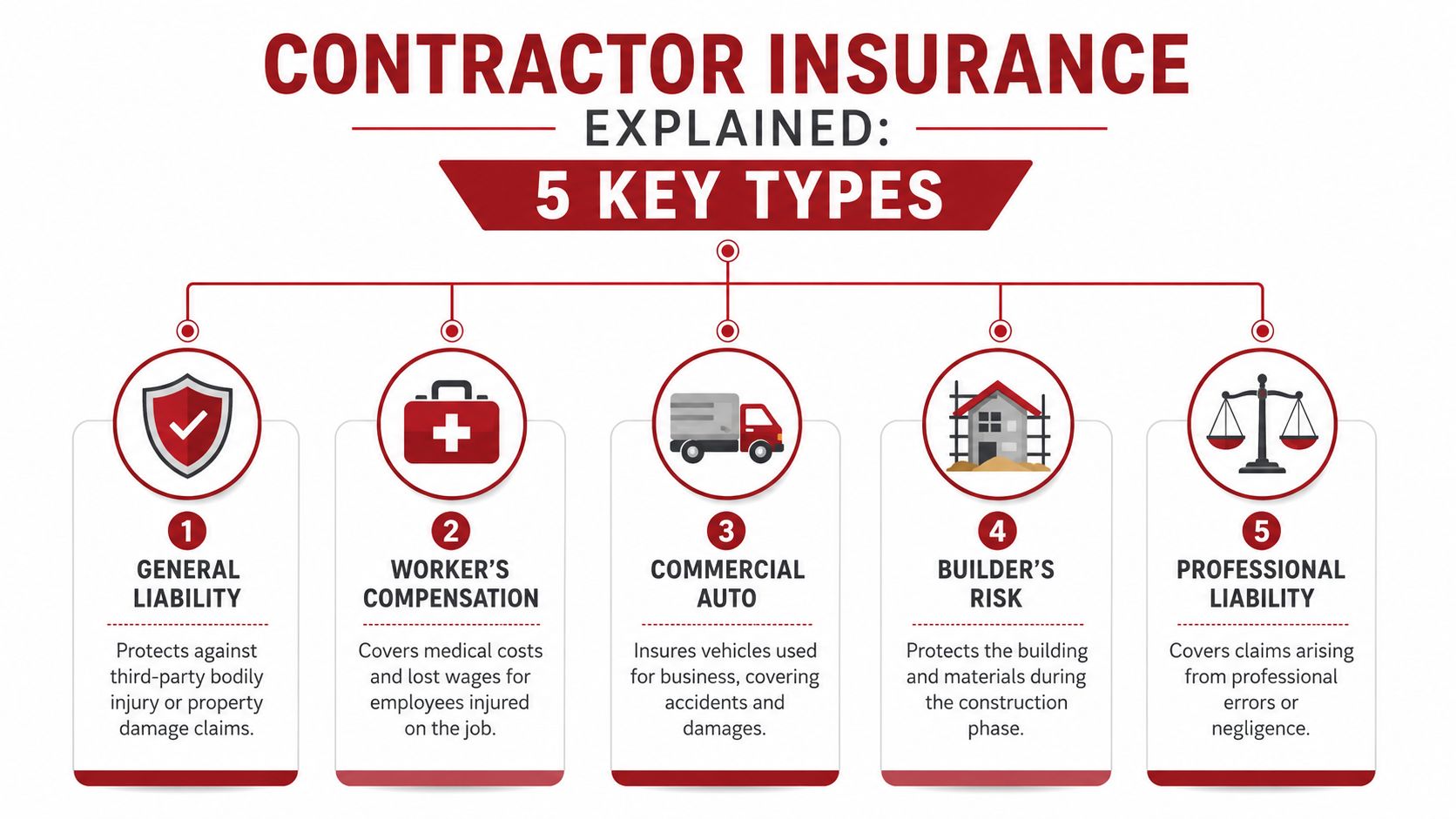
The foundation is Commercial General Liability. The benchmark most contractors have to meet is $1 million per occurrence and $2 million aggregate, and that baseline is required by the vast majority of construction contracts before work starts (industry benchmark for contractor liability limits). If you want a plain-English refresher on understanding liability coverage, that overview is useful before you compare certificates.
General Liability
This is the policy people mean when they say, “Yes, we're insured.”
Its job is to respond to third-party bodily injury or property damage claims. If a worker damages a neighbor's property, or someone gets hurt because of jobsite conditions, this is the first policy people look to. For homeowners, it matters because it helps prevent a claim from landing directly on your finances.
What it does not automatically mean is that every defect in the contractor's own work will be covered. That's one reason homeowners get confused.
Workers' Compensation
This policy covers workers injured on the job.
If a carpenter, tile installer, or laborer gets hurt while working on your property, workers' comp is meant to handle medical costs and wage-related obligations through the employer's coverage. Without it, disputes can become messy very quickly, especially when a contractor relies on a mix of employees and subcontractors.
When a crew member gets injured, the homeowner's first protection is making sure the contractor already has the right coverage in place.
Commercial Auto
A remodeling company may have vans, pickups, trailers, or hired vehicles moving tools, debris, cabinetry, stone, and plumbing fixtures.
Commercial auto covers accidents involving those business-use vehicles. If a work vehicle causes bodily injury or property damage while tied to the project, this policy is what should respond. Personal auto insurance is not the same thing.
Builder's Risk
Think of this as construction-phase property protection.
Builder's risk is designed to protect the structure and materials during renovation. If fire, wind, vandalism, or another covered event damages the project before completion, this is the policy that addresses the partially built work and stored materials. For major remodels, this is one of the most misunderstood parts of contractor insurance requirements.
Professional Liability
This one matters most when the work involves design decisions, specifications, layout judgment, or technical recommendations.
Professional liability, often called Errors and Omissions, addresses claims tied to professional mistakes or negligence. In a remodel, that can matter when the contractor is providing design-build services, planning custom assemblies, or making decisions that go beyond basic labor execution.
A good way to remember the five policies:
| Coverage type | What it protects against |
|---|---|
| General Liability | Injury or property damage claims involving third parties |
| Workers' Compensation | Job-related injuries to employees |
| Commercial Auto | Accidents involving business vehicles |
| Builder's Risk | Damage to the structure and materials during the remodel |
| Professional Liability | Errors in professional judgment, design, or technical decisions |
Contractor Insurance Rules for Michigan Homeowners
Michigan homeowners often assume the legal bar and the practical bar are the same. They aren't.
For residential remodeling in Michigan, the industry standard for general liability is $1,000,000 per occurrence and $2,000,000 aggregate, and that standard matters because it supports Products and Completed Operations coverage for latent defects in kitchen and bathroom installations, including post-project water intrusion from custom tilework (Michigan remodeling liability standards). In plain terms, the insurance needs to fit the kind of work being done, not just satisfy a low entry requirement.
What homeowners in Southwest Michigan should expect
If you're planning work in Portage, Kalamazoo, or nearby communities, what should be expected from a professional remodeler is not bare-minimum paperwork. It's a coverage package that fits the risk of opening walls, changing plumbing paths, finishing basements, and installing moisture-sensitive assemblies.
That matters most in projects like:
- Kitchen remodels where plumbing, appliances, cabinetry, and finish materials all converge
- Bathroom renovations where waterproofing details decide whether the room performs for years
- Basement finishing where moisture, insulation, framing, and structure all interact
- Custom tilework where failure often shows up after occupancy, not during installation
The gap between licensing and contract reality
The legal minimum might let a contractor stay in business. It may not be enough to satisfy a serious homeowner, lender, or project manager. This is the key point homeowners should understand when reviewing contractor insurance requirements.
Here's the trade-off:
- Lower limits may reduce a contractor's insurance cost.
- Higher, standard limits reduce the homeowner's risk when a claim involves significant damage.
- Completed operations coverage matters because many remodeling problems don't appear on day one.
Cheap insurance usually means narrow protection. On a remodel, narrow protection becomes your problem fast.
Michigan projects create delayed-risk problems
Kitchen and bath jobs are especially vulnerable to delayed claims because water doesn't announce itself right away. A shower pan issue, a plumbing connection, or a poorly managed transition at tile and drywall can stay hidden until damage spreads.
That's why Products and Completed Operations is such a big deal in remodeling. It's tied to the work after the work is done. If you only look at whether a contractor “has liability,” you can miss the exact part of the policy that matters most for a finished room.
Workers' compensation also deserves attention in Michigan projects involving crews and subs. Homeowners shouldn't assume everyone on site is covered the same way. Ask who is employed directly, who is subcontracted, and whether each party carries its own valid coverage. Clean answers matter. Vague answers don't.
How to Read a COI and Ask the Right Questions
A Certificate of Insurance, or COI, is the document homeowners should ask for before work starts. It won't tell you everything in the policy, but it gives you the snapshot you need to start verifying whether the contractor's insurance requirements are being met.
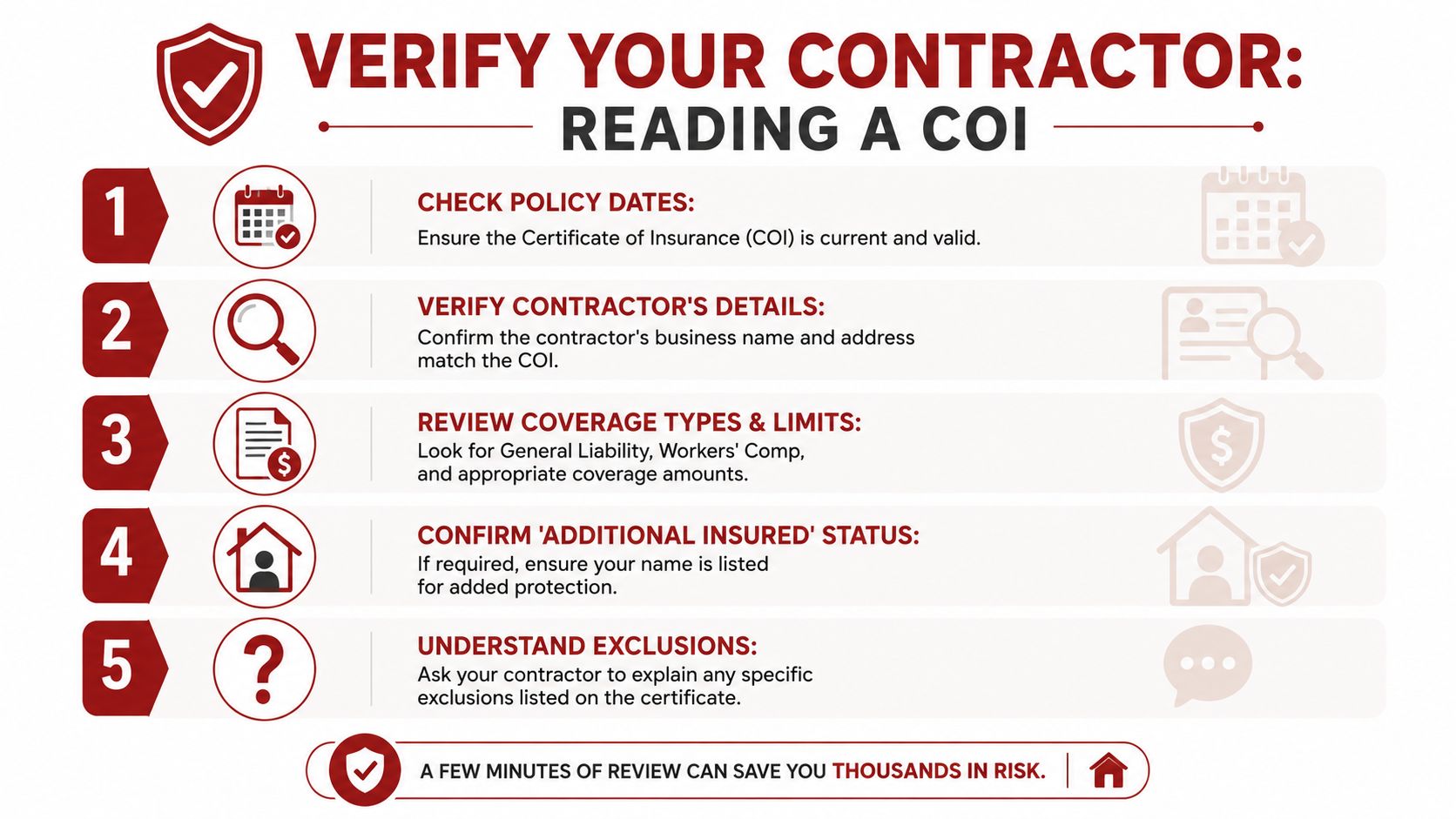
Start with the basics. The business name on the COI should match the company name on the contract. The policy dates should cover your project period. The listed coverage types should match the kind of work being performed.
What to check first
Use this checklist when the COI lands in your inbox:
- Match the legal business name. If the contract says one company name and the COI lists another, ask why.
- Check effective and expiration dates. Coverage that expires mid-project creates risk.
- Review the policy types listed. General liability alone may not fit the job.
- Look at the limits shown. The numbers should align with the standards discussed earlier.
- Ask whether you can be added as an additional insured when appropriate under the contract.
A short explainer is helpful before you review one in real time:
The phrase most homeowners miss
One technical detail matters more than it sounds. The contractor's liability policy should be on an occurrence form, not a claims-made form. An occurrence form covers incidents that happened during your project even if the claim shows up years later. For structural work, homeowners should also confirm the contractor carries Builder's Risk Insurance to protect the structure itself during renovation (occurrence form and builder's risk guidance for construction projects).
That distinction matters because remodeling defects often surface after the job is complete. A policy that only works if the claim is reported while the policy is still active can leave a homeowner exposed.
Smart questions to ask before signing
Don't ask only, “Are you insured?” Ask better questions.
- Is your general liability policy written on an occurrence form?
- Does your coverage include products-completed operations for this kind of remodel?
- Do you carry builder's risk for projects involving major structural or interior work?
- Are there exclusions for residential remodeling or for specific trades involved in my job?
- Who is responsible for insurance when subcontractors are on site?
- Can my property be listed correctly on the certificate and can I be added as additional insured if the contract calls for it?
If a contractor gets annoyed by detailed insurance questions, that tells you something useful.
What a COI does not tell you
A COI is a summary, not the full policy. It may not show every exclusion or endorsement. That's why good follow-up matters. If the project is large or technically complex, ask the contractor to have their agent confirm specific endorsements in writing.
A professional builder won't see that as a red flag. They'll see it as a homeowner doing proper due diligence.
The Real Risks of an Uninsured Contractor
The biggest insurance disputes in remodeling usually start with a false assumption. Homeowners think “general liability” means any mistake that damages the house will be paid for. It often doesn't work that way.

A 2025 industry analysis found that 74% of homeowners incorrectly assume their contractor's general liability covers structural errors like improper tile installation. In reality, builder's risk or specific professional liability coverage is often needed, and without it homeowners can face major out-of-pocket costs when faulty work claims are denied (industry analysis on common contractor coverage misunderstandings).
Where the financial hit lands
Consider a few situations that come up in real remodeling work.
A worker gets injured in your home, and the contractor doesn't have the right workers' comp setup. That claim may not stay neatly between the worker and the contractor.
A delivery or work vehicle damages a neighboring structure or parked car during the project. If the business auto coverage is missing or weak, arguments start fast about who is responsible.
A kitchen remodel suffers a fire or major loss before final completion. Without the right construction-phase property coverage, the homeowner may learn too late that the damaged work and materials weren't protected the way they assumed.
Underinsured can be nearly as bad as uninsured
Homeowners sometimes focus only on whether a contractor has a certificate. The harder question is whether the certificate reflects enough coverage for the project size and scope.
A company can be technically insured and still leave dangerous gaps:
| Problem | Why it matters to a homeowner |
|---|---|
| Policy limits are too low | A serious claim can exceed available coverage |
| Wrong policy form | A later-discovered issue may fall outside coverage |
| Missing builder's risk | Damage to the unfinished structure may not be covered |
| No professional liability | Design or specification errors may trigger disputes |
| Subcontractor gaps | One uninsured trade can create a chain of problems |
What reliable contractors do differently
Professional contractors build insurance into the way they operate. They keep current certificates on file. They understand their limits. They know when a project calls for additional coverage. They don't treat insurance as a checkbox at bid time.
That's also why low bids deserve scrutiny. Sometimes the price difference comes from efficiency, overhead, or scope. Sometimes it comes from carrying less protection than the job really calls for.
Good insurance doesn't make a contractor better at tile, framing, or finish carpentry. It does make the consequences of a bad day far less destructive for the homeowner.
Your Contractor Hiring Checklist and Next Steps
A homeowner usually finds out whether insurance was handled correctly at the worst possible moment. A pipe bursts during demolition, a subcontractor gets hurt, or custom materials are damaged after delivery. At that point, you do not want to be asking what the contractor meant by "we're covered."
Use this checklist before you sign a contract or pay a deposit. In Michigan, the legal minimum can still leave a homeowner exposed during a major remodel. The goal is not just to confirm that a contractor has insurance. The goal is to confirm that the coverage fits your job.
The short hiring checklist
- Request a current COI and make sure the insured business name matches the contract exactly.
- Check that liability limits fit the size of the project, especially for larger kitchen, bath, basement, or whole-home work.
- Ask whether products-completed operations coverage is included for work that could cause damage after the crew leaves.
- Verify workers' compensation coverage for employees, and ask how subcontractors are screened and insured.
- Confirm the liability policy is written on an occurrence form if that is available for the work being performed.
- Ask who is covering materials and the unfinished structure when the job includes major demolition, structural changes, or exposed interiors.
- Ask about professional liability if the contractor is making layout, specification, waterproofing, or design-build decisions.
- Request additional insured status if your contract requires it.
- Review exclusions tied to your project such as roofing, structural work, tile shower waterproofing, or other specialty tasks.
- Pause if the answers are vague, delayed, or inconsistent with the contract paperwork.
A clean certificate does not always mean your project is well protected. Homeowners should look for proof that the contractor has thought through the actual risks of the remodel, not just the minimum paperwork needed to stay in business.
What works in practice
Ask for insurance documents early, before final contractor selection. That saves everyone time and avoids the awkward situation where pricing looks good but the coverage does not hold up under review.
Read the certificate next to the proposal. If the contractor is opening walls, relocating plumbing, changing structure, handling waterproofing, or storing expensive materials on site, ask what policy responds if something goes wrong. A good contractor should be able to answer plainly or get a clear answer from their agent.
Price matters. So does what the price includes.
Low bids sometimes reflect tighter operations or a smaller scope. They can also reflect lower limits, missing policies, or looser subcontractor controls. That trade-off is rarely obvious until there is a claim.
The practical next step is simple. Keep your shortlist to contractors who can prove coverage, explain the gaps they have already accounted for, and put the same details into the contract. A remodel goes more smoothly when the paperwork protects the investment as carefully as the workmanship does.