
When it comes to picking the right kitchen cabinets, it's a juggling act between three key things: your budget, your personal style, and how you actually use your kitchen day in and day out. It's easy to get swept away by a beautiful door style in a showroom, but the real first step is to get clear on what you truly need from your space.
Your Starting Point for Choosing Kitchen Cabinets
Choosing your kitchen cabinets is probably the single biggest decision you'll make during a renovation. They set the entire tone for the room, define how well it functions, and often eat up the largest slice of the budget—sometimes as much as 50% of the total cost. So, where do you begin? Forget the catalogs for a moment and start with a solid foundation.
This isn't just about picking a color; it's about mapping out your real-world needs. Think about your daily routine and what kind of kitchen you truly live in.
-
For the Serious Home Chef: If you’re constantly prepping, cooking, and experimenting, you’ll need workhorse materials that can take a beating. Think about maximizing counter space and integrating smart storage like deep pot drawers and pull-out spice racks right where you need them.
-
For the Busy Family Hub: Is your kitchen the command center for homework, snacks, and morning chaos? You'll want to focus on surfaces that are a breeze to clean, plenty of pantry space, and a layout that keeps everyone from bumping into each other.
-
For the Entertainer: If your kitchen's main purpose is hosting friends and family, you might lean towards a statement-making island, glass-front cabinets to show off your best dinnerware, and a sleek design that wows your guests.
Figuring this out first stops you from splurging on features you’ll never use or picking a high-maintenance finish that doesn’t fit your lifestyle. For a deeper dive into making the best choice, this guide on how to choose the best kitchen cabinets is a fantastic resource.
Grounding Your Project in Reality
This initial thinking is crucial. It takes your project from a vague idea—"I want a new kitchen"—to a concrete, actionable plan. It’s a decision millions of homeowners face every year. In fact, the global kitchen cabinet market was valued at a staggering USD 160 billion in 2023 and is only expected to grow, largely because people want that perfect mix of looks and function. You can see more on these trends in this dataintelo.com report. A market that big means you have endless options, which makes getting your priorities straight more important than ever.
Key Takeaway: How you use your kitchen should be the filter for every other decision you make. Understanding your lifestyle is the best tool you have for choosing cabinets you’ll love for years.
To get the ball rolling, I've put together a simple table that breaks down the three main types of cabinets. It gives you a quick snapshot of the costs, customization, and timelines involved.
A Quick Look at Cabinet Types
| Cabinet Type | Typical Cost | Customization Level | Average Lead Time |
|---|---|---|---|
| Stock | $ (Most Affordable) | Limited (standard sizes/finishes) | 1-3 Weeks |
| Semi-Custom | $$ (Mid-Range) | Good (size/finish modifications) | 4-8 Weeks |
| Custom | $$$ (Premium) | Unlimited (built to spec) | 8-16+ Weeks |
This comparison should help you frame your project with realistic expectations right from the start, setting you on the right path before you even step foot in a showroom.
Navigating Stock, Semi-Custom, and Custom Cabinets
Once you have a good handle on your needs, you'll hit your first major fork in the road: choosing between stock, semi-custom, and custom cabinets. This decision is about way more than just the price tag. It's about finding the perfect fit for your project's goals, your timeline, and the quirks of your actual home.
Each of these tiers offers a different mix of speed, flexibility, and cost. Getting to know the real-world differences is crucial for making a smart investment. Let's break down what each category truly means for you and your kitchen.
The Case for Stock Cabinets
Think of stock cabinets as the "off-the-rack" option in the kitchen world. They're mass-produced in standard sizes and are waiting for you at big-box home improvement stores, either pre-assembled or in ready-to-assemble (RTA) kits. The huge advantages here are immediate availability and the lowest cost.
Let’s say you're flipping a house or updating a rental property. Your goal is to get a fresh, functional kitchen in place fast to get it back on the market. Stock cabinets are your best friend in this scenario. You can literally pick them up and have them installed within a week, keeping your project moving and your budget in check.
The trade-off, of course, is a lack of flexibility. You're working with standard dimensions (usually in 3-inch increments) and a limited menu of popular styles and finishes. If your kitchen has odd angles or you've been dreaming of a very specific shade of sage green, this probably isn't the route for you.
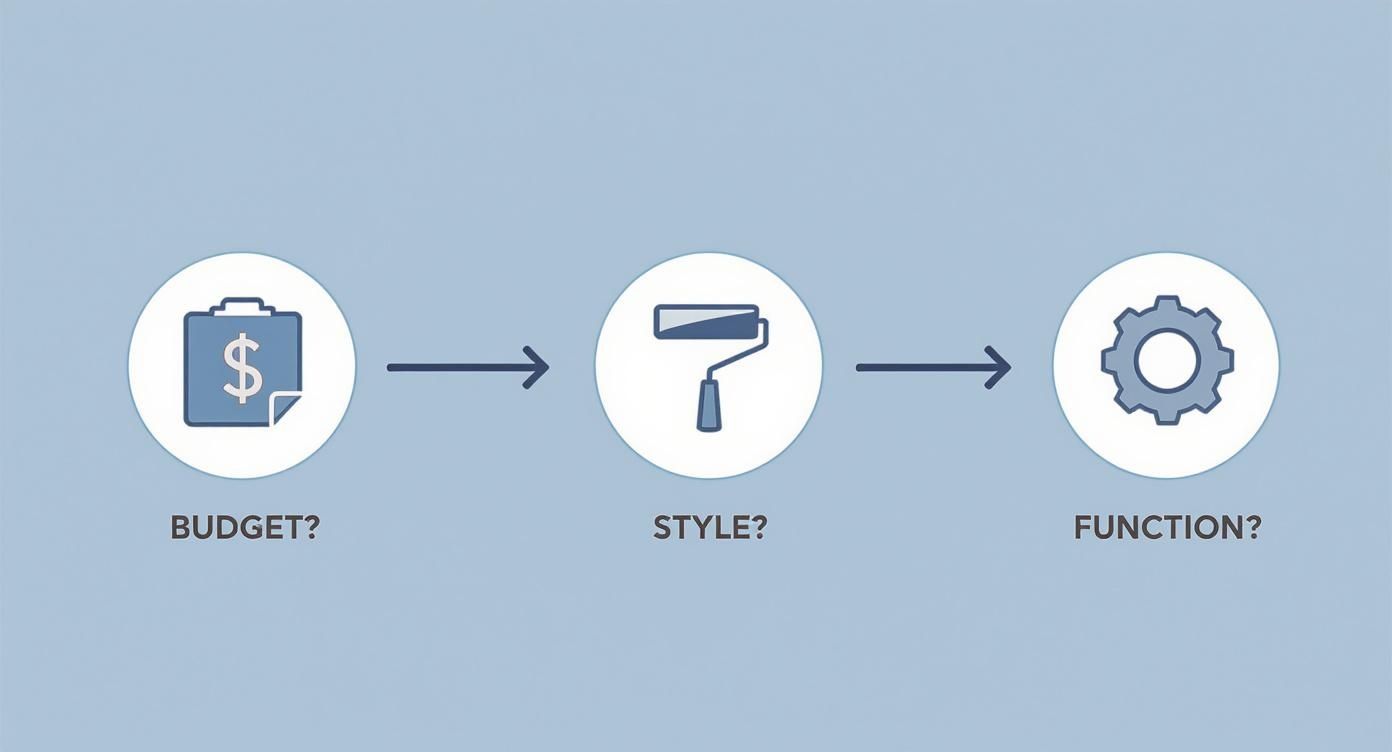
This decision map is a great starting point. It shows how clarifying your budget and functional priorities can quickly point you toward the right cabinet type for your kitchen's unique demands.
Finding the Sweet Spot with Semi-Custom
Semi-custom cabinets are the perfect middle ground, offering a taste of personalization without the fully custom price tag. They start with a standard stock framework but open the door to a whole range of modifications. This is where you can really start to inject your own personality into the design.
Imagine you have a pretty standard kitchen layout but you crave that high-end, designer feel. With semi-custom, you could:
- Adjust drawer depths to perfectly organize your collection of cast iron pans.
- Modify cabinet width or height by a few inches to eliminate awkward filler pieces and get a true built-in look.
- Choose from a much wider catalog of paint colors, wood species, and finishes.
This level of choice bridges the gap between off-the-shelf convenience and bespoke design. The lead times are a bit longer than stock—you're typically looking at 4 to 8 weeks—and the cost is higher, but the end result is a kitchen that feels much more thoughtfully designed for you.
The Unmatched Flexibility of Custom Cabinets
When you have a unique vision, a tricky space, or very specific functional needs, nothing beats custom. A cabinetmaker builds these from the ground up, tailored precisely to your specifications. The possibilities for size, shape, material, and finish are virtually limitless.
This is the go-to solution for that historic home with charmingly bowed walls and non-standard ceiling heights. A skilled craftsman can scribe the cabinets directly to the wall, creating a seamless fit where stock or semi-custom options would leave frustrating gaps.
It's also the answer for a family that needs specific ergonomic solutions, like a lowered countertop for a wheelchair user or perfectly-sized drawers for a passionate baker's tools. It’s this problem-solving ability that’s driving a major market shift. In fact, custom cabinetry's market share in the U.S. jumped from 20% in 2022 to 25% by mid-2024, while mass-produced cabinet sales saw a decline. You can dive deeper into these cabinet market trends to see what it means for homeowners.
Key Insight: Custom cabinets aren't just a luxury. They are a problem-solving tool for non-standard spaces and highly specific needs, delivering value that goes far beyond aesthetics.
While custom gives you total creative freedom, it also comes with the highest price and the longest wait. Lead times often stretch 8 to 16 weeks or more, an investment in time and money that reflects the one-of-a-kind craftsmanship you receive.
Decoding Cabinet Materials and Construction
The long-term beauty and resilience of your kitchen cabinets really come down to two things: what they're made of and how they're put together. It’s easy to get wowed by a pretty door style in a showroom, but knowing the difference between a cabinet that just looks good and one that will stand up to years of daily life is the key to a smart investment. Let's break down how to judge cabinet quality from the inside out.
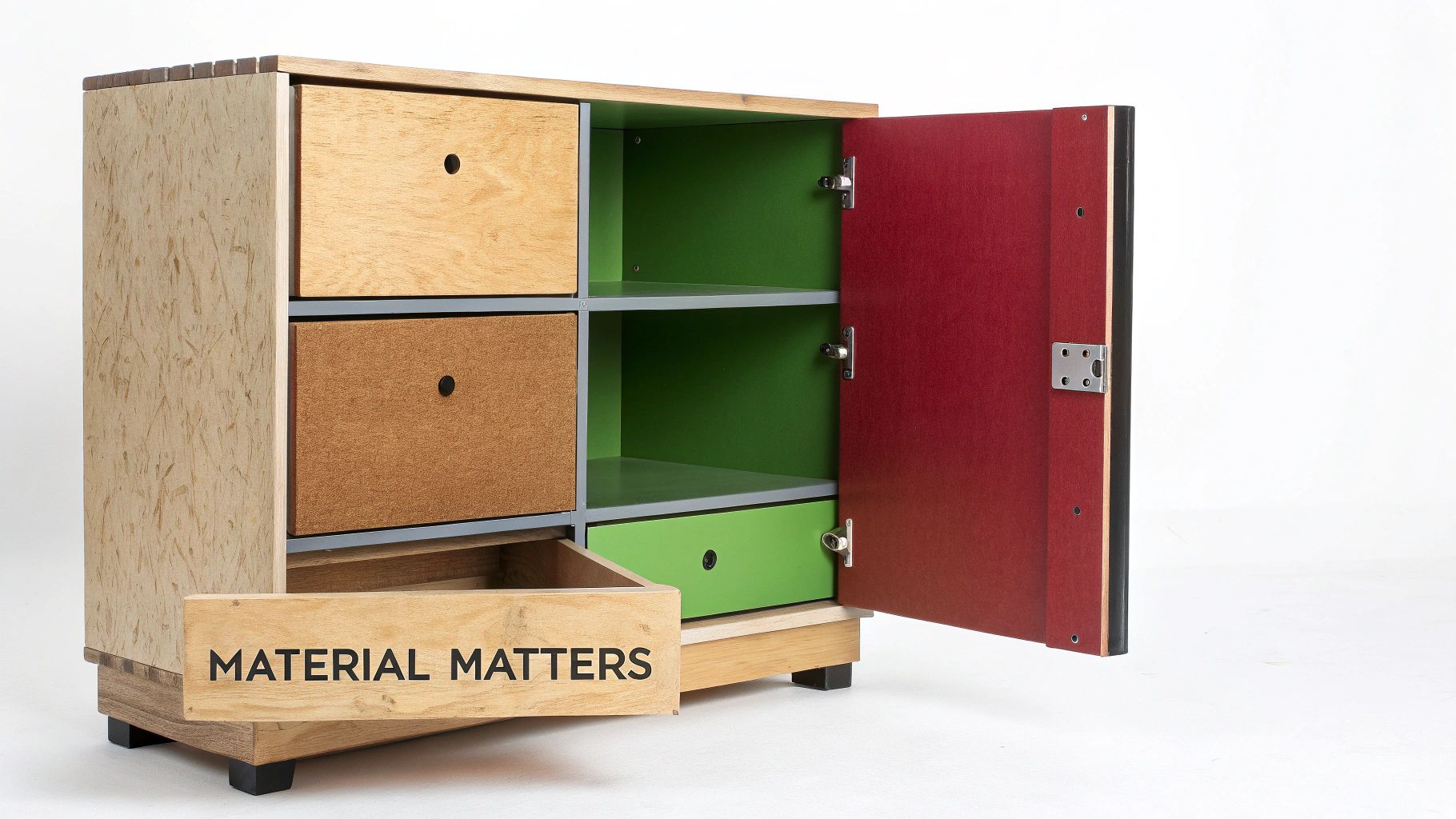
You’ll notice that the materials used for the cabinet doors often differ from what's used for the box (the main body). This isn't a cost-cutting trick; it's by design. Each part has a different job to do.
The Foundation: The Cabinet Box
Think of the cabinet box as the unsung hero of your kitchen. It provides all the structural integrity. While your first instinct might be to demand solid wood for everything, it's often not the best material for the box itself.
-
Plywood: This is the gold standard for high-quality cabinet boxes. It’s made from thin layers of wood veneer glued together in alternating directions, making it incredibly strong and stable. Plywood resists moisture, expansion, and contraction far better than solid wood—a massive advantage in a steamy kitchen.
-
MDF (Medium-Density Fiberboard): A good quality MDF is a fantastic engineered wood product. It's made from wood fibers, wax, and resin pressed under intense pressure. The result is a perfectly smooth and stable surface, which makes it an ideal base for a flawless paint finish. Its main downsides are that it's heavy and can be susceptible to water damage if the seal is ever compromised.
-
Particleboard: This is your most budget-friendly option, made by pressing wood chips and sawdust together with glue. Modern particleboard is better than it used to be, but it’s still the least durable choice, prone to sagging and water damage. You'll find it most often in stock or ready-to-assemble (RTA) cabinetry.
Doors and Drawer Fronts: The Visible Style
This is where you'll most often find solid wood, and for good reason—its natural beauty gets to shine on the parts you see and touch every day. But don't overlook engineered materials here, especially if you want a painted finish. A high-quality paint job on a stable MDF door can often look better and last longer than a poorly stained solid wood door.
Pro Tip: Don't automatically dismiss MDF for cabinet doors. Its stability means it won't expand or contract with temperature swings. This prevents the hairline paint cracks you often see develop at the joints of solid wood doors over time.
Spotting Quality Cabinet Construction
Beyond the raw materials, the way a cabinet is assembled tells you everything you need to know about its durability. When you're looking at samples, get hands-on. Pay close attention to the joinery and hardware. These are the small details that separate a cabinet that lasts five years from one that lasts twenty.
Key Construction Details to Look For
-
Framed vs. Frameless: Framed cabinets have a solid wood face frame on the front of the box, which adds rigidity and creates a more traditional look. Frameless cabinets (often called European-style) skip the frame, giving you slightly more interior space and a sleek, modern appearance. Framed construction is generally more forgiving to install, especially in older homes with walls that aren't perfectly plumb.
-
Drawer Box Joints: This is a big one. Pull out a drawer and look at the corners. Dovetail joints—those interlocking "pins" and "tails"—are the mark of true craftsmanship. They create an incredibly strong bond that will last a lifetime. Cheaper cabinets often use simple staples or butt joints, which are far more likely to wiggle loose and fail down the road.
-
Hardware Quality: Open a door and slide out a drawer. How does it feel? Look for soft-close mechanisms that prevent slamming, which saves a lot of wear and tear on the whole cabinet. Full-extension drawer glides are another feature you’ll be thankful for every single day; they let you access the entire drawer instead of having to rummage around in the back corner. These might seem like minor upgrades, but they completely change how your kitchen functions.
Ultimately, choosing kitchen cabinets means looking past the surface. When you understand the practical differences between plywood and particleboard, appreciate the strength of a dovetail joint, and know when an engineered material is actually the smarter choice, you can confidently select cabinets that are not just beautiful, but truly built to last.
Getting the Look Right: Doors, Finishes, and Hardware
Okay, you've nailed down the practical stuff like cabinet construction and materials. Now we get to the fun part—the elements that give your kitchen its soul. The cabinet doors and hardware are what everyone sees first; they're the face of your kitchen, and they set the entire tone for the space.
Choosing the right door style is probably the single biggest design decision you'll make for your cabinets. It's the foundation of your kitchen's aesthetic. Think of the cabinet box as the structure and the door as the fashion.
What’s Your Style? Finding the Right Cabinet Door
Let's walk through three of the most popular door styles. Seeing how they work in different contexts will help you figure out what feels right for your own home.
-
Shaker Style: This one is a true classic for a reason. Shaker doors, with their simple frame and recessed center panel, are the ultimate design chameleons. I've seen them look perfectly at home in a cozy farmhouse kitchen, a sleek transitional space, and even a minimalist modern setup. It all comes down to the finish and the hardware you pair them with.
-
Slab (Flat-Panel): If you're chasing that clean, uncluttered look, slab doors are your answer. A single, smooth panel is the go-to for modern and mid-century modern designs. This style is fantastic for showing off a stunning wood grain or a bold, high-gloss color without any other details getting in the way.
-
Raised Panel: For a more traditional and formal feel, you can't beat a raised panel. The center panel is elevated, creating beautiful shadows and highlights that add a real sense of depth and dimension. This style speaks to classic elegance and detailed craftsmanship.
The best advice I can give is to let your home's existing architecture be your guide. A super-sleek slab door might feel jarring in a rustic colonial, just like an ornate raised panel could clash with the clean lines of a contemporary home. Harmony is key.
The Finishing Touch: Selecting Hardware
If the doors are the outfit, then the hardware is the jewelry. The right knobs and pulls can completely transform your cabinets, elevating the entire look. Don't treat this as an afterthought!
Your first decision is knobs versus pulls. There are no strict rules here, but a common practice that works really well is using knobs for doors and pulls for drawers. It’s practical—pulls are just easier to grab on heavy, loaded drawers—and it creates a nice visual balance. Of course, using all pulls can create a very clean, linear look, while using all knobs can feel a bit more vintage or traditional.
Designer's Insight: Don't be afraid to mix things up. I often specify elegant knobs for upper cabinets and more substantial, easy-to-grip pulls for the lowers. This creates a layered, custom look that adds visual interest without looking messy.
The finish of your hardware is what really ties the room together. The trick is to coordinate it with the other metal finishes in the room, like your faucet, light fixtures, and appliances.
A Quick Guide to Pairing Finishes
| Hardware Finish | Pairs Well With | The Vibe It Creates |
|---|---|---|
| Matte Black | Stainless steel or black appliances, modern faucets. | Modern, Industrial, Bold |
| Brushed Brass | White, black, or stainless steel appliances. | Warm, Luxurious, Timeless |
| Polished Nickel | Stainless steel appliances, classic plumbing fixtures. | Classic, Elegant, Bright |
| Satin Bronze | Black or panel-ready appliances, traditional faucets. | Warm, Rustic, Understated |
Your hardware doesn't have to be a perfect match to your faucet or light fixtures. In fact, a complementary finish often looks more sophisticated than a "matchy-matchy" one. The goal is to keep the undertones (cool tones like chrome and nickel, or warm tones like brass and bronze) consistent for a kitchen that feels polished and thoughtfully designed.
Smart Storage Solutions for a Functional Kitchen
A beautiful kitchen that doesn't actually work for you is just a showroom. When you're learning how to choose kitchen cabinets, the real magic happens once you get past the pretty finishes and start thinking about smart storage. The kind of storage that makes your daily life genuinely easier.
Maximizing every square inch isn't a luxury; it's the key to a kitchen that feels intuitive and effortless. This is where you move beyond standard shelves and start exploring clever solutions that bring everything out of those frustrating, hard-to-reach dead zones.
Think about those awkward corner cabinets. Are you tired of getting on your hands and knees to find a lost pot lid? A simple Lazy Susan or a more advanced blind corner pull-out can bring everything right to your fingertips. Problem solved.
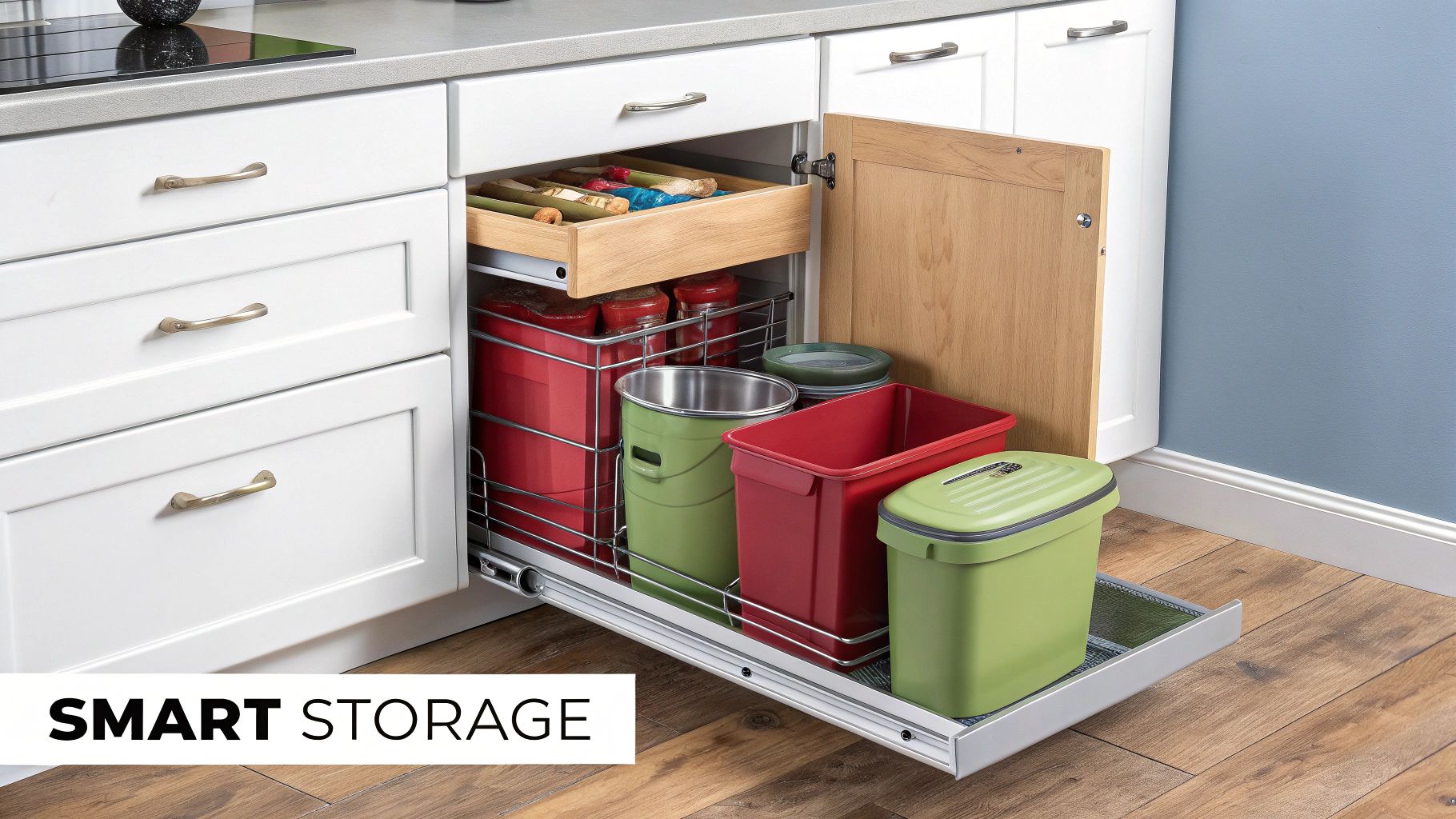
This push for hyper-functional design isn't just a niche idea; it's a major global trend. The demand for modular and ready-to-assemble (RTA) kitchens is soaring because they offer incredible space efficiency right out of the box. In fact, studies show that over 50% of new homeowners are opting for modular layouts that integrate these smart features from the get-go. You can dive deeper into these trends in the cabinet market to see where things are headed.
First, Do a Quick Kitchen Inventory
Before you fall in love with a slick pull-out gadget you saw online, take a moment to assess your own kitchen chaos. A quick inventory of what you own and where it lives is the best way to pinpoint your biggest storage headaches.
- Pots and Pans: Are they stacked in a teetering pile? Deep drawers are an absolute game-changer. You can see everything from above instead of digging blindly into a dark base cabinet.
- Baking Sheets & Trays: Shoved into a drawer or lying flat under the oven? A narrow base cabinet with vertical tray dividers keeps them organized, upright, and easy to grab.
- Spices & Small Jars: Lost in the back of a wall cabinet? A narrow pull-out spice rack right next to the stove keeps them visible and within reach while you're cooking.
- Trash & Recycling: Are your bins eating up valuable floor space? An integrated pull-out keeps them completely hidden and frees up your kitchen’s footprint.
This simple exercise ensures you spend money on features that solve your specific problems, making your daily routine that much smoother.
Pro Tip: Don't just think about what you have now; consider how you want to live. If your goal is to cook more fresh meals, prioritizing a pull-out pantry for easy ingredient access might be a more valuable upgrade than a fancy wine rack.
Game-Changing Storage Upgrades to Consider
Once you've identified your pain points, you can start exploring targeted solutions. Modern cabinetry offers a huge range of inserts and organizational features that can turn a standard box into a high-performance storage machine.
Cabinet inserts are often the unsung heroes of a great kitchen design. Below are some of the most popular upgrades we see homeowners request—and for good reason.
Smart Storage Upgrades Worth Considering
| Storage Solution | Primary Function | Best For | Relative Cost |
|---|---|---|---|
| Pull-Out Pantry | Full-height, accessible storage | Replacing deep, traditional pantries where items get lost in the back | High |
| Lazy Susan/Corner Pull-Out | Making corner cabinets usable | Awkward blind corners under the countertop | Medium to High |
| Deep Pot/Pan Drawers | Organizing heavy cookware | Base cabinets near the stove or cooktop | Medium |
| Vertical Tray Dividers | Storing flat items upright | Organizing baking sheets, cutting boards, and platters | Low |
| Pull-Out Spice Rack | Keeping small jars visible | Narrow base or wall cabinets next to the cooking area | Medium |
| Trash/Recycling Pull-Out | Concealing waste bins | Base cabinet near the sink or main prep zone | Medium |
| Utensil Drawer Inserts | Separating cooking tools | The "junk drawer" or top drawers near the prep space | Low |
These thoughtful additions are what truly define a functional kitchen. By prioritizing storage that works for your life, you're not just choosing cabinets—you're designing a space that actively helps you, every single day.
Budgeting for Your Kitchen Cabinet Project
Alright, let's talk about the money part. Nailing down a realistic budget isn't just a good idea—it's the foundation of a successful kitchen renovation. This number will guide every single choice you make, especially when it comes to your cabinets.
Why is this step so critical? Because cabinets are almost always the single biggest line item in a kitchen project. You can expect them to eat up a hefty 40% to 50% of your total renovation cost. Knowing this upfront helps you avoid that dreaded sticker shock and make smarter decisions from day one.
When you start shopping around, you'll see prices talked about in "linear feet." It's the industry standard for pricing, and the cost can swing dramatically depending on what type of cabinet you're looking at.
What Do Kitchen Cabinets Actually Cost?
Here’s a rough breakdown of what you can expect to pay, based on my experience in the field.
-
Stock Cabinets: These will typically run you $100 to $300 per linear foot. They are your workhorse, get-it-done option, perfect when you need something fast and affordable.
-
Semi-Custom Cabinets: You're looking at a price range of about $200 to $650 per linear foot. This is the sweet spot for many homeowners, offering a great mix of customization options without the full custom price tag.
-
Custom Cabinets: For true, built-from-scratch cabinetry, the sky's the limit, but a good starting point is $500 to over $1,200 per linear foot. You’re paying for one-of-a-kind craftsmanship and total design freedom.
These numbers give you a great starting point, but they don't paint the whole picture. One of the most common mistakes I see homeowners make is forgetting about all the other costs that sneak into the final bill.
Pro Tip: Your cabinet quote is just that—a quote for the boxes and doors. I always tell my clients to add a 15-20% contingency to their cabinet budget to cover the "extras." This turns your estimate into a realistic, all-in budget.
Don't Get Blindsided by Hidden Costs
The price of the cabinets themselves is just the beginning. To keep your project on track, you absolutely have to account for the other essential expenses that come with the territory.
Be Sure to Factor These Into Your Budget:
- Hardware: This is a big one. Knobs, pulls, and handles are almost always sold separately, and costs can range from a couple of bucks a piece to over $30 for high-end options.
- Installation: This is a major cost. A pro installer might charge per cabinet, per hour, or as a flat percentage of the total job.
- Delivery Fees: Getting all those heavy boxes from the warehouse to your doorstep isn't always included. Always ask about shipping and delivery charges.
- Tear-Out and Disposal: Someone has to take out the old cabinets, and that labor—plus any disposal fees—will cost you.
- Sales Tax: Don't forget Uncle Sam! Depending on where you live, sales tax can add a significant chunk to the final invoice.
- Cosmetic Tweaks: If you're not ready for a full-blown cabinet replacement, you can still get a major style upgrade. Looking into modern and chic cabinet wraps is a smart, budget-friendly move that can completely change the look of your kitchen.
Getting a firm handle on the full financial picture is the best way to choose cabinets you'll love for years to come—without breaking the bank.
Your Kitchen Cabinet Questions, Answered
As you get closer to making a final decision, a few key questions always seem to surface. It's perfectly normal. Getting straight answers to these common queries will give you that last bit of confidence before you pull the trigger. Here’s what we hear most often from homeowners trying to choose the right kitchen cabinets.
What’s the Toughest, Most Durable Material for Kitchen Cabinets?
When you’re talking about true, long-lasting durability, it’s not just one material—it’s the combination that really counts. For a cabinet that can take a beating and still look great for decades, the gold standard is plywood boxes paired with solid hardwood doors and face frames.
Here’s why that pairing works so well. Plywood is incredibly stable, meaning it won't warp, swell, or shrink with the temperature and humidity swings you get in a kitchen. That's a huge plus for the cabinet box itself. Then, for the parts you see and touch every day—the doors and frames—solid hardwood provides the brute strength and dent resistance you need. It’s truly the best of both worlds.
Are Frameless Cabinets Really Better Than Framed Ones?
Honestly, one isn't "better" than the other. They just offer different looks and have different strengths. The right choice for you comes down to the style you're going for and how you need your kitchen to function.
-
Frameless Cabinets: You'll often hear these called "European-style." They provide a clean, contemporary look with seamless lines. The big functional benefit is that you get slightly more interior space and easier access since there’s no face frame in the way.
-
Framed Cabinets: This is the classic American style, built with a solid wood frame attached to the front of the cabinet box. A lot of builders prefer this construction because it adds rigidity and can be more forgiving to install, especially if your walls aren't perfectly straight.
Think of it as a trade-off between modern aesthetics and traditional structure. Frameless gives you that sleek, full-access design, while framed offers a classic feel with a bit more structural heft.
How Can I Actually Save Money on New Kitchen Cabinets?
Saving money doesn't have to mean settling for cheap, flimsy cabinets. It's all about making smart, strategic choices. The single biggest way to cut costs is to go with stock or semi-custom cabinets instead of paying the premium for a full custom job.
But you can save even more by focusing on the details. Try these tips:
- Simplify your door style. A fancy, ornate door with raised panels requires more labor and material to build than a simple, clean Shaker or flat-panel door. That difference goes straight to your bottom line.
- Stick to standard finishes. That unique, custom-matched paint color is beautiful, but it can add a hefty upcharge. Choosing from a manufacturer's popular, standard finishes will keep your budget on track.
- Do some of the prep work yourself. If you're handy, handling the demolition and hauling away your old cabinets can save you a surprising amount in labor costs.
Planning a kitchen remodel is a big project, but you don’t have to figure it all out on your own. At Trademaster Construction, our team has been guiding homeowners across Southwest Michigan through every phase of the process, from the first sketch to the final installation. We're here to make sure you get a kitchen you'll love for years to come. Start planning your project with us today.

